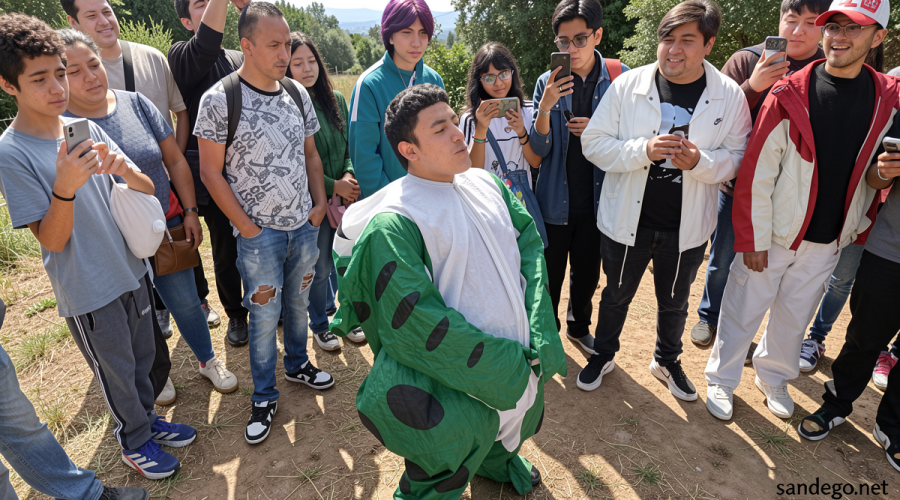
Aura Farming: Latin America’s New Youth Sport
Sandego.net – Aura farming began as a meme, but across Latin America’s plazas and university courtyards it has hardened into something with spectators, competitors, and cash prizes. In San José, Costa Rica, teenagers now lock eyes inside a ring of shouting peers, trading rapid dance steps and frozen poses while phones record every frame. The University of Costa Rica hosts sanctioned contests, and dozens of similar gatherings are spreading through cities and towns from Mexico to Chile.
There is no rulebook, no judging panel, no scoring rubric. Two performers execute exaggerated viral dance moves and theatrical stances in quick succession, then read the room. The crowd’s roar decides the winner. Short clips of these encounters are engineered for virality — punchy, shareable, built to travel across TikTok and Instagram feeds.
Plaza Culture Meets the Algorithm
Frederick Luis Aldama, a humanities professor at the University of Texas at Austin, traces the format’s appeal to a centuries-old regional habit. Latin American urban life has always orbited the plaza, the courtyard, the park bench — open spaces where neighbors gather without tickets or appointments. Aldama views the new contests as that tradition updated for a generation raised on scrolling feeds.
“These are definitely collective and public and person to person, and because in Latin America, we have a long history of the plaza, of the courtyard, of the gathering in the parks.”
He also frames the events as a low-cost, nonviolent outlet for teenagers craving face-to-face contact. In a region where smartphone saturation among youth is near-universal, the contests offer a sanctioned reason to put the device down and be physically present with peers.
How a Phrase Became a Competition
The competitive format descends from slang that migrated from niche internet corners into mainstream vocabulary. Merriam-Webster now defines the practice as “the act of doing something to look cool, impressive, stylish, etc., especially — and importantly — without trying too hard.” Know Your Meme traces the phrase’s first notable appearances to early 2024, with popularity compounding through the following year.
The inflection point arrived with viral clips of an 11-year-old Indonesian boy, Rayyan Arkan Dikha, standing at the prow of a narrow rowing boat. With total composure, Dikha executed a looping sequence of dance moves while oarsmen pushed the vessel down a river. Commenters flooded the posts with remarks about his effortless cool. The videos racked up millions of views; Dikha gained thousands of Instagram followers and was named a tourism ambassador for his home province of Riau.
After that moment, the phrase bled into anime edit reels, athlete highlight posts on X, and celebrity commentary threads until it became shorthand for unforced style.
Organizers Bring the Concept Offline
Local content creators across several countries now stage the concept as a live event in parks or university courtyards, filming the proceedings for social-media distribution. Clips routinely pull hundreds of thousands of views.
In Suzano, Brazil, creator Victor Gabriel Tourinho Camargo — known online as Uvitinho — organized multiple tournaments drawing more than 200 participants. Footage showed the park packed with young people, including one competitor dressed as a sheikh clutching a briefcase stuffed with Brazilian reais.
“The aura farming championship was something created with the focus of taking something popular on the internet and bringing it to reality, mixing it with childhood games and showing people and children that there is still hope for a more real life with genuine moments.”
Uvitinho noted that the participant pool spanned the full spectrum of social temperament — shy, antisocial, extroverted — and that performing in front of a cheering crowd dissolved those boundaries within minutes. In Mexico, YouTuber Alex Crashers documented a contest in a video posted earlier this week, describing how each new move sent a jolt of excitement through the assembled crowd. Argentinian creator Cielo, operating under the handle Cieloween, helped coordinate an event in Chile, extending the format’s geographic reach further south.
Frequently Asked Questions
Where can I watch or participate in a live event? Most gatherings are announced through TikTok, Instagram, and YouTube channels of local creators. University courtyards and public parks in Costa Rica, Brazil, Mexico, and Chile have hosted contests; follow regional creators for upcoming dates.
Is there an official rulebook or governing body? No. Each event sets its own informal parameters, and victory is determined entirely by crowd reaction rather than a scored rubric.
How old do participants need to be? There is no universal age requirement. Events have drawn teenagers and young adults; some organizers welcome younger children alongside older competitors.
Where did the term originate? The phrase surfaced in niche internet slang around early 2024 and exploded after viral clips of Indonesian teenager Rayyan Arkan Dikha performing dance moves from a rowing boat. It now appears in Merriam-Webster’s dictionary.