
China Speeds Up Data Center Construction as AI Competition Intensifies
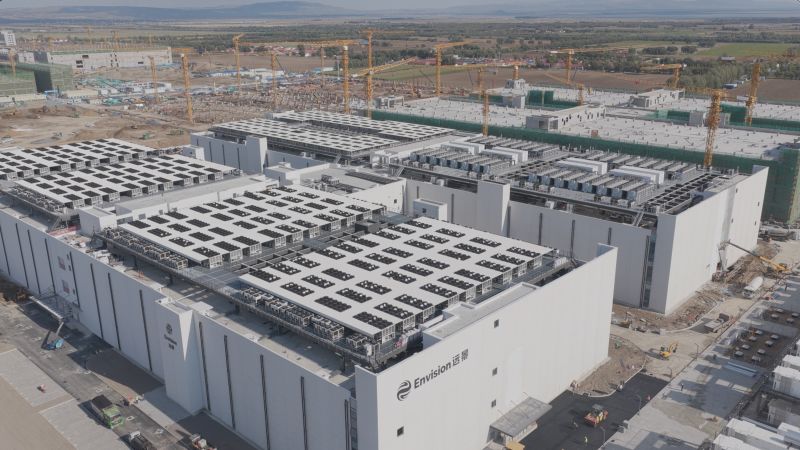
Sandego.net – On the grasslands near the Gobi Desert, a rapidly expanding cluster of data centers is reshaping the landscape around Ulanqab, Inner Mongolia. Large facilities bearing the names of Huawei, Kuaishou and VNET now stand beside farmland where sunflowers and sorghum grow, while more buildings rise behind construction barriers.
The city, home to fewer than two million people, is becoming an important part of China’s effort to expand the computing capacity needed for artificial intelligence. Nearly 90 data centers are planned for Ulanqab, making it a striking example of how quickly Beijing is pursuing the infrastructure behind its wider AI ambitions.
China still faces a substantial gap with the United States. Stanford University research showed that, as of last year, the US had roughly 10 times as many AI data centers as China. American companies also hold a major lead in available computing power and retain access to the world’s most advanced chips, hardware that is central to training and operating sophisticated AI systems.
Yet Ulanqab illustrates several advantages China can bring to the contest. Its data center campuses have been built at exceptional speed. Much of the Bayin Big Data Industrial Park emerged in only two years, reflecting the country’s capacity to organize and construct large-scale projects quickly.
Land, Energy and a Rapid Buildout
The region’s physical conditions are well suited to energy-hungry computer facilities. Strong winds, intense sunlight and expansive open land provide access to renewable power potential and relatively inexpensive sites for development. Those elements matter because data centers require vast quantities of electricity, cooling and network infrastructure.
At Bayin Industrial Park, building activity has brought a steady flow of workers, trucks and supplies. On a recent weekday, construction workers passed through facial-recognition checks as they entered work sites. Temporary stalls outside the compounds sold items such as noodles and cigarettes to people arriving for jobs or business.
The scale of construction has also affected nearby communities. In the United States, large data center proposals frequently prompt debates over electricity demand, water use, land development and local disruption. In China, the extensive construction taking place in places such as Ulanqab has not faced the same visible public resistance.
For some local residents, the projects have created new customers and more regular commercial activity in an area previously dependent largely on agriculture. Ma Rong, 56, has operated a grocery store and guest house nearby for three decades. He said the arrival of construction workers has transformed the pace of his business.
“Before, we’d just sit there and wait for customers. Now we’re constantly busy – picking up orders, doing this and that. We barely get a break,” Ma said.
“Our business has gotten much better than before,” he said.
Not everyone has experienced the changes without disruption. Liu Baoping, 58, who owns a restaurant, said he had to relocate after a highway was demolished. Still, he said the number of customers visiting his business each day has doubled as the data center expansion accelerated.
“The environment isn’t as clean as before, but people’s incomes and the economy – it’s way better,” Liu said.
AI as an Economic Priority
Ulanqab’s expansion is tied to a broader national strategy that treats artificial intelligence as a potential driver of growth. China is confronting a slowing economy and a shrinking population, and policymakers see AI as a technology that could raise productivity across manufacturing, services and daily life.
In July, Chinese leader Xi Jinping told an international artificial intelligence conference in Shanghai that China had embraced AI enthusiastically. He pointed to efforts to introduce the technology into fields ranging from health services to household goods, while presenting AI-enabled manufacturing as a major feature of Chinese modernization.
Official figures indicate that more than 700 million people in China already use AI. Extending those tools across factories, industry and consumer services requires far more than software applications: it depends on physical systems capable of storing data, processing enormous workloads and moving information quickly between networks.
Beijing announced a $560 billion plan last month to expand information infrastructure, including computing facilities, during the coming five years. Chinese technology companies are increasing their own spending as well. Investment in AI infrastructure by listed Chinese firms is expected to double this year to about $139 billion.
That figure remains far below the scale of investment by major US technology companies, whose AI data center spending totals $800 billion. The difference highlights the challenge facing China even as its construction campaign accelerates.
Computing Hardware Remains a Constraint
New buildings alone do not guarantee equivalent AI capabilities. Data centers need advanced processors and other specialized equipment, and Chinese companies have limited access to the highest-end hardware. That shortage is especially important because the most capable chips are a crucial component for developing and running leading AI models.
China’s strategy therefore involves both expanding the number of facilities and making the most of the computing resources it can obtain. The country’s advantage lies in its ability to mobilize land, energy, capital and construction capacity around a strategic priority. Its limitation is that the machines filling those facilities may not match the most advanced systems available to US rivals.
For Ulanqab, the immediate effects are visible in cranes, delivery trucks, new jobs and busier small businesses. For China’s technology sector, the city represents something larger: an attempt to build the industrial foundation for an AI economy at enormous scale, even while the global race for chips and computing power remains heavily contested.
Related Reading
Frequently Asked Questions
What is The US is fighting over data?
The US is fighting over data is the main topic of this guide. The article explains the context, practical details, and next steps readers should understand.
Why does The US is fighting over data matter?
The US is fighting over data matters because readers are looking for a useful answer, not just a short summary. Good content should match search intent and help them decide what to do next.