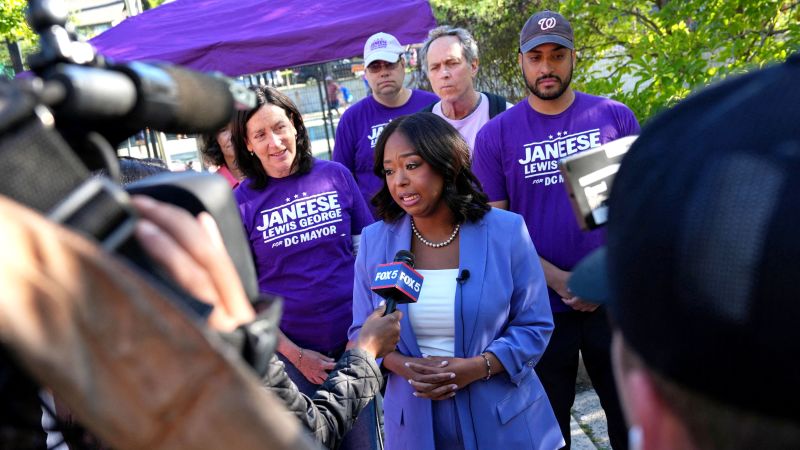
Democratic Socialist Janeese Lewis George Maintains Strong Lead in DC Mayoral Primary
Sandego.net – As initial election results began to trickle in Wednesday evening, Democratic socialist Janeese Lewis George has established a significant early advantage in the Washington, DC mayoral primary, according to preliminary data. However, the race remains too close to call, with CNN yet to officially project a winner. Lewis George, a DC councilmember and prominent advocate for progressive policies, has positioned herself as a top contender by emphasizing themes of affordability, improved public services, and defiance of President Donald Trump’s administration. Her campaign has drawn attention for its focus on addressing rising housing costs and expanding opportunities for DC residents, while also challenging the federal government’s influence over local governance.
McDuffie in Second Place, But Race Could Turn on Ranked-Choice Voting
Kenyan McDuffie, a former DC Councilmember and trial attorney who worked under President Barack Obama, currently trails Lewis George by a notable margin. With 73% of the estimated votes tallied, Lewis George has secured nearly 53% of the total, while McDuffie holds around 36%. The remaining 11% of ballots—primarily mail-in votes yet to be counted—are still pending, and the outcome could shift dramatically as these results come in.
The mayoral race is set to use ranked-choice voting, a system that could determine the final winner if no candidate achieves a majority. This method allows voters to rank their preferences, ensuring a winner who has broad support across the electorate. If Lewis George’s support dips below 50%, the process would require a second round of counting, where votes from the second-choice selections of those who ranked her lower would be redistributed. Despite the potential for a runoff, Lewis George appears well-positioned to clinch the nomination, even under the ranked-choice framework, given her current lead and the size of her margin.
McDuffie’s campaign has centered on issues like economic growth and judicial reform, but his efforts to overtake Lewis George would depend on a sharp decline in her support. For him to gain momentum, Lewis George’s tally would need to drop significantly, potentially below 45%, as the remaining votes are processed. This scenario, while possible, is considered unlikely given her current position. Analysts note that the remaining ballots may not be sufficient to alter the trajectory of the race, though the system’s structure ensures a fair resolution if no candidate secures a majority.
Robert White Secures Delegate Seat Amid Norton’s Exit
Meanwhile, DC at-large Councilman Robert White has emerged victorious in the Democratic primary for the city’s nonvoting delegate seat in Congress, as reported by CNN’s Decision Desk. White, who ran to replace Eleanor Holmes Norton, faced a competitive field after Norton announced her intention to step down from her reelection bid in January. Norton, a long-serving 89-year-old Democrat, had faced scrutiny over her ability to represent DC amid tensions surrounding the city’s autonomy during the second Trump administration.
White’s campaign has highlighted his role as a key supporter of Norton’s legislative agenda, particularly his work on initiatives aimed at increasing DC’s self-governance. In a
“I helped draft legislation to reduce Congress’ control over DC, giving residents more independence,”
White explained, emphasizing his commitment to local autonomy. His efforts as a staff member on congressional oversight hearings, combined with his later leadership in the attorney general’s community outreach office, have shaped his platform as a candidate for the delegate seat.
The race for the delegate position was marked by a diverse group of contenders, including Ward 2 Councilmember Brooke Pinto, former Norton aide Trent Holbrook, and former Democratic National Committee official Kinney Zalesne. Greg Jaczko, the former chairman of the Nuclear Regulatory Commission, also entered the fray. White’s victory underscores his appeal within the Democratic Party, particularly his alignment with the city’s push for greater independence. His background in policy and advocacy positions him as a representative voice for DC’s interests in Congress, even without the power to vote.
White’s win comes as the city continues to navigate the complexities of its political structure. The nonvoting delegate, while unable to cast a vote on legislation, plays a critical role in debates and committee discussions, shaping policy from the sidelines. This dynamic highlights the importance of the position, especially in a year where DC’s autonomy and representation have been central to political discourse. The delegate’s influence is amplified in committee votes and floor debates, where their voice carries weight despite the limited voting authority.
Ranked-Choice Process and Future Implications
Following the release of a portion of results on Wednesday evening, the Board of Elections confirmed they would continue to update first-choice vote tallies as ballots are processed. The board also stated that they aim to release an initial set of ranked-choice results by Sunday, ensuring transparency throughout the counting process. This timeline allows for a thorough evaluation of how the system will resolve the mayoral race if no candidate achieves a majority.
For Lewis George, the ranked-choice process represents both an opportunity and a test of her campaign’s resilience. Her current lead suggests she is likely to secure the nomination, but the system’s mechanics mean that her supporters must remain engaged to prevent a potential shift. The board’s decision to release results incrementally provides voters with real-time updates, fostering a more informed and participatory election process. This approach also aligns with the city’s commitment to modernizing its electoral systems, reflecting broader trends in voter engagement and policy reform.
As the election progresses, the focus will shift to how the ranked-choice mechanism influences the final outcome. While Lewis George’s lead appears secure, the possibility of a runoff adds an element of uncertainty. The system’s design ensures that the winner will have a coalition of support, rather than a narrow victory. This could have long-term implications for the city’s political landscape, potentially shaping the direction of future policies and governance.
McDuffie’s campaign, though trailing, remains competitive and has a clear strategy to gain traction. His experience as a trial attorney and his work under Obama provide a foundation for his arguments on legal and economic reform. The remaining votes, particularly those from mail ballot drop boxes and later-arriving mail ballots, could tip the balance in his favor. The Board of Elections’ commitment to transparency ensures that all votes are accounted for, regardless of the method used to tally them.
The results of the mayoral primary are not only a reflection of current priorities but also a barometer for the Democratic Party’s direction in DC. Lewis George’s campaign, rooted in socialist principles, represents a growing movement within the party to prioritize social equity and municipal control. Meanwhile, White’s delegate victory reinforces the importance of local representation in national politics, even in a nonvoting capacity. These developments underscore the evolving political landscape in Washington, DC, as candidates navigate both local and federal challenges.
The initial findings from the primary, released Wednesday, set the stage for a pivotal election that could reshape the city’s governance and political identity. With ranked-choice voting in play and a diverse field of candidates, the outcome will hinge on how votes are distributed and how the system is applied. The Board of Elections’ updates will provide clarity as the count continues, ensuring that the final decision is both accurate and reflective of the electorate’s will.