
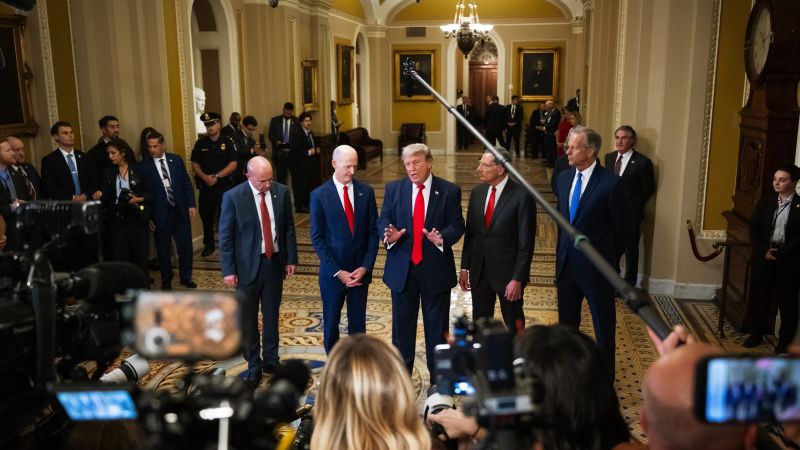
Senate Modifies Criticism of Trump’s Iran War Strategy
Sandego.net – Just a day after the Senate approved a resolution calling for the withdrawal of U.S. military forces from the Iran conflict, the chamber reversed its earlier rebuke of President Donald Trump’s approach to the war. The decision to scale back their criticism came amid a late-night vote that ultimately rejected a proposed measure aimed at curbing executive authority in the ongoing dispute with Iran. This shift in stance reflects growing tensions within the Republican Party as they attempt to balance their support for Trump with the need to demonstrate unity on key issues.
The vote took place Wednesday, following Trump’s frustration with Senate Republicans who had previously endorsed a war powers resolution on Tuesday. The president accused members of Congress of undermining his position during negotiations with Iran, particularly those who had voted for the measure earlier in the week. His ire was also directed at Republicans who missed the Tuesday vote, framing their absence as a betrayal of his administration’s strategic goals. The resolution, which sought to limit the executive’s role in the war, had initially garnered bipartisan backing, but the final tally revealed a divided chamber.
A Key Shift in Voting Blocs
Two prominent GOP senators, Rand Paul and Bill Cassidy, altered their positions during the Wednesday vote. Paul, a Kentucky Republican, cast a present vote, while Cassidy, from Louisiana, opposed advancing the resolution. This marked a significant departure from their earlier support for congressional oversight in the conflict. In contrast, Susan Collins and Lisa Murkowski, both Republican senators, reaffirmed their backing for the measure, joining the Democratic contingent led by John Fetterman, who once again voted against it. The result was a narrow 47-50-1 split, underscoring the political calculus at play.
“This vote puts Iran on notice!”
Trump shared his reaction on Truth Social, celebrating the shift as a victory for his administration. He highlighted Paul’s and Cassidy’s changes as a sign that the Senate was aligning with his vision for the conflict. However, the vote was not without controversy. Earlier that day, Cassidy had engaged in a heated exchange with the president during a GOP lunch, expressing his concerns about the lack of transparency. “You have not told the American people what’s going on,” he said, noting that the war had stretched beyond its intended four-week duration. “Our original objectives have not been achieved, and I want to know what’s going on,” he added, vowing to continue advocating for congressional involvement.
Despite his earlier dissent, Cassidy later acknowledged that he had received a thorough briefing from Vice President JD Vance and special envoy Steve Witkoff. “I want to thank Vice President Vance and Special Envoy Witkoff for the thorough briefing this afternoon on Iran,” he posted on X, emphasizing his appreciation for the updated information. The senator’s decision to pivot his stance appeared to be influenced by the White House’s efforts to address his concerns, though the timing of the briefing raised questions about its impact on the vote.
“My opinion on the debate over war and executive power has not changed… I will do so. My vote of present is a way to give the President more space and leverage to negotiate a lasting peace.”
Paul echoed similar sentiments, stating that while his views on war powers remained unchanged, Trump’s request for his support during negotiations prompted a strategic adjustment. The Kentucky senator’s present vote was seen as a compromise, allowing the administration to maintain its momentum while preserving congressional oversight in the long term. Paul’s statement highlighted the growing divide between Trump’s diplomatic ambitions and the Republican senators’ skepticism about executive overreach.
Republicans’ Struggle for Unity
During the Wednesday meeting, Trump also targeted other GOP senators for missing Tuesday’s vote. He singled out Dave McCormick and Mitch McConnell, accusing them of failing to show solidarity with his agenda. However, McConnell’s absence was due to hospitalization, while McCormick was en route to Pennsylvania with the president on Air Force One. This inconsistency in attendance underscored the challenges Republicans face in maintaining a cohesive front, even as they seek to support the administration’s war strategy.
The resolution marked the 11th time the Senate had addressed an Iran war powers measure this year. Earlier in the month, the measure had been discharged from committee, but Democrats had delayed a floor vote to ensure sufficient support. The current effort to pass the resolution was framed as a follow-up to that initial debate, with the hope of securing a majority. Republicans, however, appeared to be optimistic about defeating the measure, leveraging the shifting votes of key senators to weaken its prospects.
Trump’s frustrations with the war powers resolutions have been consistent, even after the House passed a concurrent resolution 215 to 208. The president criticized four House Republicans for voting with Democrats, labeling them as “grandstanders” and accusing them of acting “unpatriotically.” His rhetoric intensified after the Senate’s 50-48 adoption of a similar resolution on Tuesday, where he referred to the four Republican supporters as “losers” and warned that their actions had made his diplomatic efforts more challenging.
Despite the Senate’s reversal, some Democratic senators maintained their support for the measure. Tim Kaine of Virginia argued that passing a war powers resolution was essential to prevent the conflict from reigniting without congressional input. “I think it’s a good time to have the vote to say, ‘Hey, if we’re really in a period of maybe some stability here, let’s not just allow it to start up again without Congress being involved in that decision,’” he stated, underscoring the Democrats’ belief in the importance of legislative oversight.
The broader implications of the vote highlight the evolving dynamics within the Senate. While Trump’s administration sought to consolidate control over the Iran conflict, the resolution served as a reminder of Congress’s role in shaping foreign policy. The 47-50-1 tally demonstrated that even within the Republican bloc, there were divisions over how much executive authority should be granted. For Democrats, the measure represented a crucial step in maintaining checks and balances, even as the war seemed to be moving toward a resolution.
As the debate continues, the Senate’s decision to walk back its rebuke of Trump raises questions about the future of Iran policy. Will this shift signal a broader trend toward deferring to the executive, or does it reflect a temporary compromise? The outcome of Wednesday’s vote may set the stage for further negotiations, with Trump’s administration hoping to use the backing of key senators to solidify its position on the global stage.