
‘Salami Slicing’: China’s Quiet Expansion in the Pacific
Sandego.net – Recent weeks have seen China’s naval presence extend further than ever before into the Pacific, with its ships engaging in law enforcement and mapping operations in regions previously considered contested. These actions, though seemingly routine, are part of a broader strategy to gradually solidify control over areas where Beijing’s territorial claims are contested. Analysts describe this methodical approach as a form of salami-slicing, a tactic that involves taking small, incremental steps to achieve significant long-term goals without triggering a full-scale conflict.
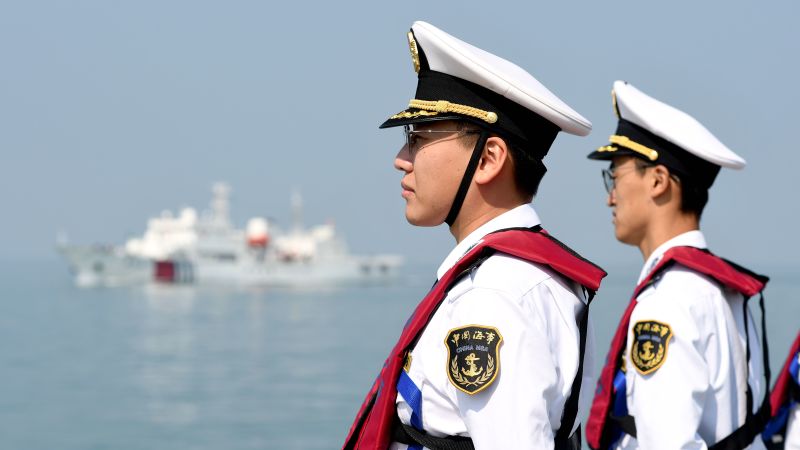
The latest maneuver involved three vessels from China’s Maritime Safety Agency (MSA), a civilian law enforcement body, navigating the Bashi Channel between the Philippines and Taiwan. Their mission focused on surveying waters east of Taiwan, a region that lies beyond the traditional boundaries of China’s territorial claims. This move has raised concerns among regional observers, who argue it signals a deliberate effort to push Beijing’s influence outward while maintaining the appearance of peaceful diplomacy.
Ray Powell, director of the SeaLight project at Stanford University’s Gordian Knot Center for National Security Innovation, highlighted the strategic significance of the MSA’s actions. “This is the first time we’ve seen them make some kind of a sovereignty patrol outside of the 9-Dash/10-Dash Line,” Powell told CNN. The 9-Dash and 10-Dash Lines are Beijing’s maritime claims in the South China Sea, which its neighbors dispute. The Hague-based Permanent Court of Arbitration ruled in 2016 that the 9-Dash Line lacks legal basis, but China has continued to assert its dominance through incremental actions.
“Beijing is essentially saying we have jurisdiction over this area on the other side of the First Island Chain. That’s pretty significant,” Powell added.
China’s activities are part of a larger plan to assert control over the western Pacific, with the First Island Chain—a network of islands stretching from southern Japan through Taiwan and the Philippines to Borneo and Singapore—serving as a key strategic boundary. Analysts note that Beijing and Washington both view this chain as critical for regional influence, making China’s recent expansion into the waters east of Taiwan particularly noteworthy.
Through its semi-official social media account Yuyuan Tantian, China’s state-run Global Times emphasized the legal and political implications of the MSA’s movement. The account stated that mapping the seabed east of Taiwan was a step toward establishing China’s nearshore waters, where it can project authority and governance. This assertion challenges foreign narratives that China lacks the capacity to enforce its claims beyond the 9-Dash Line, which has been a focal point of territorial disputes.
President Lai Ching-te of Taiwan characterized the MSA mission as a clear attempt to expand Beijing’s control. “Their real objective is to expand,” he said, pointing to the growing number of such operations as evidence of China’s persistent efforts to pressure the island nation. A Taiwanese security official corroborated this view, suggesting that the MSA’s activities create a misleading impression of China’s de facto jurisdiction over Taiwan. “They’re using these ships to make it look like they’re already in charge,” the official noted.
China’s approach to the Pacific has evolved over time, blending military and civilian initiatives to achieve its goals. While the People’s Liberation Army Navy has previously conducted exercises east of Taiwan, the MSA’s non-military presence is seen as more insidious. Analysts argue that these vessels, which also perform policing duties, are less likely to provoke immediate backlash, allowing Beijing to test boundaries without escalating tensions.
Significantly, the MSA’s incursion into these waters followed a visit by US President Donald Trump to Beijing, where the two leaders engaged in warm discussions. Yet, Xi Jinping used the opportunity to underscore Taiwan as the linchpin of US-China relations. “The biggest issue that could derail US-China relations was Taiwan,” Xi emphasized, highlighting the island’s role in the broader geopolitical struggle.
China’s salami-slicing strategy has been in play since 2023, when it expanded the 9-Dash Line to include an additional boundary east of Taiwan. This move, though subtle, represents a shift in China’s territorial ambitions, positioning the island as a new frontier for its maritime claims. By doing so, Beijing aims to consolidate its influence in the region while avoiding direct confrontation with the United States or its allies.
“The waters east of Taiwan Island will constitute our ‘nearshore waters’ — the very waters where we maintain a presence and exercise jurisdiction and governance,” said the Global Times via Yuyuan Tantian.
Taiwan has not remained passive in response to these actions. The island’s government has test-fired rockets toward China using US-supplied mobile launching systems, a demonstration of its readiness to defend its sovereignty. Lai Ching-te reiterated that Beijing’s tactics are relentless, emphasizing that “China’s threats towards Taiwan know no limits.” He called for continued vigilance, stating that the MSA’s role in the Pacific is part of a larger pattern of territorial innovation.
Experts warn that China’s salami-slicing strategy could reshape the balance of power in the region. By leveraging civilian agencies and non-military assets, Beijing can assert control in a way that is less provocative than traditional military operations. This approach allows the country to build a case for sovereignty over time, gradually altering the status quo without immediate backlash. As the MSA’s activities continue, the line between law enforcement and territorial assertion becomes increasingly blurred, raising questions about the future of regional stability.
Historical Context and Strategic Goals
The term salami-slicing originates from the practice of cutting a salami into thin slices to make it appear as though more of the meat is being consumed without triggering a full reaction. In geopolitical terms, it describes a strategy of incremental territorial gains, often using legal or diplomatic means to justify claims. China’s use of this tactic in the Pacific is part of its broader effort to secure economic and strategic advantages in the region.
Historically, China has relied on a combination of military exercises, diplomatic negotiations, and economic influence to advance its interests. The MSA’s recent operations, however, mark a new phase in this strategy, focusing on the Pacific’s less contested waters. By mapping sensitive areas and asserting jurisdiction, Beijing aims to create new facts on the water—a term used by analysts to describe the gradual accumulation of evidence supporting its claims. This method not only strengthens China’s position but also pressures neighboring countries to accept its assertions or risk being sidelined.
Analysts like Powell argue that the MSA’s role is pivotal in this strategy. “They’re essentially the constabulary of the Chinese maritime domain,” he explained. “This allows Beijing to project authority without the immediate threat of military conflict.” The non-military nature of these operations makes them harder to counter, as they blend routine activities with subtle assertion of control. Over time, this can shift public perception and international law, making China’s claims more difficult to challenge.
As China continues to push its boundaries, the implications for the Indo-Pacific region are profound. Countries like the Philippines and Taiwan, which have long been vocal in their disputes with Beijing, now face an increasingly assertive neighbor. The MSA’s activities also serve as a reminder of China’s growing maritime capabilities, which include advanced technology and a coordinated network of state agencies. This multi-faceted approach ensures that Beijing can exert influence in multiple dimensions, from legal to military to economic.
The expansion of the 9-Dash Line in 2023 was a precursor to the current MSA operations, illustrating how China’s territorial ambitions are constantly evolving. By adding new boundaries, Beijing not only increases its claims but also creates a sense of inevitability, making it harder for other nations to resist. This strategy is particularly effective in the Pacific, where the balance of power is still in flux and international agreements are frequently challenged.
Ultimately, China’s salami-slicing tactics in the Pacific reflect a calculated effort to secure dominance without provoking a full-scale war. As the MSA continues its missions, the region’s nations must navigate a complex landscape of competing claims and evolving strategies. The future of the Pacific will depend on how these incremental steps are perceived and responded to, with Taiwan at the center of a critical geopolitical showdown.