Is Trump Celebrating the Country, or Himself, on America’s 250th?
The Spectacle of Power
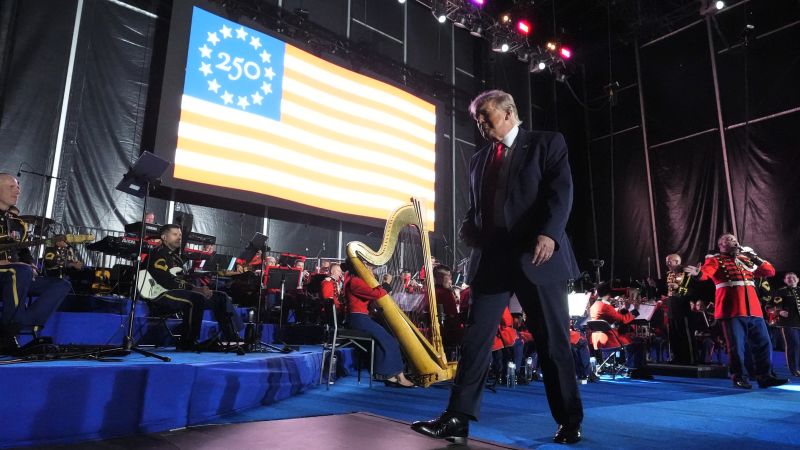
Sandego.net – On Wednesday night, as the United States commemorated its 250th anniversary, President Donald Trump took center stage at a celebratory event on the National Mall. The spectacle was marked by military jets streaking across the skies and the Marine band’s performance of patriotic songs, including “God Bless the USA,” which Trump’s supporters have long embraced as his campaign anthem. Yet, the tone of his speech hinted at a deeper intent: to position himself as the architect of America’s current prosperity, rather than merely acknowledging its historical legacy.
“America is back,” Trump declared, asserting that his leadership had rescued a “dead country” in under two years. His remarks quickly shifted from the foundational ideals of the Declaration of Independence to a catalog of recent accomplishments, real or amplified, framed as evidence of his transformative impact. By bypassing reflections on the nation’s past struggles and triumphs, Trump framed the occasion as a personal victory, one that would be celebrated in the annals of history.
Historically, such milestones have invited leaders to contemplate the nation’s journey, its imperfections, and its shared aspirations. However, Trump’s approach appeared more self-centered, aligning with a pattern of leveraging national events to elevate his own legacy. This focus became particularly striking when juxtaposed with his waning popularity, as reflected in the latest CNN Poll of Polls, which showed his approval rating at 36%—a majority of Americans oppose him at this pivotal moment in the country’s history.
A Nation Divided
Trump’s speech, while stirring for his base, left many questioning its alignment with the nation’s broader narrative. He invoked the Declaration of Independence, a symbol of American ideals, yet rushed to equate his policies with the era’s revolutionary spirit. By highlighting his achievements—such as securing the southern border and enacting tax cuts—he positioned himself as the modern-day equivalent of the Founding Fathers, a claim that critics argue overlooks the complexities of contemporary governance.
“We have taken power back from the far-off political class,” Trump proclaimed, echoing his rhetoric about reclaiming authority from Washington elites. This assertion, while resonant with his core supporters, sparked debates about whether the event had become a platform for self-aggrandizement rather than a tribute to collective progress.
Ken Martin, chair of the Democratic National Committee, captured the essence of this critique in a statement. “As Americans come together to celebrate the 250th anniversary of the nation’s founding, Donald Trump is doing what he does best: blowing money on flashy, Trump-themed events while forcing Americans to foot the bill.” Martin’s words underscored the perception that Trump’s celebrations were less about honoring the country’s heritage and more about solidifying his own place in it.
Trump’s decision to exclude certain artists from the event further fueled these accusations. When a string of performers withdrew, citing the event’s political bias, he responded with sharp criticism, framing their absence as a sign of his dominance. This reaction reinforced the view that his primary goal was to shape the narrative rather than allow for diverse perspectives. His rally following the event, which he described as a “campaign rally,” emphasized this strategy of consolidating support rather than fostering unity.
Legacy in the Making
Despite the controversy, Trump’s speech was met with enthusiasm from his loyal audience. The crowd, largely composed of his base, seemed to embrace his narrative of national resurgence. Yet, this reception raised questions about the inclusivity of his message. Millions of Americans who are not MAGA voters—those who might have viewed the event as a chance to reflect on the nation’s founding—were left wondering if their voices were being sidelined.
Presidents, even those elected by partisans, are expected to balance individual ambitions with the broader responsibilities of leadership. National celebrations, in particular, offer a platform to inspire unity, yet Trump’s focus on his own achievements suggested otherwise. His praise for the military, for instance, was widely appreciated, but his policies on Iran and the handling of diversity initiatives sparked mixed reactions. While some citizens in Washington, D.C., a typically liberal city, admired his efforts to enhance public safety and streamline historical landmarks, others were critical of his farcical renovations and proposed monuments.
“We have reclaimed our strength,” Trump said, drawing parallels between his era and the revolutionary past. Yet, his comparison to the Founding Fathers also invited scrutiny. Critics argued that his claim to national greatness overlooked the constitutional challenges his administration had faced, including debates over executive power and the balance of government.
As the nation’s 250th anniversary unfolded, the contrast between Trump’s vision and that of his opponents became more pronounced. While he portrayed himself as a savior of the American dream, his detractors highlighted the growing divisions in society, particularly around issues like immigration and social equity. The question lingered: Would this event serve as a testament to the country’s enduring spirit, or would it become a footnote in Trump’s personal saga?
Trump’s remarks also underscored a broader theme of political polarization. His insistence on framing the Biden administration as a “total disaster” reflected a tendency to measure success against perceived rivals, rather than against the nation’s long-term goals. This partisan framing, while effective in rallying his base, risked alienating those who might have otherwise joined in the celebration of America’s history.
A Future Uncertain
Even as Trump’s event drew applause, it also set the stage for future reflections on his tenure. He hinted that the celebration would continue, with a promise to have “your favorite president” speak on the Mall on July Fourth. This suggestion hinted at a longer-term strategy to cement his legacy, even as the nation grappled with its own identity.
For many, the 250th anniversary of the Declaration of Independence was an opportunity to look beyond partisan agendas and celebrate the foundational principles that have shaped the country. Yet, Trump’s approach seemed to prioritize immediate political gains over historical reflection. His ability to command attention at such events raised questions about the future of American democracy and the role of its leaders in shaping public memory.
Ultimately, the event served as a microcosm of the broader debate over leadership and legacy. While Trump’s supporters viewed it as a triumph, critics saw it as a missed chance to reflect on the nation’s progress and challenges. As the country moves forward, the question remains: Will this celebration mark a new era of unity, or a new chapter in the story of a leader who sees history as a stage for his own glory?