North Carolina Teen Faces Murder Indictment Over Role in San Diego Mosque Mass Shooting
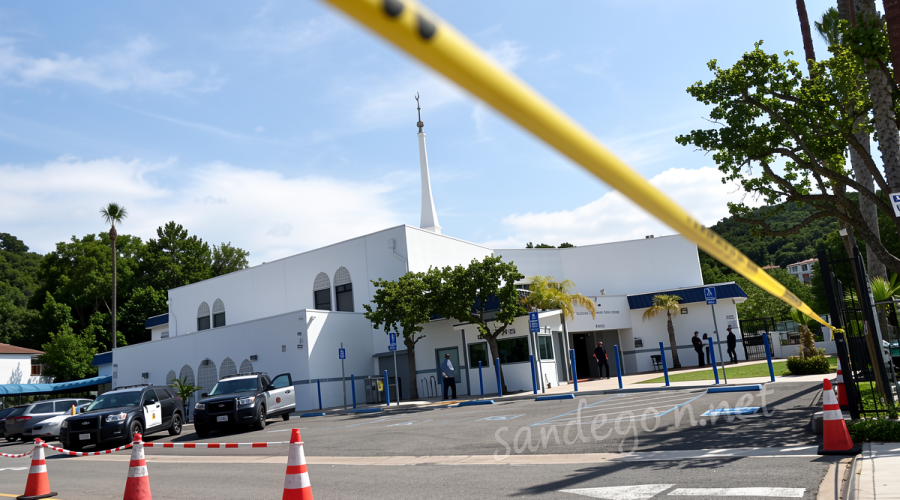
Sandego.net – A 17-year-old girl from Forsyth County, North Carolina, now stands accused of first-degree murder in connection with the May 18, 2026 massacre at the Islamic Center of San Diego, where three worshippers were killed before the two gunmen turned their weapons on themselves. Sarah Santiago was formally indicted Monday by a grand jury on three counts of first-degree murder plus one count of conspiracy to commit first-degree murder, according to Forsyth County District Attorney Jim O’Neill. Prosecutors say Santiago did not fire a single shot but helped orchestrate the broadcast and aftermath of the attack in ways that, under state law, make her equally culpable.
The Charges and the Legal Theory
The indictment alleges that Santiago “agreed and planning prior to the attack” to livestream the killing, publicly distribute the recording, and release a manifesto “purporting to justify the attack.” Prosecutors contend she carried out each of those acts. O’Neill invoked a well-established principle of North Carolina criminal law during a Monday afternoon news conference:
“The law in North Carolina is clear: a person may be guilty of a crime, although he or she personally does not do any of the acts necessary to constitute the crime.”
Among the specific details prosecutors highlighted: before the shooting, Santiago purchased and mailed a Sonnenrad patch to one of the gunmen, Caleb Vazquez, and the indictment states he “did in fact wear” it during the attack. The Sonnenrad is widely recognized as a neo-Nazi and white-supremacist emblem. Santiago’s attorney, Alan Doorasamy, told CNN in an email that his client is a juvenile and that discovery had not yet been released to him, limiting what he could say about the evidence. He added:
“At this time I can confirm that my client is innocent of all these charges.”
The May 18 Attack
On the morning of May 18, 2026, Cain Clark, 17, and Caleb Vazquez, 18, opened fire inside the Islamic Center of San Diego, killing three people before each taking his own life. The victims were Amin Abdullah, a security guard who engaged the gunmen with gunfire before being shot back; Nadir Awad; and Mansour Kaziha. Authorities said Awad and Kaziha were killed while attempting to draw the shooters’ attention away from the main prayer hall and toward the parking lot, buying time for others inside. Officials praised all three for their decisive actions in the final seconds before they died.
Law enforcement said the two gunmen had “exchanged radicalized ideology” in advance, much of which appeared in a manifesto police recovered afterward. That document covered “a wide aspect of races and religions.” Hate speech was scrawled on one of the weapons, and a suicide note contained writings about racial pride, officials said.
What Investigators Found
Executing three search warrants at residences tied to the suspects, authorities seized more than 30 firearms — including numerous pistols, rifles, and shotguns — along with a crossbow, tactical gear, ammunition, and electronic devices. Clark’s mother alerted police after discovering what she believed to be a suicide note written by her son. He had vanished from the home with a man she had never met, someone he had contacted online; both were dressed in camouflage. Several weapons normally kept in the house were also missing at the time.
Vazquez had been enrolled in a mental health program until the day before the shooting, a federal law enforcement official confirmed. The reason for his release was not disclosed because of the ongoing investigation and medical-privacy statutes. Court documents show that the previous year, after Vazquez was placed on a psychiatric hold, law enforcement obtained a gun-violence emergency protective order to remove firearms from his parents’ home amid concerns about the teenager’s “suspicious behavior idolizing Nazis and mass shooters.”
Security Measures and the Victims’ Final Moments
In the weeks before the attack, the Islamic Center had strengthened its physical security after receiving vitriolic messages and unsettling threats. The facility erected a perimeter fence, installed bulletproof windows, and conducted regular active-shooter drills at its affiliated school — steps now common among religious institutions across the United States following a wave of targeted attacks on houses of worship.
Even so, the gunmen breached the building and opened fire. Abdullah, serving as the mosque’s security guard, was the first to return fire. Awad and Kaziha were killed while trying to lure the shooters outside, according to authorities.
Planned Follow-Up Attacks
O’Neill disclosed that, after the mosque massacre, the two gunmen had planned additional mass killings at a Jewish temple and at a predominantly African American school in the area. The suspects may have stopped because
Federal and State Response
Reid Davis, the special agent in charge of the FBI’s North Carolina office, used the indictment announcement to underscore the agency’s position on digital-age accountability:
“Too often, in this age of technology, people attempt to disappear behind their keyboards and their screens. If you put lives at risk, the entire weight of the federal, state, and local government, law enforcement agencies and prosecutors will come to bring justice.”
O’Neill explained that authorities were uncertain what Santiago was capable of and that “the thought of her going back to school” posed “too great a risk” to wait for a grand jury to convene on its normal schedule. She was arrested the previous week and formally indicted Monday.
The case underscores a growing pattern in American mass-shooting investigations: prosecutors increasingly pursue not only those who pull triggers but also those who plan, broadcast, and narrate the violence from afar. Santiago’s alleged role — recording, distributing, and framing the attack through a written manifesto — places her squarely within that expanding perimeter of criminal liability, even though she was hundreds of miles from San Diego when the bullets flew.
Related Reading
Frequently Asked Questions
What is Teen charged with murder in San Diego?
Teen charged with murder in San Diego is the main topic of this guide. The article explains the context, practical details, and next steps readers should understand.
Why does Teen charged with murder in San Diego matter?
Teen charged with murder in San Diego matters because readers are looking for a useful answer, not just a short summary. Good content should match search intent and help them decide what to do next.