Trump’s Vanity Projects Are a Growing Mess
Sandego.net – President Donald Trump’s second term has been marked by a series of initiatives that have increasingly drawn criticism for their lack of coherence and strategic timing. While his administration’s attempts to transform Washington, DC, into a personal showcase have captured headlines, these efforts have also exposed a pattern of haphazard planning and political overreach. From the White House ballroom to the Kennedy Center, Trump’s projects have not only faced logistical hurdles but have also sparked debates about their purpose and public reception.
Kennedy Center Naming Controversy
One of the most notable incidents involved the Kennedy Center, a prominent cultural institution in the nation’s capital. After Trump effectively took control of the center’s board by appointing loyalists, the board proceeded to rename the building in his honor late last year. This decision came despite the fact that the Kennedy Center’s name had been federally protected for decades. The move was intended to elevate Trump’s legacy, but it soon collided with legal challenges that highlighted the administration’s disregard for established procedures.
“This removal threatened to be ‘an indelible — and telling — image.'” — [Author’s previous analysis from earlier this month]
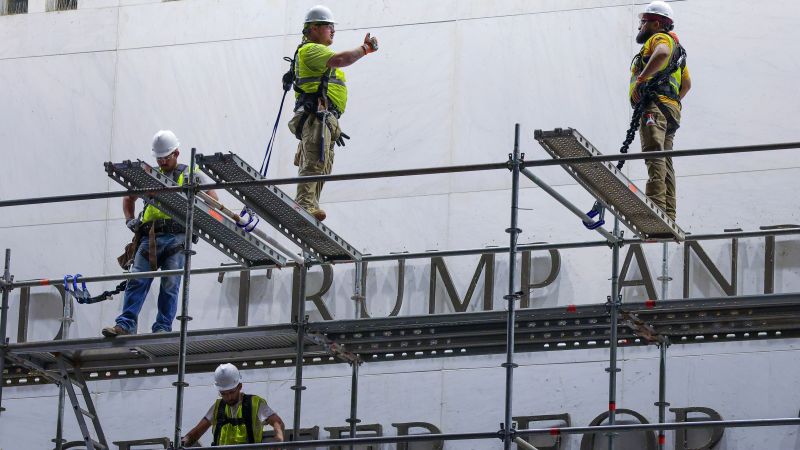
When the courts ruled that the renaming was unlawful, the administration was forced to confront the optics of erasing Trump’s name from the building. The removal, carried out in the middle of the night, was done with the help of scaffolding and tarps to prevent public scrutiny. By Monday, the building’s exterior remained concealed, leaving many to question the transparency of the process. This event underscores how Trump’s self-promotion has often come at the expense of institutional integrity, even when the results are politically inconvenient.
Reflecting Pool Algae Crisis
Another high-profile project that has stumbled is the Lincoln Memorial’s Reflecting Pool. The administration’s effort to paint the pool’s bottom dark blue, a visually striking modification, was initially estimated to cost $1.8 million. However, the cost skyrocketed to over $14 million, partly due to a no-bid contract awarded to the contractor. This approach, typically reserved for emergencies, has raised eyebrows as the project’s legal foundations were questioned.
Despite the financial overruns, the National Park Service has maintained a positive outlook on addressing the algae problem that has since plagued the pool. The water turned green shortly after the project was completed, with reports indicating the issue was already present before the color change. Park employees, wearing hip-waders, have been actively working to remove the algae using nanobubbling machines. Yet, the challenge has proven persistent, raising concerns about the long-term viability of the project.
Trump, ever the self-promoter, took notice of the algae issue and used it to his advantage. On Monday, he shared a social media post citing an article from a supportive outlet that praised the pool’s “beauty.” However, the article in question was a week old, suggesting that Trump’s timing was as opportunistic as ever. This incident reflects a broader strategy of leveraging public events to reinforce his image, even when the results are mixed.
Politicizing the 250th Anniversary
The administration’s handling of the country’s 250th anniversary celebration has also drawn scrutiny. Events such as the UFC fights held on the South Lawn of the White House were designed to showcase Trump’s leadership and connect with the public. Yet, the celebrations were marred by a controversial moment when a fighter mistakenly claimed former First Lady Michelle Obama was a man. The comment, which circulated widely on social media, became a symbol of the administration’s tendency to weaponize public spaces for ideological messaging.
“This Freedom 250 and the celebration of the 250th is a nonpartisan event.” — Interior Secretary Doug Burgum, May 2026
Burgum’s statement, made during a CNN interview, contrasted with the reality of how the events were being framed. The White House, under Trump’s direction, seemed to shift the focus toward his own persona, even as other organizers initially claimed the anniversary was inherently nonpolitical. Trump’s recent assertion that the July 4 celebration on the National Mall would be “the most spectacular TRUMP RALLY of them all” further reinforces this narrative.
The inconsistencies in Trump’s approach have become more apparent as the administration grapples with multiple setbacks. From the Kennedy Center to the Lincoln Memorial, his projects have faced scrutiny for their execution and intent. While the desire to leave a personal mark is understandable, the repeated missteps suggest a lack of oversight and a tendency to prioritize visibility over substance. These challenges have not only complicated the administration’s image but also raised questions about its ability to manage large-scale initiatives effectively.
A Pattern of Self-Centered Ambitions
Trump’s behavior during these projects has followed a familiar script. He has consistently framed his actions as necessary for national pride, even when the outcomes have been questionable. For instance, the administration’s push to secure funding for the White House ballroom was tied to security concerns, yet the initiative’s effectiveness remains debatable. Similarly, the Lincoln Memorial project, while visually ambitious, has faced criticism for its cost and the algae problem that emerged unexpectedly.
These incidents are part of a larger trend in which Trump’s government has used public events to advance his personal brand. The renaming of the Kennedy Center, the reimagining of the Reflecting Pool, and the UFC celebrations all serve as platforms to highlight his influence. However, the disconnect between these efforts and the public’s priorities—such as economic concerns—has become more pronounced over time. As the administration continues to push forward with its vanity projects, the question remains: how much of this is about legacy, and how much is about maintaining a narrative of presidential dominance?