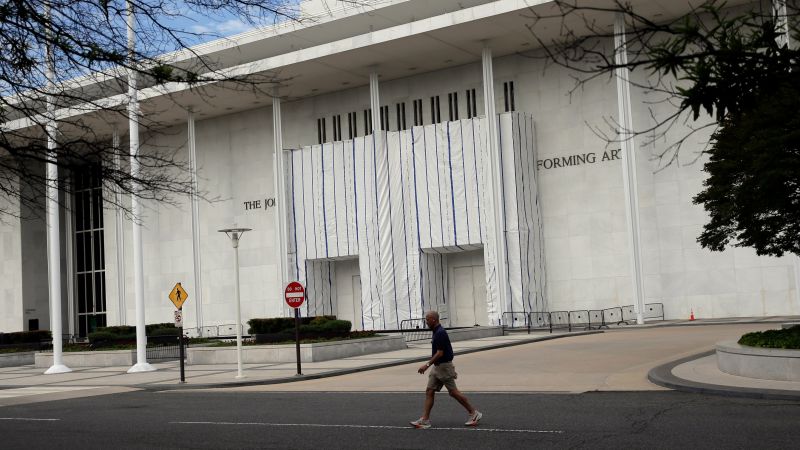
Kennedy Center Exterior Still Covered as Trump’s Name Removal Completes
Sandego.net – On Sunday, the Kennedy Center’s exterior remained draped in massive striped tarps, leaving visitors to the iconic arts venue puzzled and frustrated. The name of former President Donald Trump, which had been displayed on the building since December, was officially removed on Saturday following a federal judge’s directive. However, the visible remnants of the change were still obscured by the coverings, sparking curiosity and concern among attendees. Stephen Caken, a New York resident who had traveled to Washington, DC, for an internship, expressed his bewilderment to CNN. “It seems like they’re trying to just kind of take away attention from this whole charade,” he remarked, highlighting the lingering uncertainty about the decision’s permanence.
Public Reaction to the Ongoing Coverage
John Mathew Smith, a Maryland resident who visited the Kennedy Center, took a more ideological stance on the matter. “To me, he’s trying to deface America’s symbols before he starts finishing defacing the country itself,” Smith said, emphasizing his belief that the removal of Trump’s name was part of a larger effort to challenge national identity. Meanwhile, Tim Terpstra, a Washington resident living nearby, visited the venue for the second time that weekend, hoping to witness the final stage of the process. “It would be nice to be able to see to make sure that it is down, and no vestiges of what was up there still remain,” he added, underscoring the desire for complete transparency.
“Trying to weaken America’s symbols” – John Mathew Smith
CNN contacted the Kennedy Center for clarification on the tarp’s continued presence. The institution had begun the process of erasing Trump’s name from the building’s facade, which had been installed in December as part of the president’s campaign to reshape the nation’s capital. The decision followed an appeals court’s refusal to delay a ruling by US District Judge Christopher Cooper, who had determined that the Kennedy Center acted unlawfully by adding Trump’s name to the structure. The center had initially reversed the change in some areas but retained the signage to avoid immediate compliance with Cooper’s order.
The Symbolic Significance of the Naming Change
The installation of Trump’s name on the Kennedy Center, named after assassinated President John F. Kennedy, ignited a symbolic debate among locals. For many, the center has long been a cultural cornerstone in the nation’s capital, representing artistic integrity and historical legacy. The addition of Trump’s name in December was seen as a disruption to that legacy, prompting a wave of artists to withdraw from performances and fueling public discourse. The decision to remove his name, now partially completed, is viewed as a small but significant step toward reclaiming the space’s original purpose.
Trump’s administration has faced legal challenges since the name change. Rep. Joyce Beatty, an Ohio Democrat and former member of the Kennedy Center’s board of trustees, swiftly launched a lawsuit to contest the decision. Her activism extended beyond the courtroom, as she shared a celebratory video on social media of herself performing a dance popularized by Trump to the tune of “YMCA” by The Village People. The video became a symbol of both the president’s cultural influence and the bipartisan opposition to his presence on the building.
“Trying to take away attention from this whole charade” – Stephen Caken
Broader Efforts to Transform Washington, DC
Trump’s push to alter the Kennedy Center is part of a larger pattern of urban redevelopment in Washington, DC. His administration has implemented several changes to the city’s landscape, including converting the White House Rose Garden into a sprawling Mar-a-Lago-style patio, demolishing the East Wing to construct a massive ballroom, and repainting the Lincoln Memorial Reflecting Pool to a new hue. These projects, along with the Kennedy Center’s name change, reflect a strategy to modernize the capital while embedding his political vision into its infrastructure.
Meanwhile, other initiatives have focused on ideological alignment rather than aesthetics. White House officials have launched a continuous review of the Smithsonian Institution, aiming to adjust its narrative to align with Trump’s interpretation of American history and culture. This effort has included reinstating a controversial Confederate monument and removing references to George Mason’s ownership of slaves from his memorial, despite his advocacy for individual rights. Such actions have drawn criticism from historians and civil rights advocates, who argue they undermine the center’s commitment to inclusivity.
Context and Timeline of the Legal Battle
The removal of Trump’s name at the Kennedy Center marked the culmination of a legal struggle that began in December. At that time, the president’s handpicked board of trustees had approved the addition of his name to the building’s exterior, a move that immediately sparked controversy. The legal challenge, spearheaded by Beatty, led to a ruling that the venue had acted unlawfully by altering its name without proper authorization. The appeals process, which delayed the final removal, allowed the center to strategically keep the signage in place until the last moment.
On Friday, crowds gathered near the Kennedy Center, watching as workers erected scaffolding to facilitate the removal. Protesters chanted “Take it down” and hailed the workers as “heroes,” reflecting the divided sentiments surrounding the decision. By Saturday, the process reached its peak, with footage from a small scaffolding opening showing crews carefully dismantling the letters. The final removal was completed shortly before midnight, leaving the building’s facade devoid of Trump’s name.
Trump’s Cultural Influence and Legacy at the Kennedy Center
Despite the recent removal, Trump’s cultural footprint at the Kennedy Center persisted throughout his presidency. The venue became a platform for his ideological alignment, hosting events that promoted his vision of American culture. In December, he received the Kennedy Center Honors, an annual tribute to outstanding artists. The center also premiered Melania Trump’s documentary, further cementing their connection to the institution. Last week, the venue hosted the final round of Trump’s national civics contest, which aimed to engage young Americans in his political agenda.
While the removal of Trump’s name represents a symbolic shift, the broader implications of his influence on the Kennedy Center remain. The building’s transformation into a space reflecting Trump’s preferences highlights the intersection of politics and culture in the nation’s capital. As the legal battle continues, the Kennedy Center’s decision to keep Trump’s name on the facade for a short period underscores its strategic approach to navigating the ruling. The appeal process, which is expected to unfold in the coming weeks, will determine the final fate of the name’s presence.
Trump’s efforts to reshape Washington, DC, extend beyond the Kennedy Center and into the city’s historical and cultural fabric. His administration has not only altered physical landmarks but also redefined their narratives. From redeveloping the Rose Garden to constructing a golf course and a towering arch near Arlington National Cemetery, the changes aim to reflect a new era of American identity. The Kennedy Center’s name removal, while a key moment in this transformation, is part of a larger movement to align the nation’s cultural symbols with its political leaders.
As the tarp was finally removed, the Kennedy Center’s exterior was revealed to the public, signaling the end of a contentious chapter. Visitors now walked past the site of the former signage, contemplating the shift from a presidential moniker to a restored cultural landmark. The event marked a turning point in the ongoing debate over the role of public spaces in political messaging, with implications for the future of how history and identity are displayed in the capital.