Fact Check: Trump’s False and Unproven Claims About the Reflecting Pool
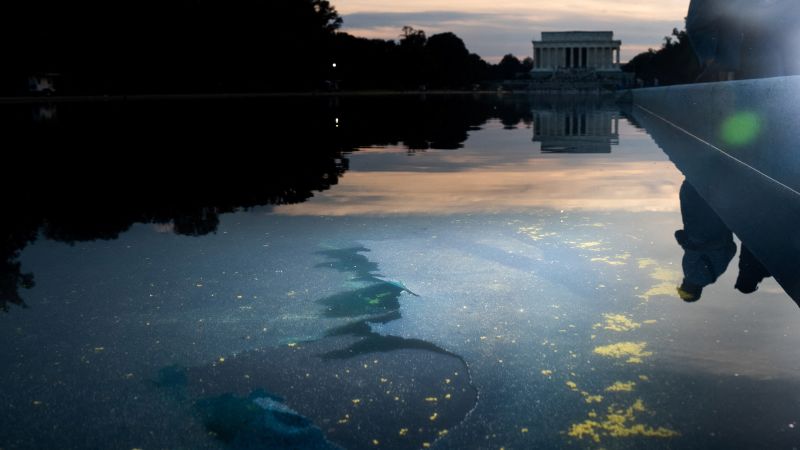
Sandego.net – President Donald Trump has sparked controversy with a series of unverified assertions regarding the Lincoln Memorial Reflecting Pool. The pool, a iconic feature of the National Mall, has become a focal point of his narrative about infrastructure maintenance and public oversight. While Trump insisted that the visible damage to the pool stemmed from “vandals” rather than the recent repair efforts, the evidence he presented was limited, leaving room for doubt about the validity of his claims.
The Timeline of the Pool’s Condition
Trump’s statements emerged after the pool was refilled in early June. He claimed that the water had been “made crystal clear” by his administration, yet algae was already visible within days of the refilling. This raised questions about the effectiveness of the repairs. Despite the Trump team’s assertions, the algae problem persisted, suggesting that the pool’s condition had not improved as promised. The National Park Service, which oversaw the project, acknowledged the issue but noted that the damage was not linked to the “American flag blue” coating peeling or the algae’s presence.
Trump’s focus on vandalism shifted attention away from the ongoing maintenance work. He repeatedly described the damage as a “250-foot long gash,” “300-foot gash,” “350-foot slit,” and “numerous slashes over a very long 350-foot length.” This inconsistency in his claims highlighted the lack of concrete evidence. The New York Times revealed that internal documents mentioned two 171-foot blade cuts, which could align with Trump’s 350-foot figure. However, the documents did not specify how these cuts occurred or their connection to the current damage, leaving the narrative open to interpretation.
The Role of Video Evidence
On Tuesday night, Fox News aired a video provided by the Interior Department, which Trump’s team claimed depicted vandalism of the pool. The footage showed two individuals bending or crouching near the pool’s edge, with others passing by. While the department suggested the video captured people “destroying and removing a piece of the lining,” the scene was not entirely clear. Fox host Jesse Watters questioned the certainty of the claims, stating, “We don’t know if they’re committing a crime.” The video, though notable, did not conclusively demonstrate the creation of two 171-foot gashes, underscoring the need for more detailed analysis.
Trump’s portrayal of the damage has evolved over time, sometimes contradicting earlier statements. Initially, he described the gash as 250 feet long, but by Monday, he adjusted it to 300 feet. By the end of the day, the figure had grown to 350 feet, with a note about “slashes” over the length. This shifting narrative complicates efforts to assess the truth of his claims. The Times noted that the internal documents referenced two cuts, but the specifics of their origin remained unclear. Trump’s team has not provided definitive proof linking the cuts to the vandalism he described.
Historical Misstatements About the Pool’s Maintenance
Trump’s focus on the current situation has overshadowed his long-standing misrepresentations about the pool’s history. During a Monday event, he claimed that the two-year repair project under former President Barack Obama left the pool “never even opened.” This contradicts historical records, as the pool reopened in August 2012 and has been accessible for most of the past 13 years. While there were brief closures for maintenance and repairs, including a notable shutdown in October 2012, these were exceptions rather than the rule.
Trump also accused former President Joe Biden of spending tens of millions on the pool, a claim he reiterated during the same event. However, the Biden administration did not pursue a major repair project. Chuck Sams, who served as the National Park Service director under Biden, informed CNN in May that a “full rehabilitation” of the pool would cost “above $100 million,” but the project was never approved. This suggests that Trump’s figures about Biden’s spending are exaggerated or entirely fabricated.
Furthermore, Trump’s assertion that the Obama administration’s project cost “over $100 million” was challenged when CNN inquired in May. The actual contract was for about $35 million, and the Trump White House could not provide any supporting documentation for the higher amount. This inconsistency raises questions about the accuracy of his financial claims. The pool’s repair history, including the recent work, indicates that the costs were well within the $35 million range, yet Trump persistently presented a more inflated figure.
Public Perception and the Need for Verification
The confusion surrounding the pool’s condition has fueled public debate. Trump’s insistence on attributing the damage to vandalism, rather than the repair process itself, has drawn criticism from experts and fact-checkers. The absence of clear evidence linking the cuts to vandals, combined with the visible algae and the pool’s ongoing use, suggests that the damage may be a result of normal wear and tear. The Trump administration’s failure to provide substantiation for its claims has further eroded public trust.
As the situation unfolds, the focus remains on verifying the facts. While the Interior Department’s video offers a glimpse into the pool’s recent history, it does not resolve the discrepancies in Trump’s descriptions. Fact-checkers continue to investigate the source of the gashes and the extent of the repairs, emphasizing the importance of transparency in public discourse. The pool, a symbol of national heritage, has become a battleground for conflicting narratives about its upkeep and the role of past administrations in its maintenance.
Trump’s claims, whether about vandalism or spending, highlight a pattern of redefining facts to fit his agenda. The Lincoln Memorial Reflecting Pool, a site that has been in use for over a century, now faces scrutiny not just for its physical condition but for the political interpretations of its state. As the public watches the unfolding story, the key question remains: how much of the damage was caused by the repair project, and how much by the actions of individuals? The answer may not be as straightforward as Trump’s claims suggest.