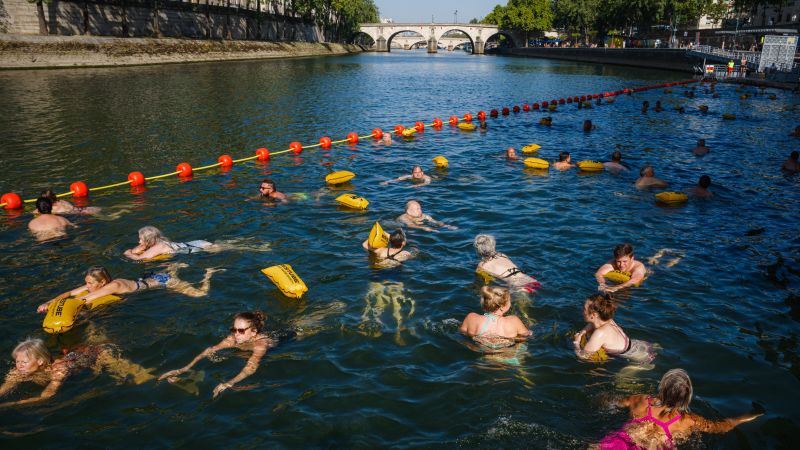
The Seine used to be a toxic mess. Now it’s the hottest new swim spot in Paris
The Seine used to be a toxic – Paris this summer offers an unexpected highlight: swimming in the Seine. Following a recent heatwave that shattered previous records, with temperatures reaching 104 degrees Fahrenheit (40 Celsius) in late June, the city’s third wave of extreme heat looms just days away. This timing couldn’t be more perfect for the debut of three new swim zones along the river, marking a return to a practice once considered unthinkable. For the first time in two years, Parisians and visitors can cool off in the river, transforming it into a modern summer attraction.
A Century-Old Ban
Though many view river swimming as a recent trend, Paris has a rich, if complicated, history with the Seine. The practice dates back to the 17th century, when nude bathing was a common pastime on the river’s sloped banks. However, in 1716, authorities imposed a ban, citing concerns over public decency. This restriction didn’t stop the tradition entirely, but it shifted it to a more structured format by the 18th century. Floating baths, simple canvas-covered vessels, became popular, allowing bathers to swim in the river’s current within designated safety zones.
By the 19th century, the act of bathing had evolved into a significant social and athletic event. The banks of the Seine hosted lavish establishments, blending leisure with culture. One such venue, the Piscine Deligny, rose to prominence as a fashionable spot. It later played a role in the 1900 Paris Olympics, hosting swimming competitions. Yet, the river’s golden age began to wane at the turn of the 20th century, as incidents like drownings and accidents spurred stricter regulations.
The 2016 Revival
Parisian swimming culture faced its most severe decline in the mid-20th century, when pollution drastically worsened the water quality. By the 1970s, the Seine had become a symbol of urban decay, with over half of the region’s untreated wastewater pouring directly into its waters. The ecosystem suffered immensely, and by 1970, the river was nearly lifeless, supporting only three resilient fish species.
Efforts to restore the Seine began in the 1980s, culminating in a political promise that would become a lasting symbol of the city’s environmental challenges. In 1988, then-mayor Jacques Chirac, campaigning for reelection, vowed to swim in the Seine within three years to prove its cleanliness. He reiterated the pledge on television in 1990, but the promise never materialized, becoming a recurring joke among Parisians. Despite this, the Seine remained a polluted body of water, with events like the 2013 Paris triathlon canceled due to unsafe conditions.
“She had a vision of herself living in Paris. Now this American woman calls it home.”
The turning point came in 2016, when mayor Anne Hidalgo revived Chirac’s promise as part of the city’s preparations for the 2024 Olympics. This initiative required a massive investment—over a billion euros—and a revolutionary engineering project to overhaul Paris’s wastewater systems. A key component of the effort was the construction of a colossal underground basin near Gare d’Austerlitz. This structure, a massive concrete cylinder 50 meters wide and 30 meters deep, serves as a stormwater storage facility. Its capacity, equivalent to 20 Olympic-sized pools, ensures that excess water is diverted away from the Seine during heavy rainfall.
Historically, Paris’s 19th-century sewers combined rainwater and sewage in a single network, resulting in untreated waste spilling into the river during storms. The new system separates these flows, drastically reducing contamination. This transformation has not only improved water quality but also revitalized the Seine as a recreational space. The timing of the seasonal swim zones aligns with the 250th anniversary of Franco-American friendship, making it a symbolic gesture for American visitors. For them, there may be no better way to celebrate the 4th of July than a refreshing swim in the iconic river.
While the Deligny, once a cornerstone of Parisian bathing culture, was forced to adapt to survive. After the 1923 ban, it transformed into a floating, filtered pool, operating independently from the river’s water. It remained a beloved institution until 1993, when it mysteriously sank. Yet, unauthorized swimming persisted, especially during scorching summer months, and the long-distance race established in 1905 continued unabated, challenging the authorities for decades.
The Seine’s journey from a polluted urban stream to a thriving recreational spot underscores the city’s commitment to environmental renewal. The new swim zones, now open for the second consecutive summer, are a testament to this progress. With improved water quality and modern infrastructure, the river has become a focal point of Paris’s summer scene. The revival of this tradition not only offers a unique experience for visitors but also highlights the city’s transformation from a polluted industrial hub to a green, sustainable destination.
As Parisians embrace the opportunity to swim in the Seine, the river’s renewed vitality serves as a reminder of the long road to recovery. What was once a symbol of neglect is now a celebration of resilience and innovation. The Seine’s current state, once deemed unfit for human contact, now invites both locals and tourists to partake in a tradition that blends history, culture, and environmental progress. Whether as a summer escape or a nod to the city’s storied past, the Seine has become more than just a waterway—it’s a living legacy of Paris’s determination to reclaim its natural resources.