Trump is growing tired of hearing ‘no’ from Thune. GOP senators are lining up behind the majority leader
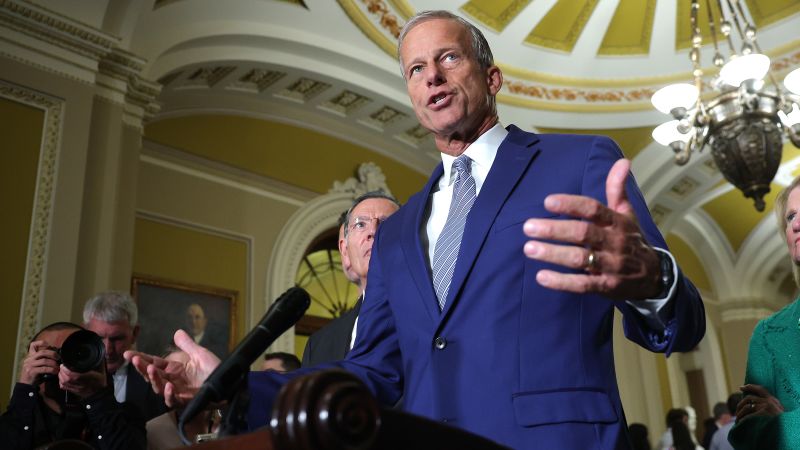
Sandego.net – As the nation braces for pivotal midterm elections, the relationship between President Donald Trump and Senate Majority Leader John Thune has become a focal point of internal GOP tensions. Despite Trump’s status as the party’s leader, Thune continues to wield significant influence within the Senate, often defying the president’s more contentious demands. This dynamic has led to growing frustration among Trump, who recently attended a lunch with Senate Republicans at the U.S. Capitol, as he grapples with Thune’s persistent resistance to his agenda.
The Tightrope of Leadership
Thune, a South Dakota senator, has found himself in a delicate balancing act, navigating the demands of a president who insists on aggressive action while maintaining the stability of the Senate. With less than five months until the midterms, his colleagues report that he has managed to secure broad support, even as the White House pushes for sweeping changes. This support, however, comes at a cost. Many Republicans have grown increasingly bold in their willingness to challenge Trump’s policies, viewing Thune’s leadership as a stabilizing force in a turbulent political landscape.
According to insiders, Trump has grown weary of Thune’s refusal to unconditionally endorse his priorities. The Senate leader’s insistence on measured action has sparked complaints from the president, who believes that Thune is not doing enough to advance his agenda. “The president is creating terms that will never ever be satisfied,” said retiring Senator Thom Tillis, a North Carolina Republican. “Why are we walking into a boxed canyon? That’s what John is confronted with.” Tillis praised Thune’s resilience, calling him “an extraordinary leader” who possesses “the patience of Job.” He added, “I could not do his job.”
Political Grenades and Strategic Calculations
Thune’s role as a mediator has been tested repeatedly as he disarms political challenges that Trump has devised. From the federal elections overhaul to the filibuster debate, the majority leader has been forced to negotiate and compromise. These efforts have not gone unnoticed, with some GOP senators expressing gratitude for Thune’s willingness to risk his own political future to protect the party’s majority.
One of the most contentious issues has been the push for a sweeping federal elections bill. Trump, who has argued that such a measure is vital for securing control of the House and Senate, has been particularly vocal in his demand for its passage. However, Thune has made it clear that the Senate lacks the necessary votes to approve the bill without significant concessions. Despite this, he has brought the proposal up for discussion multiple times, including during a recent marathon voting session to pass an immigration enforcement funding package.
Thune’s refusal to eliminate the filibuster or remove the parliamentarian, the Senate’s nonpartisan rules referee, has drawn criticism from Trump. In private conversations with allies, the president has vented about Thune’s lack of urgency, claiming that the majority leader is not pushing hard enough to achieve his goals. “The president depends on the majority leader to get his agenda passed,” said Texas Senator John Cornyn, a Republican who recently lost a primary to a Trump-backed challenger. “As far as I can tell, John Thune is guilty of nothing except telling the president the truth, which is there are not the votes.”
Broader Implications for the GOP
The growing rift between Trump and Thune reflects a deeper divide within the Republican Party. While the president remains committed to his most ambitious priorities, many Senate Republicans have grown disillusioned with his approach. They argue that preserving the party’s majority in November may require a more flexible strategy, one that acknowledges the Senate’s institutional constraints and the political challenges facing individual members.
Recent standoffs over Trump’s new acting intelligence chief, Bill Pulte, and his unsuccessful attempt to establish a $1.8 billion fund have further highlighted this divide. Critics claim the fund would disproportionately benefit Trump’s allies, raising concerns about fairness and public trust. These conflicts have underscored the Senate’s role as a battleground where party loyalty and pragmatic governance often clash. Thune, as the Senate’s presiding officer, has become the central figure in these debates, tasked with ensuring cohesion while managing the fallout from Trump’s demands.
With the midterm elections looming, the Senate is under pressure to maintain its majority. Thune’s leadership has been critical in this effort, as he works to align his colleagues behind a unified front. However, his strategy has also drawn scrutiny. Some Republicans worry that his measured approach may undermine Trump’s influence, while others see it as a necessary step to safeguard the party’s long-term interests. The upcoming lunch meeting between Trump and Senate Republicans is seen as a crucial opportunity to resolve these differences and refocus the party’s efforts on the election.
Staying Together Amid Division
Senator Tommy Tuberville of Alabama described the lunch as a “day of reckoning,” a chance to mend the rifts that have formed within the Republican Senate. “We gotta stay together as a team,” Tuberville emphasized. “Right now, we’re kind of a split group.” His remarks highlight the growing recognition that internal unity is essential for the GOP to withstand the challenges of the midterms.
Trump, driven by his own political instincts, has insisted that his allies must follow his lead. He has repeatedly urged Republicans to abandon caution and embrace bold initiatives, believing that his vision will guide the party to victory. However, the reality is more complex. Many Senate Republicans are now convinced that the party’s survival may depend on striking a balance between loyalty to Trump and the need for strategic flexibility.
As the Senate moves forward, Thune’s ability to manage these competing interests will be key. His leadership has not only kept the party from fracturing but has also demonstrated a commitment to maintaining the Senate’s integrity. While Trump may be frustrated by Thune’s resistance, the majority leader’s actions have earned him the respect of his colleagues, who see him as a bridge between the president’s ambitions and the Senate’s practical realities.
Amid these challenges, the Senate has also taken steps to assert its independence. Just one day before Trump’s visit to Capitol Hill, the chamber voted to rein in the president’s influence on foreign policy, particularly regarding Iran. This move signals a growing willingness among Republicans to challenge Trump’s unilateral decisions, even as they remain loyal to the party’s broader goals.
The situation underscores a broader theme: the Senate is no longer a passive extension of the White House. While Trump seeks to dominate the legislative process, Thune and his allies are ensuring that the chamber retains its autonomy. This dynamic is likely to shape the GOP’s strategy in the months leading up to the midterms, as the party navigates the delicate interplay between presidential power and congressional responsibility.