
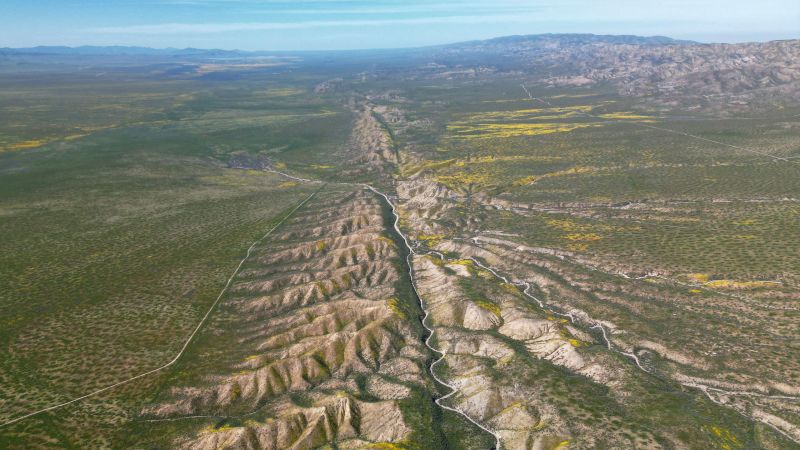
The ‘earthquake gate’ stopping a San Andreas disaster is under its highest stress in 1,000 years
Sandego.net – Imagine a catastrophic event unfolding in Los Angeles, where a massive earthquake triggers a chain reaction of destruction. Scientists now warn that the conditions for such a scenario are more critical than ever, with the San Andreas fault and adjacent San Jacinto fault line nearing their maximum stress levels in a millennium. This discovery challenges previous assumptions about seismic risks, suggesting the potential for a more widespread and devastating quake than previously anticipated.
A Key Fault Junction Under Pressure
Researchers have identified a pivotal point of convergence between the San Andreas and San Jacinto faults, known as Cajon Pass. This region, acting as a sort of “earthquake gate,” could either block or amplify the spread of seismic activity between the two fault systems. A recent study highlights that the stress buildup in this area has reached a critical threshold, raising concerns about the likelihood of a massive rupture affecting multiple regions simultaneously.
Historically, earthquakes have occurred when accumulated energy along a fault is abruptly released. The San Andreas fault, a major tectonic boundary, has been accumulating stress for over a century. This buildup, caused by the slow movement of Earth’s crust, has created a situation where some segments are locked in place, unable to slip freely. The result is a coiled spring of potential energy, waiting to be unleashed.
Seismic Risks Across Southern California
Both the San Andreas and San Jacinto faults form the boundary between the Pacific and North American tectonic plates. While these plates move past each other at a gradual pace—just a few centimeters annually—certain zones remain locked, leading to increased stress. This stress has been growing steadily, with the southern segments of the San Andreas and San Jacinto fault systems now under unprecedented pressure. The implications of this stress buildup are significant, as it could lead to a major earthquake that impacts multiple regions at once.
The study, which analyzed the last 1,000 years of seismic activity, found that the San Jacinto Bernardino segment has reached its highest stress load in recorded history. This segment, located less than 60 miles northeast of downtown Los Angeles, currently registers 3.6 megapascals of stress, surpassing its previous peak from nearly 50 years ago. Similarly, the Mojave South segment of the San Andreas fault has exceeded its own stress record from a decade prior, measuring 2.8 megapascals.
A Past Earthquake as a Warning Sign
In 1812, a 7.5-magnitude earthquake known as the Wrightwood event rippled through both the San Andreas and San Jacinto fault systems. Scientists believe this quake, which likely crossed Cajon Pass, caused 40 fatalities and demonstrated the potential for a rupture to spread across multiple fault lines. Today, the situation is eerily similar, with researchers suggesting that the conditions for a comparable event are now in place.
The current stress difference between the two fault segments is 0.8 megapascals, a significant jump from the 0.3 megapascals observed in past simulations. This disparity highlights the growing tension that could lead to a widespread earthquake. “The insight isn’t that stress builds over time, which we’ve long known,” said Matthew Weingarten, a geologist at San Diego State University. “But that the balance of stress across the junction may decide whether the next earthquake stays contained or grows into a much bigger rupture.”
“We talk loosely about faults being ‘overdue,’ but it’s important to see a physics-based estimate that the system is sitting at a 1,000-year high,” said Liliane Burkhard, the study’s lead author and geophysicist at the University of Bern, Switzerland.
Understanding the Mechanics of Earthquakes
Earthquakes occur when sudden slippage along a fault releases stored energy, causing ground shaking and other effects. Stress accumulates as tectonic forces push against the crust, but when a fault is locked, this energy builds up without release. The San Andreas and San Jacinto faults, though part of the same tectonic boundary, have different stress dynamics. The southern portions of these faults are now at their highest stress levels in a millennium, increasing the probability of a major quake.
The Cajon Pass junction is particularly critical. If a strong earthquake initiates in either fault zone, it could propagate through this pass, affecting areas north of Los Angeles, including San Bernardino, Riverside, and the Coachella Valley. “In terms of severity, a joint rupture crossing Cajon Pass could approach around a magnitude 7.4 to 7.8 and affect a far larger area than a single-fault event,” Burkhard explained.
Implications for Future Disaster Preparedness
The findings of the study emphasize the need for urgent action. While the probability of a 6.7-magnitude or higher earthquake along the southern San Andreas fault is estimated at over 50% in the coming decades, the role of Cajon Pass as a conduit for seismic energy adds a new layer of complexity. If the stress balance at this junction shifts, the potential for a more extensive rupture could increase dramatically.
Researchers have reconstructed the seismic history of these faults to understand how stress accumulates and releases over time. Their analysis shows that large ruptures have previously traversed Cajon Pass when both sides of the fault had comparable stress levels. Today, the same condition is emerging, with the San Jacinto Bernardino segment currently experiencing the highest stress in the region. This suggests that the conditions for a massive earthquake may be more favorable than in the past.
Although the study does not advocate for panic, it underscores the importance of proactive measures. “The underlying message of the new research is not to panic but act with urgency,” Burkhard noted. This includes strengthening infrastructure, improving early warning systems, and ensuring emergency preparedness across vulnerable regions. The data from the past 1,000 years provides a clearer picture of seismic risks, enabling better planning for the future.
A Growing Concern for Southern California
The San Andreas and San Jacinto faults are not just geological features; they are the backbone of Southern California’s seismic landscape. The increased stress levels in these systems have raised concerns about the potential for a more severe earthquake than previously predicted. Scientists warn that if the stress across Cajon Pass continues to rise, the risk of a major rupture could escalate, impacting cities and infrastructure across a vast area.
With the stress difference now at 0.8 megapascals, the situation is more precarious than in earlier decades. This level of stress could lead to a chain reaction, where an earthquake on one fault triggers widespread damage on adjacent faults. The implications are far-reaching, as major highways, railways, and energy corridors could be disrupted simultaneously. This scenario would not only cause immediate devastation but also have long-term consequences for the region’s resilience.
The study’s findings highlight the need for a deeper understanding of how stress is distributed across fault systems. By analyzing historical patterns, researchers can predict future risks with greater accuracy. The Cajon Pass, as a critical point of connection, may determine whether a smaller quake remains localized or evolves into a catastrophic event. With the current stress levels, the probability of such an event is higher than ever before, prompting experts to urge immediate action to mitigate potential impacts.
Preparing for the Unseen
While the exact timing of a major earthquake remains uncertain, the data suggests that the risk is increasing. The San Andreas fault, which has been locked for over a century, is now at its highest stress levels in a millennium. This means that the potential for a significant quake is not just a possibility but a growing reality. The San Jacinto fault line, which has also seen a rise in stress, adds to the concern.
Experts stress that the key to reducing the impact of such an event lies in preparedness. By identifying high-risk areas and implementing mitigation strategies, communities can better withstand the effects of an earthquake. The Cajon Pass, with its role as an “earthquake gate,” serves as a critical focal point for these efforts. Understanding its behavior could help predict the extent of future ruptures and guide emergency response plans.
As the stress levels in the San Andreas and San Jacinto faults continue to rise, the potential for a major earthquake grows. This research provides a clearer picture of the seismic risks facing Southern California, offering valuable insights for both scientists and policymakers. The next step is to translate this knowledge into actionable measures that can protect lives and infrastructure in the event of a disaster.