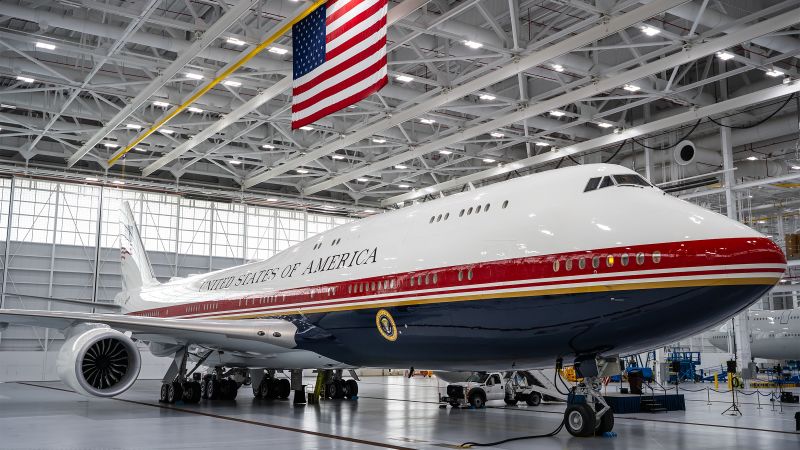
Trump Unveils a New Presidential Airplane
Sandego.net – President Donald Trump, during a ceremony at Joint Base Andrews on Friday, highlighted the arrival of a freshly redesigned presidential aircraft, claiming it to be the “world’s most luxurious plane.” The event, which drew a crowd of military personnel, marked a significant shift in the design of the nation’s official air travel vessel. Trump emphasized his personal satisfaction with the new model, which he said had been tailored to reflect his preferences after years of frustration with the outdated Boeing 747s that had served as Air Force One since 1990.
Design Overhaul and Color Scheme
The interior of the aircraft features premium wood paneling, a detail Trump praised as the “highest quality.” While the previous design had adopted a robin’s egg-blue palette, the new look has been described as “much better” and “more appropriate.” According to Trump, the updated color scheme incorporates navy blue and white elements, accented by red stripes, creating a more “American” appearance. He also noted that the flag on the tail, once a rigid, straight design, now waves with a more dynamic flair, calling it a “better representation” of national symbolism.
“I like the color of the American flag, right? That makes sense.”
Interestingly, the new plane’s aesthetic closely mirrors Trump’s personal jet, which he has used for years. The Air Force revealed that its primary focus during the retrofitting process was on “mission over aesthetics,” resulting in minimal changes to the existing layout. Trump, however, expressed approval of the modifications, stating that the Qataris had left the plane “perfect” for his needs. Among the notable changes was the addition of seatbelts bearing the presidential seal, a subtle yet symbolic upgrade.
Qatar’s Role in the Donation
The aircraft, which was donated by the government of Qatar last year, has undergone extensive preparation by the Air Force. Trump’s satisfaction with the final product was evident as he descended the red-carpeted stairs of the jet, which had been customized to his specifications. The $400 million gift, though initially met with scrutiny over potential ethical concerns, was embraced by the White House as a strategic move to modernize presidential air travel.
While the Air Force maintains that the cost of modifications remains under the $400 million donation, the decision to accept foreign funding has sparked debates about transparency. Nevertheless, Trump framed the choice as necessary to ensure the plane’s readiness for his administration’s demands. The delays in Boeing’s production of two new presidential aircraft, expected to be completed by 2029, had reportedly been a source of irritation for the president, who had previously criticized the slow pace of upgrades.
A New Era for Presidential Air Travel
The introduction of the Qatar-funded jet signals a departure from the previous era of travel, which relied on two aging Boeing 747-200s. These planes, modified over decades, have served as Air Force One for presidents from Bill Clinton to Joe Biden, logging countless hours in global missions. Trump’s new aircraft, however, is designed to replace these workhorses with a more contemporary and opulent alternative. The Air Force described the current phase as “commissioning flights,” a process intended to test the aircraft’s readiness before it becomes the primary transport for the president.
Despite the upgrades, the older planes will not be retired immediately. Trump mentioned that they would be “fixed up a little bit” and potentially displayed in museums, acknowledging their historical significance. “They’re great planes, they’re great history,” he said, underscoring the balance between modernization and preservation. The new jet, however, represents a bold step forward, with its lavish interiors and tailored design.
Trump’s vision for the aircraft extends beyond mere comfort. He has expressed plans to use it for high-profile events, such as a symbolic flight to Mount Rushmore ahead of July 4, the nation’s 250th birthday. On Independence Day itself, he aims to have the plane overhead the U.S. Capitol, emphasizing its role in showcasing American pride. “Our country has to be represented properly,” he stated, suggesting that the plane’s design is as much about political messaging as it is about functionality.
Comparisons and Criticisms
Some analysts have drawn parallels between the new plane’s design and the personal jet Trump has used for years, raising questions about the potential for prioritizing style over practicality. The Air Force’s emphasis on “mission over aesthetics” has led to minimal alterations to the interior, with reporters noting features such as leather seats that recline flat and gold light fixtures. The tan walls and carpets, combined with the navy-blue fuselage, create a cohesive yet understated look that Trump seems to endorse.
Yet, the debate over the plane’s design and funding continues. Critics argue that the choice to accept a $400 million donation from a foreign ally could be seen as a compromise in national sovereignty. Trump, however, dismissed such concerns, framing the decision as a necessary investment in the future of presidential mobility. He also pointed out that a “normal president” would likely not have the same level of personalization, highlighting his unique approach to the role.
The new aircraft’s unveiling marks a pivotal moment in the evolution of presidential air travel. While the two Boeing 747s have been the backbone of Air Force One for over three decades, the Qatar donation provides an immediate solution to the long-standing delays in Boeing’s project. The Air Force’s statement about the “final exam” for the aircraft’s modifications suggests that the focus is now on ensuring its operational reliability and readiness for high-stakes missions.
As the United States enters this new chapter, the plane’s design serves as a testament to Trump’s preference for bold, self-expressive symbolism. From the choice of colors to the layout of the interior, every detail reflects his belief in a more visually striking representation of presidential power. While some may question the cost or the necessity of such a redesign, the president’s enthusiasm underscores its importance in his administration’s identity.
Legacy of the Old Planes
The two aging Boeing 747s, which have been in service for 35 years, remain an integral part of the presidential fleet. They have flown numerous leaders, including the two George Bushes, Clinton, Obama, and Biden, across international borders. Their reliability and familiarity have made them a trusted asset, but their outdated appearance has also been a point of contention. Trump’s new jet, in contrast, is intended to offer a more modern and personalized experience for the nation’s top leader.
Despite the shift in design, the legacy of the older planes is not being erased. Trump’s remarks about their future use in museums highlight an appreciation for their historical role. The Air Force, meanwhile, continues to maintain and operate these aircraft as backup options, ensuring continuity in presidential travel. As the nation’s first fully customized presidential jet prepares for service, it raises questions about the future of Air Force One and the balance between tradition and innovation in executive transportation.
With the new plane set to begin its commissioning flights soon, the transition to this updated model is underway. Trump’s hope to use it for iconic events like the July 4 flight to Mount Rushmore underscores the symbolic weight of the aircraft. As the U.S. continues to rely on air travel for diplomatic and domestic purposes, the new jet represents a blend of luxury, functionality, and political statement. Whether this approach aligns with the expectations of future leaders remains to be seen, but for now, it is a defining feature of Trump’s presidency in the realm of transportation and design.