Russian Assault on Kyiv Leaves at Least 20 Dead, Widespread Damage
Russia unleashes a massive assault on Ukraine – The early hours of Thursday saw Kyiv plunged into chaos as a Russian attack struck the city, hitting multiple residential buildings and claiming the lives of at least 20 people. Among those affected was Iryna Moskaeva, a 61-year-old resident who recounted the harrowing experience of fleeing her apartment after an explosion. “All the windows in the room were shattered, and the door was jammed—I couldn’t open it,” she said, highlighting the suddenness of the attack. Moskaeva, who was later rescued by firefighters, noted that this was the second time her home had been damaged by Russian strikes. “The first time there was an attack like this, I started crying—I was shaking so badly,” she added, emphasizing the emotional toll of the ongoing conflict.
Residents Trapped in the Wake of Destruction
As the attack unfolded, residents found themselves scrambling for safety, but many had no escape. The city’s emergency services reported that 33 projectiles landed in Kyiv, with the damage stretching across 59 locations. Over 110 teams were deployed to address the aftermath, working tirelessly to rescue those trapped and assess the extent of the destruction. Meanwhile, thousands of citizens sought shelter in the subway system, with the Kyiv Metro confirming that 52,500 residents, including 4,500 children, spent the night underground. The city’s mayor, Vitaliy Klitschko, described the night as “a terrible night for Kyiv,” noting that the most severe damage occurred in Darnytskyi, a residential area southeast of the capital. “Part of the building was literally blown away,” he said, underscoring the scale of the devastation.
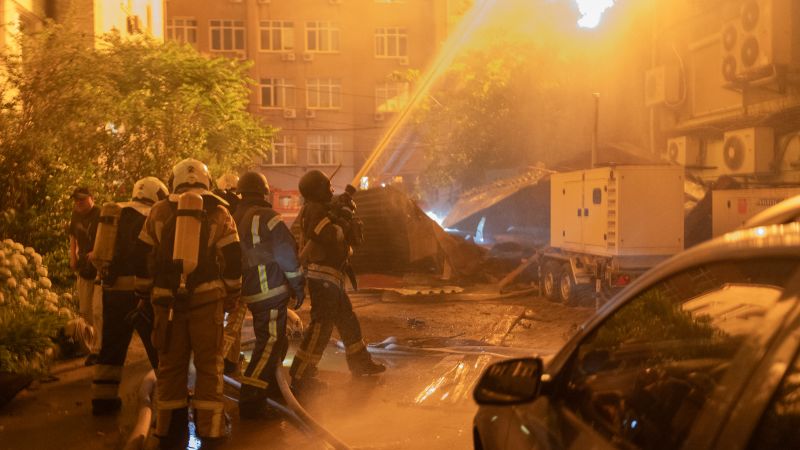
“We demand strong international responses. Not only words of condemnation but concrete action to stop Russian terror,” Ukrainian Foreign Minister Andriy Sybiha stated, as the death toll was expected to rise. The strikes left a trail of ruins, with fires consuming crumbling structures and rescuers sifting through rubble to locate survivors.
Russian Strikes Targeted Strategic Infrastructure
According to the Russian defense ministry, the attack was a “massive strike using high-precision, long-range weapons,” aimed at disrupting Ukraine’s military operations. The assault reportedly included nearly 500 drones and over 70 missiles launched from multiple directions, targeting Kyiv as well as the Dnipropetrovsk, Poltava, Cherkasy, and Chernihiv regions. However, Ukrainian officials claimed the majority of the damage was inflicted on civilian areas, particularly residential buildings, which were hit more frequently than industrial sites. President Volodymyr Zelensky highlighted the destruction, noting that over 20 locations were damaged, including an ambulance station, a research institute, and a hotel. “The attacks have targeted both military and energy infrastructure, but the impact has been felt most deeply by ordinary citizens,” he said.
Escalating Tensions and Strategic Moves
The Russian military framed the strikes as a retaliation for Ukrainian attacks on Russian civilian facilities, a claim that has been a recurring narrative in recent weeks. Ukraine’s air force described the assault as a “coordinated attack” meant to disrupt Moscow’s operations and push the war toward a decisive outcome. In the days leading up to the strike, Zelensky had urged residents to “be especially careful” and heed air-raid sirens, warning that Putin had been “preparing a massive strike against Ukraine for some time.” This warning proved prescient as the attack began overnight, catching many off guard. By midday Thursday, emergency services confirmed 20 deaths and at least 85 injuries, with two children among the casualties.
“How am I supposed to get there? There’s no power, no clothes to change into, there’s nothing,” Moskaeva said, reflecting on the challenges of returning to her normal life. Her apartment, now in ruins, serves as a grim reminder of the war’s relentless pace.
International Response and Strategic Context
As the toll of the attack mounted, Ukrainian officials called for international support to counter the Russian aggression. “Concrete action to stop Russian terror” was emphasized by Sybiha, who warned that the death count would likely climb. Meanwhile, Russia’s military continued to assert its dominance, with its defense ministry reporting the interception and destruction of 327 drones launched by Ukraine in recent days. These drones, part of a broader campaign targeting Russian energy infrastructure, have been a key component of Ukraine’s strategy to force Moscow into a defensive position. “We are striking at critical points in Russia’s infrastructure to weaken its ability to sustain the war effort,” Zelensky said, framing the strikes as a calculated move to shift the conflict’s momentum.
Damage Beyond Kyiv
The assault extended beyond Kyiv, with reports of significant damage in the Dnipropetrovsk, Poltava, Cherkasy, and Chernihiv regions. In Kstovo, a major oil refinery was hit by Ukrainian forces, while a railway bridge over the Donets River and a command post in Kharkiv were also targeted. These strikes, conducted overnight, marked another phase in the escalating battle between the two nations. The Russian military, however, insisted that its actions were defensive, aiming to counter Ukraine’s growing capabilities in the air and on the ground.
Ongoing Rescue Efforts and Civilian Impact
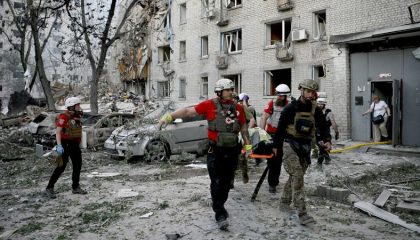
Rescuers worked relentlessly through the night to clear debris and locate survivors, with some families still trapped beneath the rubble. Klitschko noted that a 15-year-old girl and her family were among those feared missing, adding to the human cost of the attack. The destruction has left many Kyiv residents displaced, with some forced to rely on relatives for temporary shelter. “The city is in shock,” one resident said, as the community grappled with the aftermath of the strikes. The damage to residential buildings, in particular, has raised concerns about the long-term effects on civilians, with many fearing the loss of homes and livelihoods.
Context of the Conflict
As the war enters its third year, Kyiv has become a focal point for Russian military operations, with the capital’s strategic importance making it a frequent target. The latest strikes, however, have intensified the pressure on the city, testing the resilience of its residents and infrastructure. While the Russian military claims to be targeting Ukraine’s forces, the focus on civilian areas has drawn widespread condemnation. “This is not just a military campaign—it’s a war on the people,” Sybiha said, calling for urgent international intervention. The attack has also highlighted the evolving tactics of both sides, with Ukraine’s drone strikes and Russia’s high-precision weaponry shaping the conflict’s trajectory.
The ongoing bombardment has left Kyiv in a state of emergency, with officials working to restore power, clear streets, and provide aid to the affected population. As the city rebuilds, the question remains: how will the war’s impact on everyday life continue to shape Ukraine’s future? For now, the focus is on survival, with residents like Moskaeva hoping for a return to normalcy. “We are fighting for our city, our lives, and our future,” she said, her voice steady despite the chaos around her. The night of destruction has only deepened the resolve of Kyiv’s people, even as the battle for their capital rages on.