
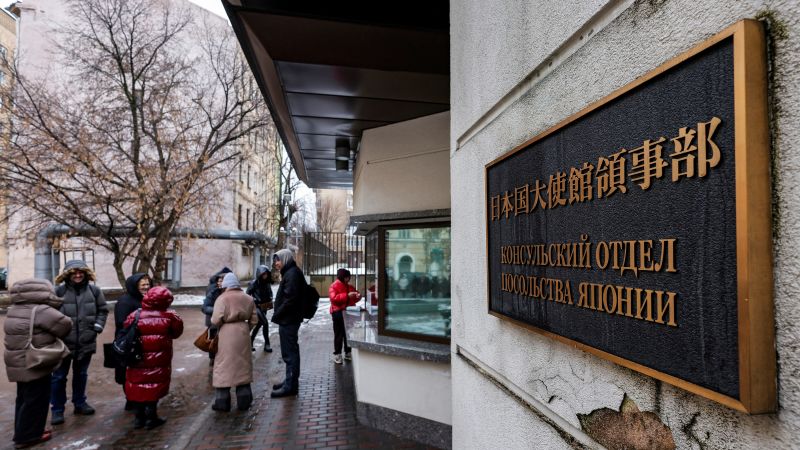
Japan Seeks Access to Journalist Held by Russia in Espionage Case
Sandego.net – Japan is pressing Russia for information and consular access after Russian authorities detained a Japanese journalist in the Sakhalin region on allegations of espionage, deepening already strained ties between the two neighboring countries.
Russia’s Foreign Ministry identified the journalist as Yuki Imai. The Federal Security Service, known as the FSB, said he worked for the Hokkaido Shimbun, a newspaper based on Japan’s northern main island. Russian authorities said he was taken into custody shortly before he was expected to depart the country, though they did not state the precise date of his arrest.
The FSB accused Imai of gathering and retaining material concerning Russia’s defense capabilities. It claimed the information had been collected for intelligence purposes and could be used in ways harmful to Russian security. The allegation has not been independently tested in court, and the Hokkaido Shimbun said it was still working to establish the details of the case.
The newspaper did not publicly confirm that its reporter was the person detained. It said the journalist’s safety was its foremost concern while it sought further clarification.
Tokyo lodges protest
Japanese Chief Cabinet Secretary Minoru Kihara said Tokyo had requested an explanation from Russian authorities and called for the Japanese national to receive fair and humane treatment.
Japan’s Foreign Ministry subsequently summoned Nikolay Nozdrev, Russia’s ambassador to Japan, to formally protest both the detention and Moscow’s public statements about the matter. Japanese officials objected to Russia issuing assertions about the case without first providing Tokyo with an explanation.
Kimitake Nakamura, director-general of the ministry’s European Affairs Bureau, also urged the ambassador to arrange a meeting with the detained journalist without delay. Such access is particularly important in a case involving a foreign citizen held on serious criminal allegations, as it enables Japanese officials to assess his welfare and discuss available consular support.
“It is true that there are many issues between Japan and Russia.”
Kihara acknowledged the difficult state of bilateral relations when asked whether Japan’s purchases of Russian liquefied natural gas and improving relations between Moscow and Washington might complicate Tokyo’s response.
“From Japan’s perspective, despite the difficult situation in Japan-Russia relations, Japan has taken resolute measures based on its position. At the same time, Russia is a neighbouring country to Japan, and communication is necessary to resolve these issues.”
Video shows arrest and court appearance
Footage broadcast on Russian state television showed three masked men wearing black uniforms handcuffing a man who was lying on the ground. An off-camera voice said the person was suspected of spying. The report then showed a man being escorted onto an aircraft by two FSB officers before appearing inside a courtroom cage in Moscow.
The Moscow court ordered the man held for almost two months while the investigation proceeds. Russian espionage cases can involve lengthy detention periods, and the case is likely to draw close attention in Japan because of the severity of the accusation and the limited public information released so far.
The detention is the most prominent case involving a foreign journalist in Russia since the arrest of Wall Street Journal reporter Evan Gershkovich in 2023. Gershkovich maintained that his arrest was an FSB operation designed to entrap him. A Russian court later convicted him of espionage and imposed a 16-year prison sentence. He was released in August 2024 as part of an East-West prisoner exchange.
Territorial dispute remains unresolved
The latest incident comes against the backdrop of a territorial dispute that has shaped relations between Tokyo and Moscow for decades. Russia and Japan have never concluded a formal peace treaty ending World War Two because they remain divided over the Kuril Islands, which Japan calls the Northern Territories.
Relations deteriorated further after Japan joined Western sanctions imposed on Russia over its war in Ukraine. Moscow has since categorized Japan as an “unfriendly” country, although commercial links have not disappeared. Japan remains a buyer of Russian liquefied natural gas, reflecting the complicated mix of security, geography and economic interests that continues to connect the two countries.
Tensions rose again in August when Russian President Vladimir Putin visited one of the disputed islands, prompting strong reaction in Japan. On Tuesday, a delegation from a Chinese province also visited the island, a development that appeared to underline closer coordination between Moscow and Beijing in their criticism of Tokyo.
Russian Foreign Ministry spokesperson Maria Zakharova said Japan had disregarded Moscow’s concerns over what she described as Tokyo’s “remilitarisation.” She also criticized what Russia characterized as the use of accredited journalists in the country to obtain information that could threaten Russian security.
“We have to note that what has occurred will become an additional factor clouding the atmosphere of Russian-Japanese relations,” Zakharova said.
For Japan, the detention creates an immediate diplomatic and humanitarian challenge while adding another source of friction to an already fragile relationship. Tokyo’s next priority is likely to be securing direct contact with the journalist and obtaining a fuller account of the allegations, while Moscow’s handling of the case will be watched closely for signs of whether the dispute broadens beyond the individual detention.
Related Reading
Frequently Asked Questions
What is Russia detains Japanese journalist on suspicion?
Russia detains Japanese journalist on suspicion is the main topic of this guide. The article explains the context, practical details, and next steps readers should understand.
Why does Russia detains Japanese journalist on suspicion matter?
Russia detains Japanese journalist on suspicion matters because readers are looking for a useful answer, not just a short summary. Good content should match search intent and help them decide what to do next.