Vehicles and Homes Set Afire Amid Anti-Immigrant Protests in Response to Belfast Knife Attack
Sandego.net – On Tuesday, anti-immigrant demonstrators took to Belfast’s streets, igniting a wave of unrest following a knife attack that left a man critically injured. The incident, which occurred on Monday night in northern Belfast, has been described as a catalyst for widespread anger, prompting protests that saw homes, vehicles, and public infrastructure targeted with flames. While the exact cause of the violence remains under investigation, local authorities have linked the outburst to the arrest of a suspect believed to be from Sudan. The man, charged with attempted murder, is under scrutiny for the attack that injured another individual, sparking debates about xenophobic tendencies and the role of social media in amplifying tensions.
Violence Escalates in Belfast and Surrounding Areas
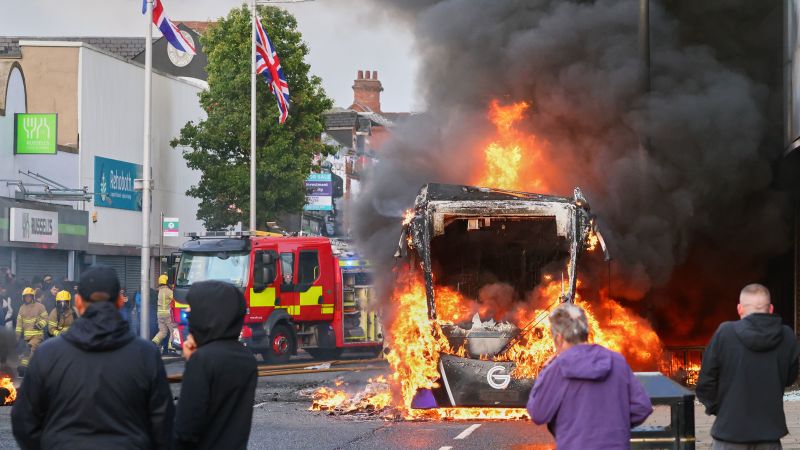
Protesters, many wearing masks, gathered in Belfast on Tuesday evening, setting multiple residences and vehicles ablaze. CNN verified footage showing flames engulfing homes in the city’s capital, with emergency vehicles and firefighters racing to contain the chaos. The scenes of destruction extended to nearby towns, including Newtown Abbey and Kilkeel, where cars were torched, according to geolocated videos. These incidents have drawn comparisons to a citywide campaign of unrest, with some describing it as a “race-based pogrom” fueled by fear and prejudice.
“Groups of masked men are burning families out of their homes in outright thuggery,” said Michelle O’Neill, the First Minister of Northern Ireland, addressing the violence on social media. Her comments highlighted the severity of the situation, as communities faced both the threat of physical harm and the erosion of trust in public spaces.
Across the UK, the unrest spread beyond Northern Ireland. Reports indicate that smaller protests emerged in cities such as Bangor, Glasgow, and London, where far-right groups clashed with law enforcement and chanted anti-immigration slogans. The presence of these demonstrations underscores a growing concern about the politicization of the incident and its potential to deepen societal divisions.
Social Media Amplifies Calls for Action
Online platforms played a pivotal role in escalating the protests, with anti-immigrant and right-wing accounts on X—formerly Twitter—spreading the attack footage and inciting action. The viral video, captured by a witness, depicted a man repeatedly striking another in the ground before being subdued by bystanders and police. The graphic nature of the clip has been cited by some as a trigger for widespread outrage, particularly among groups advocating for stricter immigration policies.
“Only by protesting REPEATEDLY and LOUDLY will there be any change!!” Elon Musk, the billionaire founder of X, tweeted while sharing content from Tommy Robinson, a controversial figure known for his anti-Muslim rhetoric and multiple criminal convictions. Musk’s endorsement of the demonstrations has drawn attention to the role of influential figures in shaping public sentiment during crises.
Keir Starmer, the UK Prime Minister, condemned the knife attack as “horrific” and “sickening,” vowing to take a firm stance against the violence. He emphasized that while the attack itself was a tragedy, the subsequent unrest risked exploiting the event to target innocent individuals. “There are dangerous attempts to use this tragedy to incite hatred and violence against people who are simply trying to live, work, and raise their families here,” Starmer stated in a post, underscoring the need for calm amid the upheaval.
Community Concerns and Calls for Peace
Belfast’s lawmakers have voiced alarm over the spread of xenophobic behavior, with Claire Hanna, a local representative, warning of a “race-based pogrom” in progress. “What you’re seeing is a race-based pogrom. We are witnessing men going door to door, demanding the removal of foreigners based solely on the color of their skin,” Hanna told BBC’s Newsnight. Her remarks reflect growing anxiety among residents about the impact of the protests on daily life and the safety of communities.
Police have acknowledged that “sporadic pockets of disorder” have erupted across Northern Ireland, with vehicles and buildings set on fire. Assistant Chief Constable Ryan Henderson of the Police Service of Northern Ireland (PSNI) urged citizens to protest peacefully, stating, “We are again appealing for calm and ask all voices of influence within local communities to encourage peaceful protest and discourage any involvement in violence or disorder.” Henderson also revealed that a 40-year-old man was seriously injured in a separate knife attack on Monday evening near Canard Avenue, though this incident appears to have been unrelated to the earlier one.
The suspect in the initial attack, a 30-year-old man from Sudan, was arrested and charged with attempted murder. According to Henderson, the individual had legally resided in Northern Ireland since entering the region in February 2023. He claimed asylum upon arrival and was granted permission to stay in the UK until 2028. At the scene of the attack, a kitchen knife was recovered, and the victim sustained severe injuries to his eyes, back, and face. Despite the suspect’s legal status, the attack has been used by critics to highlight tensions between immigrant communities and local populations.
Investigation Continues Amid Rising Tensions
As the investigation into the knife attack unfolds, police have emphasized that there is currently no evidence linking the incident to terrorism. However, the suspect’s nationality and the nature of the attack have sparked speculation about potential motivations. Henderson reiterated that the suspect remains in custody, with further details expected as the inquiry progresses. The situation has prompted calls for transparency and accountability, with leaders from across the UK condemning the violence as xenophobic in nature.
While the immediate focus remains on the physical destruction caused by the protests, there are concerns about the long-term effects on community relations. The attack in Belfast has become a symbol of broader frustrations, with some viewing it as a turning point for anti-immigrant sentiment. As social media continues to amplify voices, the challenge lies in distinguishing between legitimate protest and targeted aggression. For now, the PSNI is working to restore order, but the incident has already left a lasting mark on the region’s social fabric.
The unrest has also raised questions about the role of public figures in inciting violence. With influencers like Musk and Robinson using the footage to rally support for nationwide rallies, the line between advocacy and agitation has blurred. This has led to a call for more balanced discourse, ensuring that the protests remain focused on policy change rather than personal attacks. As communities grapple with the aftermath, the hope is that the violence will not overshadow the original incident, which remains a critical point of discussion in the UK’s ongoing debates about immigration and national identity.
Meanwhile, the victim of the knife attack remains in serious condition, serving as a reminder of the human cost of the tensions. His injuries, including damage to his eyes and severe trauma to his back and face, have underscored the brutality of the attack. As the investigation continues, the suspect’s background and legal status will be key factors in determining whether the violence was an isolated incident or part of a larger pattern. For now, the streets of Belfast and surrounding areas remain a battleground for conflicting narratives, with both supporters and critics of the protests seeking to shape the public’s understanding of the event.