Three Hours at the Kremlin: Washington’s Envoys Push for a Ukraine Ceasefire as Missiles Still Fall on Kyiv
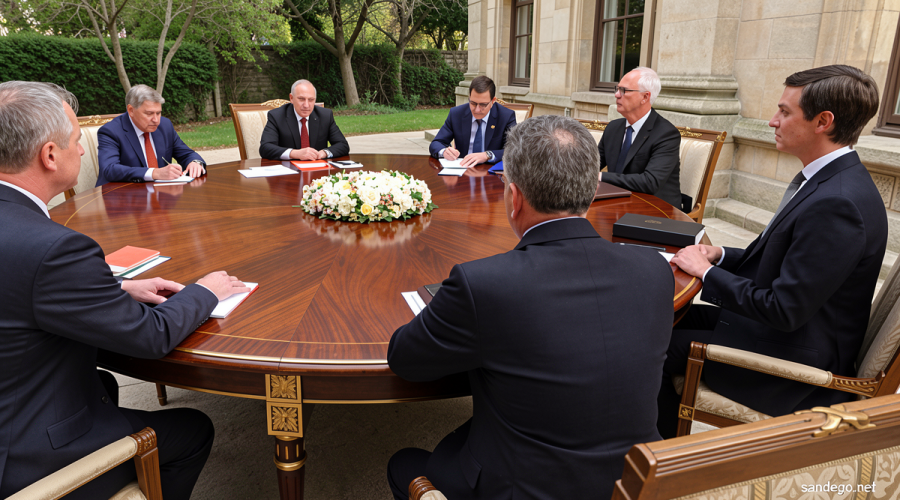
Sandego.net – On a Saturday afternoon when Russian drones and missiles were still raining over Ukrainian cities, two senior American diplomats sat across from Vladimir Putin in the Kremlin’s main negotiation chamber. The session ran for three hours, a duration that signaled both the weight of the agenda and the difficulty of the task. Steve Witkoff, President Donald Trump’s designated special envoy for Ukraine, and Jared Kushner, the president’s son-in-law and longtime political adviser, carried what the White House framed as a concrete proposal to end the war. Their visit marked the latest chapter in a series of Moscow trips the pair has made since the conflict escalated, but this time the stakes were explicitly higher: a written plan for peace was reportedly in their briefcase.
Putin Opens With Gratitude, Witkoff Closes With Warmth
The Russian president did not waste time on preamble. Addressing the American delegation as they took their seats, Putin acknowledged the complexity of the task ahead while directing a message of thanks to the man who had dispatched them.
“The situation we need to work through today is, of course, not a simple one. But before we begin doing that, I want to ask you to convey my very best wishes, and a word of gratitude, to the President of the United States, Mr. Trump.”
The tone in the room, at least as captured in Kremlin-released video, leaned toward collegiality rather than confrontation. Witkoff, in a remark that drew attention for its informality, told the Russian leader that the two sides would one day look back on these negotiations as a shared chapter of history.
“When we retire, we’ll have all these incredible stories, and incredible memories, and yours will be right at the top of it all.”
On the Russian side of the table sat Yuri Ushakov, Putin’s presidential aide who has long served as the Kremlin’s point of contact for Western diplomatic channels, and Kirill Dmitriev, head of Russia’s sovereign wealth fund and a designated special envoy. After the session wrapped, Ushakov characterized the exchange as “useful” and noted that the Americans had pledged to relay “observations and assessments they received personally from the President of Russia” when they met Ukrainian President Volodymyr Zelensky the following day. Dmitriev, posting on the social platform X, called the encounter an “important peacemaking visit,” language that Moscow rarely deploys for bilateral talks of this kind.
The Kyiv Leg: A First, and a Calculated Risk
The Moscow meeting was only the first half of a two-city diplomatic itinerary. Witkoff and Kushner were scheduled to travel to Kyiv on Sunday — their first visit to the Ukrainian capital since the war began. To smooth the way, Putin ordered a three-day suspension of Russian strikes on Kyiv timed to coincide with the delegation’s arrival, though he was careful to stress that no broader ceasefire had been agreed between the two sides.
Zelensky, for his part, signaled a reciprocal gesture. In a post on X, he confirmed he had already spoken with the American envoys on Saturday and outlined Ukraine’s willingness to mirror the pause.
“I have just spoken with the U.S. President’s envoys. They have already begun working with the Russian side today. From now through the end of Saturday, as well as on Sunday and Monday, Ukraine is ready to refrain from strikes on Moscow, and we expect the Russians to do the same regarding Kyiv.”
The Ukrainian president added that his government was “waiting for Steve Witkoff and Jared Kushner and are ready for a substantive conversation,” framing the Sunday meeting as an opportunity for what he called a real negotiation rather than a photo opportunity.
Missiles Over Airports and the SBU Headquarters
The diplomatic window opened against a backdrop of continued bombardment. Earlier on Saturday, Russian missiles struck two airports in the Kyiv region, including Boryspil, the international gateway that had handled commercial flights before the invasion. Zelensky drew a direct line between those strikes and the American delegation’s planned arrival.
“Evidently, these Russian strikes on airports are a reaction to discussions and preparations regarding the possibility of the American side using an aircraft to arrive in Ukraine.”
Since the war began, visiting foreign leaders have generally reached Kyiv by rail from Poland, a slower but less conspicuous route. Whether the airport strikes would alter the Americans’ travel plans remained unclear. The broader air-defense picture was grim: Zelensky had warned that an acute shortage of interceptor missiles left Ukraine exposed to ballistic missile salvos. On Friday, a direct hit struck the headquarters of Ukraine’s Security Service, the SBU, in central Kyiv — a symbolic and operational blow that underscored how close the fighting had come to the seat of government.
Washington’s Optimism Meets Moscow’s Caution
Back in Washington, Trump had staked out a confident posture on Friday, describing his two envoys as “great negotiators” and telling reporters they were “bringing with them a proposal to end the war.” He added, with characteristic bluntness, that “there may be a good chance we will do it.”
The Kremlin’s public messaging told a different story. Spokesman Dmitry Peskov, pressed on whether the Americans were carrying fresh ideas, pointed to Trump’s own earlier remarks suggesting no new concepts were on the table.
“Yesterday Trump himself said that there’s no talk of new ideas. That was a statement by the US president.”
Deputy Foreign Minister Sergei Ryabkov, speaking to Russian state media, reinforced the hardline framing: Moscow’s position, he insisted, remained unchanged, and any settlement had to reflect what he called “the realities on the ground,” where, in his words, “the situation is changing not in Kyiv’s favor.”
The Military Backdrop: Donetsk’s Slow Grind
Behind the diplomatic language, the battlefield continued its slow arithmetic. A string of industrial towns in eastern Donetsk Oblast faced mounting pressure as Russian units advanced incrementally over recent months, consolidating positions and extending supply lines toward the region’s remaining Ukrainian-held urban centers. Each additional settlement captured narrows the space in which a negotiated settlement could be framed on terms acceptable to Kyiv, and it tightens the window in which Washington’s proposal might still carry meaningful leverage.
The interplay between those grinding advances and the Saturday’s three-hour Kremlin session set the terms for the coming days: whether Witkoff and Kushner could translate a written proposal into a framework both capitals would accept before the front lines rendered its assumptions obsolete. The answer, as of Sunday morning, remained suspended in the gap between Moscow’s caution and Washington’s stated confidence.
Related Reading
Frequently Asked Questions
What is Putin holds talks with US mediators?
Putin holds talks with US mediators is the main topic of this guide. The article explains the context, practical details, and next steps readers should understand.
Why does Putin holds talks with US mediators matter?
Putin holds talks with US mediators matters because readers are looking for a useful answer, not just a short summary. Good content should match search intent and help them decide what to do next.