What Remains Where Gyirong Port Once Stood: A Moonscape of Debris and Unanswered Questions
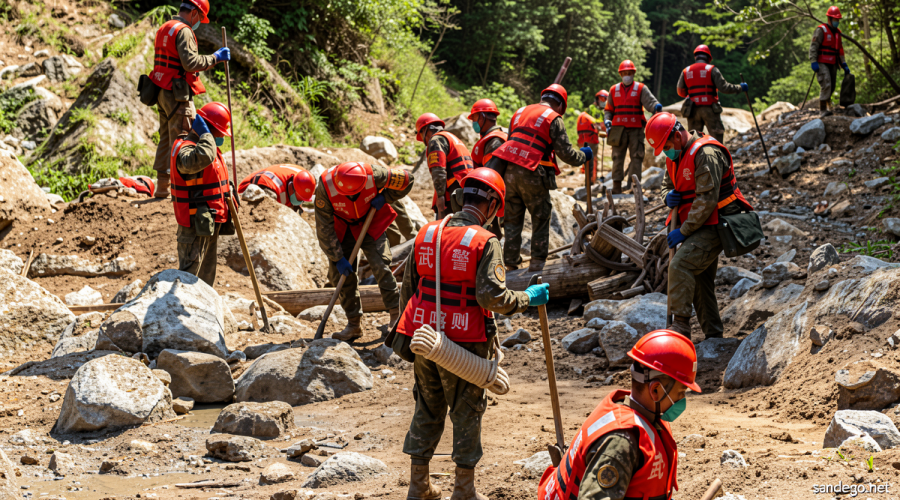
Sandego.net – Where a high-altitude border crossing once hummed with the daily traffic of traders, tourists, and commuters shuttling between two nations, there is now nothing but a jagged scar of rock, gravel, and thick sludge. Gyirong Port — the gateway linking China’s Tibet Autonomous Region to Nepal’s Rasuwa checkpoint just across the river — has been erased from the landscape. Emergency crews continue combing through the rubble, searching for bodies or signs of life in terrain that remains dangerously unstable and prone to further collapse.
The destruction came on August 26, when a massive landslide triggered a catastrophic wall of water that obliterated the port complex in seconds. Surveillance recordings captured the moment the deluge struck, showing people scrambling for survival as the flood surged through the checkpoint area. The force of the event then tore into Nepal’s side of the border, compounding the disaster across both countries. Since that day, no survivor has been recovered at the Chinese-side port.
A Checkpoint Reduced to Foundations
The five-story border inspection facility — a sprawling structure built in the imposing architectural style typical of Chinese government installations — has vanished entirely. What remains visible is only the buried skeleton of its concrete footings, half-buried in a mound of debris. Around the site, travel agencies, a supermarket, and the bridge that once spanned the river connecting the two countries have all been flattened beneath the same wall of mud and water.
Rescue worker Zhang Xiaojun described the scene to visiting journalists:
“All we could see afterward, once we started digging, was the foundation that remained. All of the structures above it had been swept away by the mudslide. It was really heartbreaking to see. So many of our fellow Chinese lost their precious lives in this disaster.”
A red-and-yellow national flag, planted in a pile of wreckage and snapping in the cold mountain wind, marked the spot where the checkpoint once stood. Heavy dust and low fog hung over the area. Dozens of rescue vehicles were staged at the site, and uniformed officials directed traffic along a road that had been entirely destroyed and then patched with loose gravel to make it passable for vehicles.
The Human Toll and the Silence of Names
Before the disaster, hundreds of people crossed the port daily in both directions. Now, families across China and abroad are left without answers. The flow of information from the Chinese side of the border has been markedly slower than updates coming out of Nepal, where rescue figures have been released more frequently.
China’s most recent official tally, issued nearly two days before the journalist visit, placed confirmed deaths at 31 and missing persons at 531 on its side of the border. Local authorities in Tibet indicated earlier in the week that more than 250 of those missing were foreign nationals. No public roster of names — neither of confirmed fatalities nor of those believed trapped or swept away — has been released by Beijing. The absence of such a list has drawn sharp criticism from grieving families and raised pointed questions about transparency in a remote disaster zone.
Beijing has pushed back against those criticisms, characterizing its information flow as open and timely. As part of that effort, roughly a dozen journalists from international news organizations were invited on a carefully arranged Sunday visit to the restricted disaster area. The trip was jointly organized by China’s Ministry of Foreign Affairs and the State Council Information Office. Participating outlets retained full editorial control over their reporting despite following an itinerary set by officials.
Reaching the Edge of the World
The visit underscored just how isolated this stretch of the Himalayan border truly is. The journey from Lhasa, the Tibetan regional capital, to Dingri — the nearest city with an airport, situated close to the Nepal frontier — covers roughly eight hours of driving through terrain that climbs to altitudes approaching 13,000 feet (nearly four kilometers). From Dingri, another six hours of travel brings visitors down to the port’s lower elevation of about 6,000 feet, along a narrow two-lane road that threads through pine-forested mountains with relentless hairpin bends. Those roads had only been cleared of debris on Wednesday, days after the initial catastrophe, illustrating how long it took for heavy equipment to reach the site.
Across both countries combined, authorities have confirmed more than 1,000 deaths from the Wednesday disaster, with thousands still unaccounted for. The Gyirong Port site, now a silent moonscape of stone and mud, stands as the most concentrated symbol of that loss — and of the unanswered questions that remain for every family waiting for news of a loved one who walked through those gates on August 26 and never walked out.
Related Reading
Frequently Asked Questions
What is On the ground in China s wiped?
On the ground in China s wiped is the main topic of this guide. The article explains the context, practical details, and next steps readers should understand.
Why does On the ground in China s wiped matter?
On the ground in China s wiped matters because readers are looking for a useful answer, not just a short summary. Good content should match search intent and help them decide what to do next.