Xi’s Expanding Purge Leaves China’s Political Elite Looking Over Their Shoulders
Sandego.net – China’s senior officials are entering a pivotal political gathering in Beijing under an atmosphere of uncertainty, as a far-reaching anti-corruption campaign continues to remove prominent figures from public life. The latest case involves Beijing deputy mayor Xia Linmao, who was recently seen meeting Walmart chief executive John Furner and other American business leaders before disappearing from public view.
His sudden absence has intensified private anxiety among Communist Party officials. The campaign has already reached former judges, intelligence figures, military officers and even personnel responsible for enforcing party discipline. Its targets have included people once viewed as politically secure or close to President Xi Jinping.
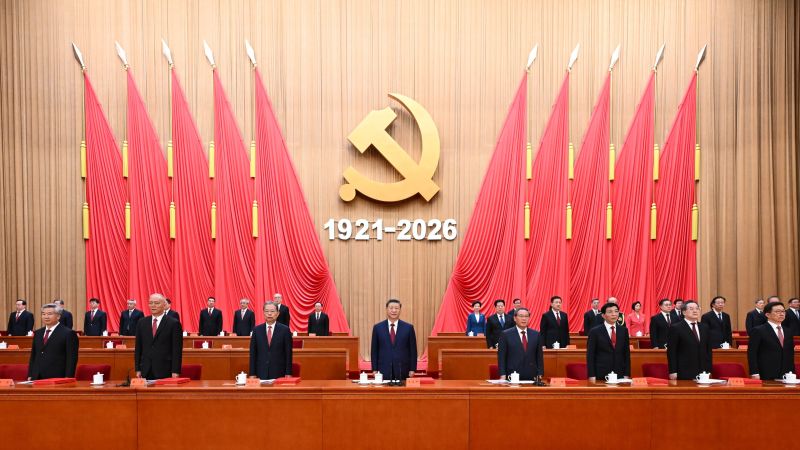
For Xi, however, the campaign has reinforced rather than weakened his position. Fourteen years after taking power, the 73-year-old leader enters this week’s closed-door meeting with more than 200 senior party figures holding authority that appears stronger than ever. The gathering is expected to endorse policies that further elevate both his leadership and the anti-corruption effort that has become a defining feature of his rule.
A meeting marked by missing officials
Attendance at the Beijing meeting is expected to be unusually low, largely because so many officials have been removed, investigated or expelled. The timing is politically significant: the session comes one year before a more consequential party leadership gathering next fall, when Xi is widely expected to seek an unprecedented fourth term.
The long campaign against alleged graft has reduced the space for competing power centers within the party. Millions of lower-level officials have been disciplined or purged since Xi first took office. More recently, the effort has moved with renewed intensity through the upper levels of the state and party system.
Official figures from the Central Commission of Discipline Inspection show that more than 500 officials at ministerial rank were investigated between 2012 and 2022. They were subsequently convicted, dismissed or expelled from the party for corruption. In the past three years alone, more than 410 officials have been purged.
Xi has portrayed the drive as essential to the party’s survival and legitimacy. In 2022, he urged officials to “turn the blade inward,” directing scrutiny toward the very people charged with upholding internal discipline. Earlier this year, he told party cadres that corruption remained a serious problem and warned of “two-faced people” within party ranks.
The war against graft would be a “never-ending struggle.”
Once-protected institutions are no longer insulated
The scale of recent removals is evident in the weakened ranks of some of China’s most powerful governing bodies. The Central Military Commission, normally composed of seven members and responsible for top-level military decision-making, now has only two members. Xi is one of them.
The Politburo, the party’s 24-member top leadership body, has also been reduced to 21 members. Such vacancies underline how deeply the campaign has cut into the political establishment ahead of a period in which Xi is expected to consolidate power further.
In the three weeks leading up to the Beijing gathering, the discipline watchdog has issued almost daily notices involving investigations, arrests and party expulsions. The steady release of announcements has created a visible reminder that no part of the bureaucracy appears beyond reach.
One case that unsettled political circles involved Huang Qifan, a former mayor of the megacity of Chongqing. Huang had built a reputation as an unusually durable political figure, serving under six Communist Party secretaries in Chongqing. Two of those leaders were later imprisoned, including a former rival of Xi.
After retirement, Huang remained highly visible, speaking frequently at conferences and appearing on television to discuss China’s economy. Following news that he was under investigation, people connected to him moved quickly to erase references to their former colleague from social media, reflecting a familiar pattern when a powerful official falls from favor.
Public visibility can vanish overnight
Xia’s case illustrates how abruptly an official’s circumstances can change. State television had shown him only days earlier attending a meeting with Furner and other US executives. As Beijing encouraged companies to deepen their business ties with the capital, Xia was shown listening and taking notes while his superior addressed the delegation.
Other officials have disappeared from public view long before authorities formally acknowledge an inquiry. Ma Xingrui, an aerospace engineer who became a senior party official and previously governed the vast western region of Xinjiang, was not seen publicly for five months before authorities announced an investigation in April.
In China’s political system, a formal corruption investigation almost always ends an official’s career. Those found guilty typically remain absent from public life even after serving prison sentences. The prospect of an inquiry therefore carries consequences far beyond a single post or administrative reshuffle.
The campaign has also become a mechanism for enforcing loyalty at a moment of major political transition. With next year’s leadership gathering approaching, the repeated removal of senior figures leaves fewer experienced officials able to form independent networks or challenge Xi’s direction.
That concentration of authority contrasts sharply with the political pressures facing elected leaders elsewhere. Xi does not face a constitutional two-term limit, and he is not confronting an imminent national election that could alter his control of government. His likely pursuit of a fourth term would extend a period of rule already longer than that of recent Chinese predecessors.
For officials attending the Beijing meeting, the central message is likely to be unmistakable. Anti-corruption enforcement remains one of Xi’s most powerful tools, and the campaign is still moving upward through the party hierarchy. In a system where public appearances can suddenly stop and longstanding connections offer little protection, the safest political position may be unquestioning alignment with the leader at the top.
Related Reading
Frequently Asked Questions
What is It can be lonely at the top?
It can be lonely at the top is the main topic of this guide. The article explains the context, practical details, and next steps readers should understand.
Why does It can be lonely at the top matter?
It can be lonely at the top matters because readers are looking for a useful answer, not just a short summary. Good content should match search intent and help them decide what to do next.