Israel’s Election Could Redefine Its Political Future
Sandego.net – Israel is holding its most consequential election in years as voters weigh the country’s security, leadership and democratic direction after a period of war and deep political division. The vote is the first nationwide election since the Hamas-led attack of October 7, 2023, which exposed Israel’s worst security failure in its history.
For many Israelis, the election is a chance to judge the government that was in power when the attack occurred and during the conflicts that followed in Gaza, Lebanon and Iran. The outcome could shape decisions on national security, military service and Israel’s place in an increasingly tense region.
Benjamin Netanyahu, Israel’s longest-serving prime minister, remains at the center of the contest. Previous elections have often focused on whether he should remain in office, but this campaign carries broader significance because it asks voters to assess the country’s course through war, social strain and growing international isolation.
Netanyahu and the Choice Facing Voters
Netanyahu’s outgoing coalition was the first Israeli government in decades to complete a full four-year term. It relied on far-right and ultra-Orthodox partners, giving nationalist and religious parties substantial influence over the government’s agenda.
His tenure has also been shaped by a corruption trial, making him the first sitting Israeli prime minister to face criminal proceedings while in office. In 2023, his government’s plans to curb the authority of the Supreme Court and other institutional checks prompted major protests across the country.
The vote is therefore about more than a contest between individual politicians. Israel is holding its most important political test of whether the country will continue on a more conservative, religious and nationalist path or move toward a different governing coalition.
How Israel’s Parliamentary Election Works
Israeli voters choose party lists rather than directly electing a prime minister. The 120-seat Knesset is selected through proportional representation, a system that gives space to Israel’s many political, religious, ethnic and national communities but regularly produces fragmented parliaments.
Parties must win at least 3.25% of the vote to enter the Knesset. Thirty-six parties were competing, though polling suggested that only about 11 to 13 could clear that threshold. Support for smaller parties can be especially important because votes for lists that fail to qualify do not produce parliamentary seats.
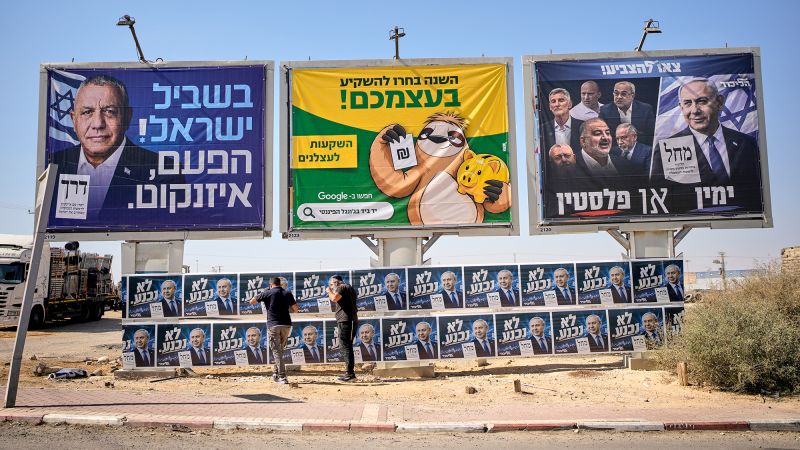
The largest parties are Netanyahu’s right-wing Likud and Yashar, a new centrist party led by former military chief of staff Gadi Eisenkot. Eisenkot has become Netanyahu’s principal challenger in a campaign dominated by questions of security and political responsibility.
Polls have painted conflicting pictures. A Channel 12 survey put Yashar at 23 seats and Likud at 21, while a Channel 14 poll projected Likud at 30 seats and Eisenkot’s party at about 20. In surveys asking who would be better suited to serve as prime minister, Eisenkot has consistently led Netanyahu.
Coalition Talks May Decide the Result
Winning the most seats does not guarantee the premiership. No Israeli party has ever secured the 61 Knesset seats needed for a majority on its own, meaning the decisive struggle usually begins after election day.
Most surveys placed Netanyahu’s potential bloc at between 49 and 55 seats. It includes Likud, the two far-right parties led by Bezalel Smotrich and Itamar Ben-Gvir, and two ultra-Orthodox parties. Even at the top of that range, the bloc would remain short of a governing majority.
That makes negotiations crucial. Smaller parties could determine whether Netanyahu can remain in power, whether Eisenkot can build an alternative coalition, or whether Israel faces another prolonged period of political deadlock.
Frequently Asked Questions
Why is this election so important?
It is the first national election since the October 7 attack and the conflicts that followed. Voters are deciding who should lead Israel through continuing regional tensions and how responsibility for the country’s security failures should be judged.
Do Israelis vote directly for prime minister?
No. Israelis vote for political parties, which receive Knesset seats according to their share of the vote. The president then gives a candidate the opportunity to try to form a coalition supported by at least 61 lawmakers.
What could delay the formation of a new government?
A closely divided Knesset could make coalition negotiations difficult. If no leader can assemble a majority, the political process may be extended and could leave Israel facing renewed uncertainty over its next government.