
New DNA Study Clarifies Thomas Jefferson’s Link to Sally Hemings’ Children
Sandego.net – DNA evidence from Thomas Jefferson has given researchers their clearest genetic picture yet of his relationship with Sally Hemings, an enslaved woman in his household. A new analysis of historic hair samples and DNA from living descendants estimates a 99.96% likelihood that Jefferson fathered at least one of Hemings’ children.
The research combines more than a decade of work to recover damaged DNA from historic material and compare it with several branches of the Jefferson and Hemings family trees. The findings are discussed in History by a Hair: Thomas Jefferson, Sally Hemings & Solving a 200-Year-Old Mystery, by Smithsonian distinguished scholar and ambassador-at-large Richard Kurin.
Kurin is also the senior author of a methods paper posted on the bioRxiv preprint platform. Because the paper had not yet undergone peer review, its methods and conclusions remain open to further scientific scrutiny.
A Hair Found in Jefferson’s Bible Was Not His
The investigation began in 2011 when staff at the Smithsonian National Museum of American History opened a Bible once owned by Jefferson and found a reddish-blond hair between its pages. Researchers initially hoped the sample could provide a direct genetic connection to Jefferson.
They tested the hair’s mitochondrial DNA against DNA from a living woman descended from Jefferson’s mother through the maternal line. Since mitochondrial DNA passes through mothers, a match would have been expected if the hair belonged to Jefferson.
The samples did not match. That result ruled out the Bible hair as a usable Jefferson sample, but it did not end the broader effort to examine the historical question through genetics.
Historic Hair and Living Descendants
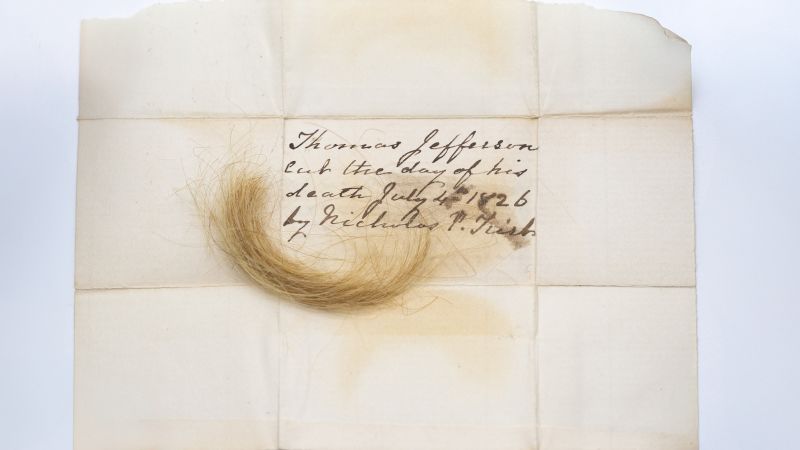
Researchers later examined other hairs attributed to Jefferson, including a lock reportedly cut at his deathbed. The Thomas Jefferson Foundation at Monticello supplied the packet containing those samples, which had not previously been available for genetic analysis.
Using the historic material, the team reconstructed genome sequences and compared them with DNA from 16 living people across relevant family lines. The group included descendants of Jefferson and his wife Martha, descendants of Jefferson’s brother Randolph, and descendants of two of Hemings’ sons, Eston and Madison.
Hemings had four children who survived to adulthood. Eston and Madison were the two sons who identified Jefferson as their father, making their descendants especially important to the analysis.
“What made this study so powerful is that researchers weren’t just comparing two genomes,” said Éadaoin Harney, a senior population geneticist at the 23andMe Research Institute. “Instead, they collected DNA samples from multiple people from different branches of the family tree.”
This broader approach is central to the new DNA evidence from Thomas Jefferson. Instead of relying on a narrow paternal marker, researchers evaluated genetic relationships across larger portions of the genome and against several connected family branches.
How the New Findings Differ From the 1998 Study
The research builds on a widely discussed 1998 study led by the late Eugene Foster, a retired pathology professor at Tufts University and the University of Virginia. That work found a rare Y-chromosome haplotype shared by male descendants of Thomas Jefferson’s uncle and descendants of Hemings.
The earlier study strongly supported a connection between Hemings’ descendants and a male member of the Jefferson family. However, it could not distinguish Thomas Jefferson from other men in the extended Jefferson line because it lacked a sample directly associated with him.
The newer analysis seeks to address that limitation by incorporating historic hair samples and a wider set of living relatives. Taken together, the DNA evidence from Thomas Jefferson provides far more specific support for the conclusion that he fathered at least one of Hemings’ children.
Frequently Asked Questions
What does the new DNA research conclude?
The analysis estimates a 99.96% likelihood that Thomas Jefferson fathered at least one child with Sally Hemings. It draws on DNA reconstructed from historic hair samples and comparisons with multiple living descendants.
Did the hair found in Jefferson’s Bible belong to him?
No. Testing showed that the Bible hair did not share the expected mitochondrial DNA connection with a living maternal-line descendant of Jefferson.
Why is this study considered more detailed than earlier research?
Earlier genetic work linked Hemings’ descendants to the wider Jefferson male line. The new study used a broader genomic comparison across several family branches, helping researchers assess where that connection most likely fits in the family tree.
Has the research been peer reviewed?
The methods paper was posted on bioRxiv as a preprint, meaning it had not yet undergone peer review at the time it was published.