China’s Chang’e-7 Lunar Probe Slips Past Its Launch Window as South Pole Water Hunt Faces Uncertainty
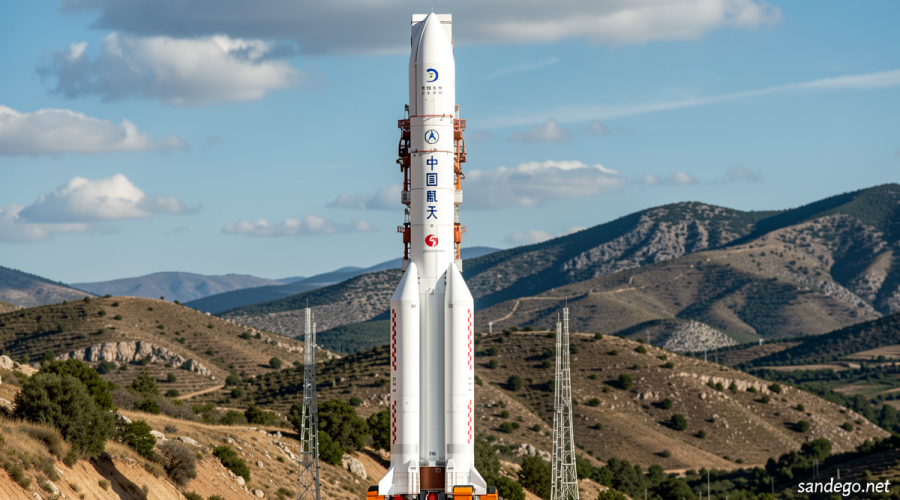
Sandego.net – The robotic spacecraft that was set to become the first mission ever to drill directly into the Moon’s surface in search of water ice will not fly this year. China’s Manned Space Engineering Office confirmed through state media channels that the Chang’e-7 probe “does not meet launch conditions” and that the postponement followed an internal review guided by “the principle of prudence, reliability and absolute mission success.” No further technical explanation was offered, and no new target date has been announced.
The probe had been poised for liftoff as early as Sunday evening or Monday morning Beijing time, making the cancellation a sudden interruption to what was already one of the most closely watched launches of the year. The precise engineering cause behind the scrub remains undisclosed, leaving analysts and space agencies on both sides of the Pacific to speculate about whether the issue involves a sensor malfunction, a thermal anomaly, or a broader systems check that failed to clear.
A Race for Frozen Water at the Lunar South Pole
The delay lands at a particularly tense moment in the broader competition between Washington and Beijing over the Moon’s southern hemisphere. Both nations view the permanently shadowed craters near the south pole as the single most strategically important real estate in cislunar space, because those dark, cold pockets are believed to harbor vast deposits of water ice. That frozen resource is not merely scientific curiosity: it can be split into oxygen and hydrogen, yielding breathable air, potable water, and rocket propellant for missions venturing beyond low-Earth orbit.
Until now, no spacecraft has actually touched the lunar surface and sampled that ice in situ. The United States has used orbiting satellites to detect spectral signatures of water and to estimate the volume of deposits, but it has never successfully deployed a lander equipped to drill into the regolith and bring back a physical sample. Chang’e-7 was designed to close that gap, carrying instruments capable of penetrating the surface and analyzing the composition of subsurface material.
The competitive stakes were sharpened in 2025 when Intuitive Machines, a Texas-based company, sent a water-hunting drill to the south pole. The spacecraft tripped during its descent onto the notoriously rugged, boulder-strewn terrain and was unable to complete its science objectives. That near-miss underscored just how unforgiving the landing environment remains, and it raised questions about whether any crewed or robotic mission can reliably reach the target sites.
Washington’s Counter-Moves
The postponement of Chang’e-7 effectively resets the clock on one chapter of what US officials have called the lunar standoff. Within roughly the next twelve months, several American spacecraft are scheduled to head toward the same polar region that the Chinese probe targets.
Astrobotic Technologies, headquartered in Pittsburgh, is preparing its Griffin lander for a south-pole insertion as soon as late 2026. Separately, Jeff Bezos’s Blue Origin has outlined plans to deliver up to two robotic landers to the Moon next year. One of those vehicles may carry the VIPER rover, a prospecting robot specifically engineered by NASA to traverse polar terrain, drill shallow samples, and characterize water-ice distribution at the surface.
The convergence of multiple US assets on the same coordinates within a single year means that, even with Chang’e-7 delayed, the window for first-contact science at the south pole remains tightly contested. Whichever nation’s probe touches down first and returns usable data will set the narrative for the next decade of lunar operations.
What the Ice Actually Means
The assumption that the south pole holds enough water to sustain a permanent human presence is still, strictly speaking, unproven. James Head, a professor emeritus at Brown University who worked on NASA’s Apollo lunar program, cautioned that the presence of water ice in quantities large enough to support life-support or propellant operations “is not currently known.” He added that Chang’e-7 could help make
“important progress on this question, sharpening and focusing experiments for further exploration and testing.”
In other words, the mission’s value lies not only in confirming or denying the existence of exploitable ice, but in calibrating the instruments and methodologies that future, larger-scale operations will depend on. Every gram of sample returned, every spectral reading taken at the surface, narrows the uncertainty that currently surrounds polar resource estimates.
From Exploration to Extraction
Yuqi Qian, a lunar geologist at the University of Hong Kong, framed the Chang’e-7 program as a structural pivot in China’s lunar strategy:
“You can see that for China and other countries, we are evolving from exploring the moon and using Earth’s resources to a more sustainable lunar exploration using lunar resources.”
He described the shift as a move “from an exploration program to a resource utilization program,” signaling that Beijing now views the Moon not merely as a destination for scientific instruments but as a potential supply depot for deeper-space ambitions, including crewed transit to Mars and beyond.
For readers tracking the broader architecture of lunar competition, the delay does not erase the strategic calculus. It compresses the timeline. The United States still has multiple vehicles in the pipeline, China still has its probe on the pad, and the south pole’s shadowed craters still hold their secrets. The question is no longer whether the race will happen; it is which flag will plant its instruments in the ice first, and what that first sample will reveal about whether the Moon can sustain the next generation of explorers.
Related Reading
Frequently Asked Questions
What is China postpones launch of unprecedented water?
China postpones launch of unprecedented water is the main topic of this guide. The article explains the context, practical details, and next steps readers should understand.
Why does China postpones launch of unprecedented water matter?
China postpones launch of unprecedented water matters because readers are looking for a useful answer, not just a short summary. Good content should match search intent and help them decide what to do next.