South Carolina’s Black Electorate Becomes the New Battleground as Buttigieg Tests a Second Presidential Bid
Sandego.net – The Democratic National Committee’s August 15 decision to retain South Carolina as the site of the nation’s first presidential primary has quietly reshaped the political geography of the 2028 race. By anchoring the nominating process to a state where roughly 55 percent of registered voters are Black, the party has handed enormous leverage to a constituency that has historically been courted late and inadequately by white candidates. That calculus now frames every visit, every speech, and every calculated silence by prospective nominees who understand that winning the Palmetto State’s Black electorate is no longer optional — it is the gate.
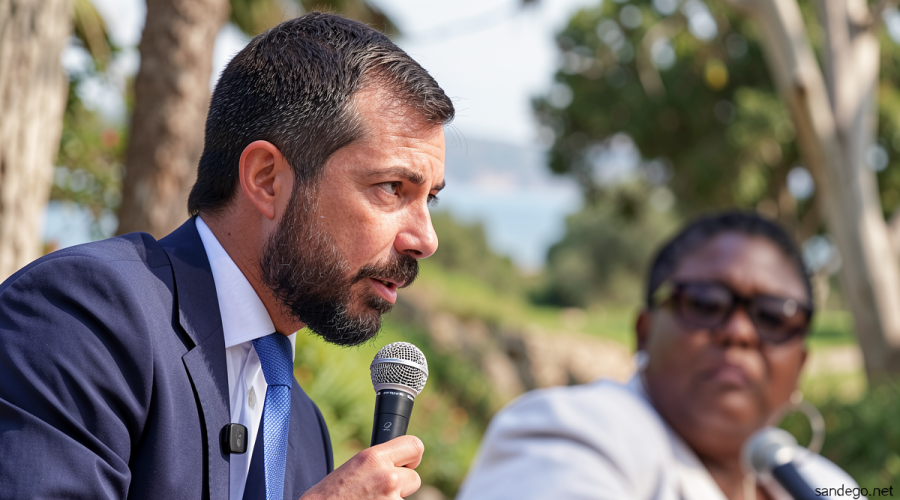
Pete Buttigieg walked through that gate this weekend in Florence, a small city in South Carolina’s Midlands that carries the weight of Orangeburg’s civil rights history just a short drive away. The former mayor of South Bend, Indiana, and former transportation secretary under President Joe Biden, arrived as a private citizen with no official title and no campaign infrastructure, yet with unmistakable intent. His weekend itinerary — a morning address to party activists, a roundtable with students at a historically Black college, and an evening appearance before the local NAACP branch — was designed to signal that he is rebuilding relationships he failed to establish during his 2020 run.
A Message Aimed at Redistricting and Democratic Erosion
In his opening remarks to activists in Florence, Buttigieg framed the current Republican agenda not as a series of isolated policy choices but as a coordinated assault on Black political power. He pointed to gerrymandering and district-line manipulation as tools in what he called:
“the culmination of a generational project to dismantle Black representation.”
The evening speech carried a sharper historical edge. Speaking to the NAACP branch, Buttigieg drew a direct parallel between the turbulence of President Donald Trump’s second term and the civil rights confrontations that erupted in Orangeburg during the 1960s. He told the audience that the present moment should not be mistaken for something unprecedented:
“The mid-2020s does not represent our nation’s first experience with corruption and self-dealing, with bigotry and exclusion, with inequality and injustice, with undemocratic behavior or with political violence.”
He stressed that those earlier struggles unfolded
“not on some distant shore, but in places like Orangeburg.”
Economics Versus Democracy: An Internal Party Argument
With the November 2026 midterm approaching and both parties locked into cost-of-living messaging, Buttigieg used the Florence stage to press a point of disagreement within his own party. He criticized fellow Democrats who, in his view, treat economic anxiety as the sole lens through which voters should evaluate governance, sidelining deeper questions about democratic integrity. Invoking the legacy of Martin Luther King Jr. and Rev. Jesse Jackson, he insisted that Americans
“can — and we must — do both.”
The remark landed in a context where South Carolina voters face grocery prices, energy costs, and housing pressures that make purely ideological appeals difficult. Buttigieg’s challenge is to thread that needle: validate material hardship while arguing that democratic backsliding demands a parallel, non-negotiable response.
The 2020 Wound and the Question of Credibility
Any assessment of Buttigieg’s current appeal must reckon with what happened here four years ago. His campaign, which had surged through the Iowa caucuses on a predominantly white demographic, collapsed in South Carolina. After Rep. Jim Clyburn — a towering figure in state Black politics — endorsed Joe Biden, Buttigieg finished fourth in the primary and withdrew the following day. Exit polls showed Biden capturing 61 percent of Black voters in the state while Buttigieg received just 3 percent. That gap remains the central obstacle to his current overture.
Marlon Kimpson, a Black former state senator who backed Biden in the 2020 primary, offered a measured assessment of the changed landscape. Speaking after the weekend events, Kimpson noted:
“The Pete Buttigieg of 2020 is not the Pete Buttigieg of 2026. He has name recognition, he’s no longer introducing himself. I think people generally like Pete, and that’s a big deal in an open race because he starts out at a plus. But as we look at his economic agenda, just for the average South Carolinian, with emphasis on the African American community … and the political infrastructure he has deployed in our state, there will be questions with respect to those issues.”
The distinction matters. Name recognition and personal likability are assets, but they do not substitute for a concrete economic platform calibrated to working-class Black households in the Midlands, nor for a sustained organizational presence between campaign cycles.
Signals of a New Phase
Buttigieg’s Florence weekend was his first major trip to South Carolina since departing the Biden administration. The timing — weeks after the DNC locked in the primary sequence — was not accidental. It marked the opening move of what appears to be a deliberate, multi-year effort to cultivate the Black electorate before any formal campaign machinery exists. At the roundtable with HBCU students, he discussed a reparations framework for slavery, a topic that resonates deeply in a state where the legacy of forced labor still shapes wealth gaps, homeownership rates, and intergenerational mobility.
The crowd itself sent mixed signals. Homemade signs reading “PETE” and “2028” appeared as he took the stage. One attendee, 64-year-old retiree Karen Ench, wore a shirt declaring “Pete Buttigieg 2028.” Afterward, she described the candidate as
“really taking it much more serious”
and focused on areas of improvement from his first run. Surveying the room, Buttigieg quipped that he should
“come here more often.”
When pressed by reporters on whether he would formally enter the 2028 race, he deflected, saying he is
“totally focused on 2026.”
The deflection was itself a signal. In the politics of South Carolina’s Black electorate, absence is read as indifference, and indifference is remembered. That lesson is precisely what the weekend was built to correct.
Competing Voices and the Road Ahead
The visit did not go unchallenged. On Sunday, Izzy Gardon, spokesperson for California Governor Gavin Newsom — another potential 2028 contender — posted a pointed remark on X: “First time in SC in 3 years? Nice!” The sarcasm underscored a real strategic question: how much ground can a candidate build in a single weekend, and how much does the three-year gap cost in trust?
For South Carolina’s Black voters, the answer will not come from one Florence speech or one reparations roundtable. It will come from whether the economic agenda Buttigieg eventually articulates speaks to the daily arithmetic of a household in Florence, Orangeburg, or Columbia — and from whether the political infrastructure he deploys in the state outlasts the news cycle. The DNC’s decision to keep the first primary here has made that accountability structural, not optional. The electorate that shaped the outcome of 2020 now holds the first ballot of 2028, and every candidate who ignores that fact repeats the arithmetic that ended a campaign in a single night four years ago.
Related Reading
Frequently Asked Questions
What is Pete Buttigieg returns to first?
Pete Buttigieg returns to first is the main topic of this guide. The article explains the context, practical details, and next steps readers should understand.
Why does Pete Buttigieg returns to first matter?
Pete Buttigieg returns to first matters because readers are looking for a useful answer, not just a short summary. Good content should match search intent and help them decide what to do next.