How Roasted Meats Went Spinning Across Cultures
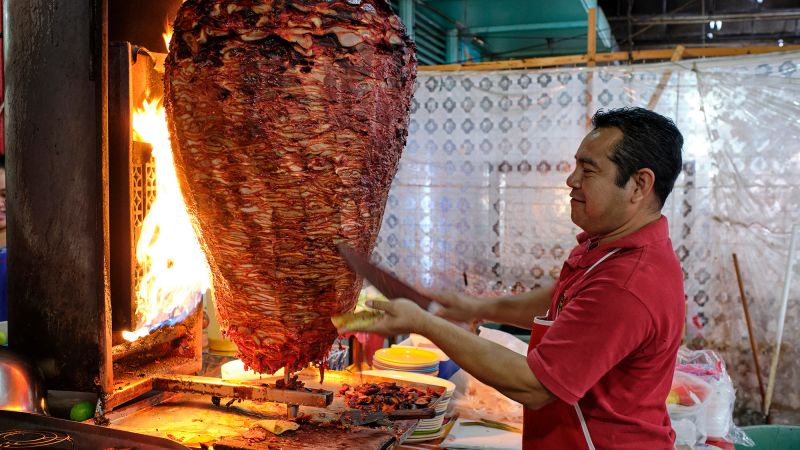
Sandego.net – The global popularity of spit-roasted meats, from the vibrant street carts of Mexico City to the bustling markets of Istanbul, traces its roots to ancient traditions that have evolved over millennia. One modern example of this enduring culinary art is Raul Morales, the owner of Taqueria Vista Hermosa in Los Angeles, whose family has preserved the al pastor taco recipe for generations. While Morales may be best known for his culinary expertise, his nickname—“Chef Al Pastor”—is a testament to a cooking method that has transcended borders and eras, embodying a blend of history, culture, and innovation.
The Ancient Roots of Rotating Roasts
Long before the term “al pastor” became synonymous with Mexican street food, the concept of roasting meat on a spinning spit was a staple of early human societies. Food historian Ken Albala, a professor at the University of the Pacific, argues that this technique is among humanity’s most primal culinary practices. Evidence of such methods dates back thousands of years, with iron spits appearing in the Aegean region as early as the 10th century BCE. These tools were not merely for cooking but also for social rituals, as noted by Susan Sherratt, an emeritus professor of East Mediterranean archaeology at the University of Sheffield. In ancient tombs associated with male warriors, spits were found alongside other instruments, suggesting that roasting meat was a communal activity tied to masculinity and the celebration of victories.
“When you celebrated a victory, you would go out and sacrifice an animal to the gods, which would basically be like a big barbecue,” Albala explained.
The Homeric epics, such as *The Iliad* and *The Odyssey*, also reference spit-roasted meals, hinting at their significance in early Greek culture. While these texts don’t specify the exact method, they imply that roasting meat was a central part of feasts, often involving whole animals or large cuts. The process was not simply about heat; it required precision and patience. Albala emphasizes that roasting meat beside the fire, rather than directly over it, allows for a more complex interplay of flavors, as the juices drip down and infuse the surrounding ingredients. This technique, he suggests, was likely refined by early cooks who experimented with different meats and spices to enhance the final dish.
Ottoman Innovations and the Birth of Shawarma
The evolution of spit-roasted meats took a pivotal turn in the Ottoman Empire, where a more specialized approach emerged. Mary Işın, author of *Bountiful Empire: A History of Ottoman Cuisine*, points to 16th-century miniature paintings in a 1620 manuscript commissioned by Ottoman statesman Hafız Ahmed Paşa. These images depict cooks slicing meat from rotating spits, suggesting that the dish was not only a staple of the empire but also a symbol of sophistication. Işın speculates that these meals were served at royal gatherings, reflecting the wealth and cultural exchange of the time.
“In those miniatures, you can see it’s an upper-class thing,” Işın noted.
While the paintings don’t specify the name of the dish, historical texts from the 15th century reveal that it was referred to as *çevirme kebabı*, or “turned kebabs.” This technique involved layering thin slices of raw meat onto a spit, creating a dense, tapered stack that could be continuously rotated for even cooking. Over time, the method spread across the empire, which at its peak stretched from central Europe to North Africa and the Arabian Peninsula. The term *çevirme* eventually entered Arabic as *shawarma*, a word that now evokes the Middle Eastern dish still cherished today. Meanwhile, in Turkey, the term *döner*—meaning “to turn”—became the dominant label, though it wasn’t widely documented until 1908, when it appeared in a novel by Hüseyin Rahmi Gürpinar.
The distinction between *çevirme* and *döner* is more than linguistic. As Işın explains, both terms describe the act of rotating meat, but the process itself has adapted to local tastes and resources. In some regions, the spit-roasted meat is skewered in a way that emphasizes texture and flavor, while in others, it’s combined with different ingredients to suit regional preferences. This flexibility has allowed the dish to remain relevant, even as it transformed from a royal delicacy to a globally accessible street food.
The Global Journey of a Timeless Technique
As trade routes expanded and populations migrated, the art of spit-roasting followed. Morales, whose family has been crafting al pastor tacos for three generations, represents this modern iteration of an ancient practice. His recipe, passed down through his ancestors, is a blend of traditional methods and contemporary adjustments. The use of fresh tortillas and seasoned pork shaved from a vertical spit is a hallmark of his work, yet the technique itself is far older than the taco itself. Morales’ story, while rooted in Mexico, is part of a broader narrative that spans continents and centuries.
Similarly, the spread of shawarma and döner reflects the movement of people and ideas. In the Ottoman Empire, the method was adapted to include lamb and beef, often marinated in a mix of spices that gave the meat its distinctive flavor. As the dish migrated to new regions, it incorporated local ingredients, from the lamb and herbs of the Middle East to the pork and chilies of Mexico. This cross-cultural exchange highlights how a single cooking method can take on diverse identities while retaining its core essence.
The cultural significance of spit-roasted meats is also evident in their association with communal dining. Whether in ancient feasts or modern food trucks, the act of sharing a meal cooked on a rotating spit fosters a sense of togetherness. Morales, for instance, often finds himself surrounded by fans who recognize his work, a phenomenon that mirrors the social dynamics of historical roasting events. These gatherings, whether in a bustling market or a royal courtyard, have always been about more than food—they are about tradition, innovation, and the human desire to connect over shared flavors.
Today, the global popularity of these dishes underscores their adaptability. From the richly seasoned al pastor tacos of Mexico to the aromatic shawarma of the Middle East, each version carries a unique story while honoring the ancient technique that brought them to life. As the world continues to embrace these culinary traditions, the spinning spit remains a symbol of the enduring link between past and present, local and global, simplicity and complexity.
Conclusion: A Culinary Legacy in Motion
Spit-roasted meats are more than a method of cooking—they are a bridge between ancient practices and modern innovation. The journey of these dishes, from the iron spits of the Aegean to the vibrant stalls of Istanbul and Los Angeles, illustrates how culture shapes food and how food, in turn, shapes culture. As the techniques continue to evolve, they remain a testament to humanity’s shared history and the timeless appeal of flavors that are both familiar and transformative.