
Trump’s drive for political revenge faces a key test in Saturday’s Louisiana Senate primary
Trump’s drive for political revenge faces a key test in Saturday’s Louisiana Senate primary
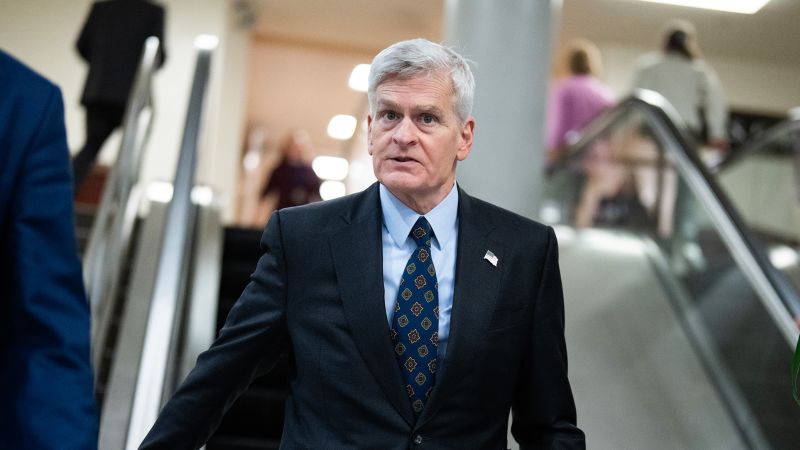
Trump s drive for political revenge – As the political landscape shifts, President Donald Trump’s strategy to reclaim influence within the Republican Party is being put to the test in Louisiana’s Senate primary on Saturday. The race pits his favored candidate, Rep. Julia Letlow, against long-standing Senator Bill Cassidy, who has been a vocal critic of Trump’s actions. This contest is significant not only for its potential to reshape the Senate but also for its implications on Trump’s ability to challenge fellow Republicans who have diverged from his agenda.
Trump’s backing of Letlow has been central to his campaign efforts, but the race is far from straightforward. A second contender, Louisiana State Treasurer John Fleming, has emerged as a formidable rival, injecting uncertainty into the outcome. Fleming, a former congressman with deep roots in state politics, has positioned himself as a more Trump-aligned candidate, which has increased the likelihood of a June 27 runoff if no one secures a majority of votes. This scenario marks a critical moment for Trump, who aims to demonstrate his capacity to unseat colleagues who have crossed him.
The Louisiana primary is set against a backdrop of heightened political stakes. With the election three days before Trump’s showdown against Kentucky Rep. Thomas Massie in another GOP primary, the result here could influence the broader narrative of his re-election bid. For Trump, winning a Senate seat would be a notable achievement, as he has yet to secure a Senate victory in a primary race. This comes after some of his Senate allies chose not to seek reelection to avoid direct confrontation with him, highlighting the internal divisions within the party.
Bill Cassidy, a Republican senator from a reliably red state, has historically supported Trump. However, his decision to vote for Trump’s impeachment in 2022 has placed him in a precarious position. The senator represents a state that backed Trump by 22 percentage points in the 2024 election, yet his recent actions have created friction with the president. As chairman of the Senate Health, Education, Labor, and Pensions Committee, Cassidy has been involved in debates over the administration’s healthcare policies. While he approved the confirmation of Trump’s health secretary, Robert F. Kennedy Jr., he has publicly disagreed with the broader “Make America Healthy Again” agenda, particularly after Trump withdrew his nominee for surgeon general, Casey Means.
Despite his financial edge in the primary, Cassidy has faced pressure from Trump’s base. His campaign has focused on attacking Julia Letlow, who is a relatively new figure in Louisiana politics. Letlow’s background in higher education and her advocacy for diversity, equity, and inclusion initiatives have become points of contention, especially in a party where such themes are increasingly viewed with skepticism. Meanwhile, Fleming has capitalized on this dynamic, positioning himself as a defender of traditional Republican values and a stronger alternative to Letlow.
As the race enters its final stretch, the competition has intensified. Both Letlow and Fleming are vying for the support of voters who may have previously leaned toward Cassidy. Fleming’s campaign has emphasized his close ties to Trump, particularly his role in the White House during Trump’s first term. Letlow, on the other hand, has countered with a focus on her policy record and the importance of unity in Congress. The two challengers are now locked in a battle that could determine the future of the Senate.
The primary is also occurring under unusual circumstances. Louisiana’s Republican Party has implemented a new closed primary system, which requires unaffiliated voters—many of whom are key supporters of Cassidy—to complete additional paperwork to participate. This change, coupled with the recent decision by Republican Governor Jeff Landry to delay House primaries while keeping the Senate race on schedule, has sparked controversy. Landry’s move was a response to a Supreme Court ruling on redistricting, but critics argue it has created an uneven playing field for the Senate contest.
Cassidy’s campaign manager, Katie Larkin, has accused Landry of orchestrating a “intentionally difficult process” for voters. She stated, “The Governor closed the primary and continuously meddled in this election to support Julia Letlow,” suggesting that the governor’s actions were aimed at bolstering Letlow’s chances. Landry’s office has not yet commented on the accusation, but in a recent Fox Business interview, he expressed confidence in Letlow’s ability to succeed. “Julia Letlow will finish strong,” he said, highlighting his belief in her campaign’s momentum.
The election’s outcome will have ripple effects beyond Louisiana. It serves as a microcosm of the challenges Trump faces in uniting the Republican base while targeting opponents who have questioned his leadership. If Letlow emerges victorious, it will mark another step in Trump’s strategy to consolidate power within the party. However, if Cassidy retains his seat, it will underscore the resilience of centrist Republicans in the face of Trump’s aggressive tactics.
Trump’s endorsement of Letlow has been a consistent theme in his recent political maneuvers. In a social media post aimed at energizing his base, he praised Letlow as “a winner who will NEVER let you down.” He further criticized Cassidy, claiming, “is a disloyal disaster. His entire past campaign for the Senate was about ‘TRUMP.’” These statements reflect Trump’s desire to frame the race as a test of loyalty to his vision, rather than a simple contest of policies or experience.
Meanwhile, Cassidy has attempted to balance his relationship with Trump while maintaining his credibility as a moderate. In a Friday interview on CNN’s “Situation Room,” he defended his position, stating, “I’m not claiming the president loves me — no — but you can work with people even if you don’t love each other if you’ve got a common goal.” His argument centers on the idea that bipartisan cooperation is still possible, even in the shadow of impeachment. This perspective has resonated with some voters, but it has also drawn criticism from those who see it as a calculated effort to distance himself from the fallout of his vote against Trump.
As the Saturday election approaches, the battle for Louisiana’s Senate seat has become a pivotal moment for Trump’s political ambitions. The race not only highlights his ability to influence internal party dynamics but also reveals the growing challenges he faces in maintaining unity. The outcome will be closely watched as a barometer for the broader Republican strategy in the 2026 midterm elections, where the balance of power in Congress could shift dramatically. For now, the focus remains on Saturday, when the final votes will be cast in a race that could shape the future of American politics.
