Trump’s World Cup Ambitions Clash with Political Turmoil
Sandego.net – When the United States secured the right to co-host the 2026 FIFA World Cup finals, Donald Trump initially expressed disappointment, joking in 2018 that he would not be present due to term limits. Yet, his remarkable political resurgence—a rare feat in modern American history—has granted him an extended opportunity to engage with the global stage. The former president, known for his love of grand gestures, has leveraged this chance to reassert his presence in international affairs, even as tensions within his administration have grown. This juxtaposition of personal ambition and political controversy highlights the complexities of hosting the world’s most prestigious soccer tournament during a time of heightened global discord.
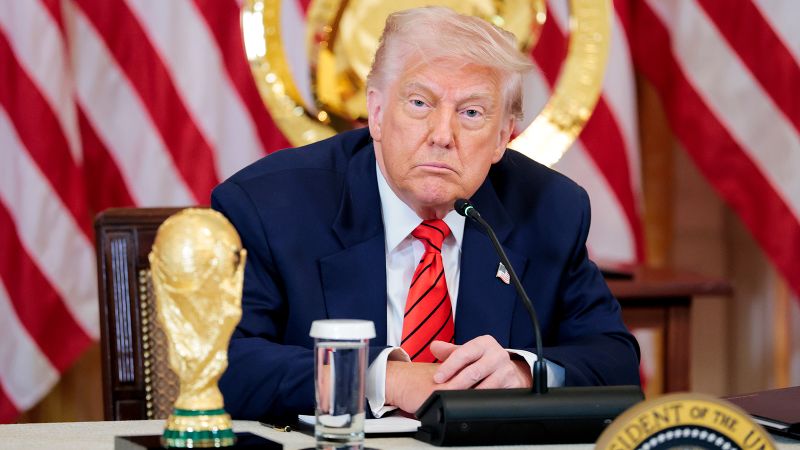
Trump’s knack for self-promotion has long been a hallmark of his political career. From the moment he entered the spotlight, he sought to position himself as a global icon. This mindset carried over into the 2026 World Cup preparations, where he showcased his flair for spectacle. A gleaming replica of the World Cup trophy, displayed in the Oval Office, became a symbol of his desire to dominate the international arena. His enthusiasm for the event was further demonstrated by hosting FIFA’s top official, Gianni Infantino, within his politically charged MAGA network. Even his participation in a FIFA club tournament last year, where he presented Chelsea with the trophy, was met with the same glee as if he had personally scored the winning goal. However, this veneer of celebration may be short-lived.
“I would certainly like to be there, but I wouldn’t pay it either, to be honest with you,”
Trump told the New York Post when questioned about the exorbitant cost of attending the first Team USA game. His words underscore a broader sentiment: the World Cup, once a unifying spectacle, now risks becoming a stage for political theater. While the event is expected to draw millions of fans, its appeal is being overshadowed by the growing unrest in the United States. Recent actions by the administration have sparked international criticism, casting doubt on the idea of the tournament as a pure celebration of sports.
The Shadow of Geopolitical Tensions
The 2026 World Cup, set to open on Thursday, coincides with a period of escalating tensions between the U.S. and its allies. Trump’s second term has been marked by a series of provocative policies and statements, including the imposition of tariffs on key trading partners and the critique of democratic institutions in close allies. These moves have not only fueled domestic dissent but also strained relationships abroad. For instance, the president’s decision to launch military strikes against Iran, a country competing in the World Cup qualifiers, has reignited debates about the role of politics in sports. The incident has drawn sharp criticism from international observers, who argue that such actions blur the lines between diplomacy and spectacle.
Meanwhile, Trump’s immigration policies have created friction with foreign fans. The administration’s focus on border security has led to reports of rigorous checks for athletes and officials from nations like Somalia and Senegal. A Somali referee, for example, was reportedly denied entry to the U.S. despite the community’s denial of accusations linking Somali residents in Minnesota to fraud. Similarly, the Senegalese team faced extensive security screenings when arriving for their pre-tournament camp, a measure the federation described as routine. Iran, too, has voiced concerns about its allocation of tickets for three group games in the U.S., citing fears of ICE raids targeting undocumented migrants during matches involving South American teams with large followings. These incidents have raised questions about the accessibility of the World Cup for fans from diverse backgrounds.
Commercialization and the Cost of Access
The soaring cost of tickets has further complicated the World Cup’s image as a people-centric event. Prices for the finals have reached unprecedented levels, with some fans spending over $1,000 for a single game. Critics argue that FIFA’s focus on maximizing revenue has come at the expense of affordability for traditional supporters, particularly those from the Global South. This trend mirrors broader economic challenges in Western societies, where rising costs and income disparities threaten to exclude lower-income groups from major events. Trump, ever the showman, may have intended to use the World Cup as a platform to showcase American prosperity, but the ticket price controversy has instead highlighted the growing divide between elite sports and its grassroots roots.
Infantino’s awarding of the FIFA Peace Prize to Trump—a gesture that seemed symbolic in 2023—now feels increasingly ironic. The decision was made amid the president’s friendship with the FIFA leader, but it has drawn scrutiny following Trump’s military actions in the Middle East. The award, intended to celebrate unity, appears to have become a testament to the political entanglements that define the tournament. Infantino’s frequent appearances in Washington and at Trump’s Mar-a-Lago retreats have deepened perceptions of his alignment with the U.S. leader, even as the president’s rhetoric continues to polarize global audiences.
Historical Parallels and the Weight of Expectations
Political interference in international sports is not a new phenomenon. The U.S. led a boycott of the Moscow Olympics in 1980, protesting the Soviet invasion of Afghanistan, while the 2022 World Cup in Qatar was marred by accusations of human rights abuses and the exploitation of migrant labor. The 2026 event, however, carries a unique burden: the presence of Trump, whose polarizing style has turned every international engagement into a political spectacle. The co-hosting arrangement with Canada and Mexico, nations often at odds with the U.S., adds another layer of complexity. This backdrop of regional rivalry and global tension could turn the World Cup into a battleground for ideological clashes rather than a celebration of the game.
Trump’s influence on the tournament is evident in the way it has been framed. His recent Instagram post, declaring that the World Cup would elevate the “entire world” alongside America, reflects his belief in using sports as a tool for political messaging. Yet, the same fervor that once made him a global figure now risks alienating those who view the event as a symbol of peace and camaraderie. The president’s tendency to amplify both support and criticism has placed Infantino in a precarious position, as the FIFA leader navigates the fine line between collaboration and compromise.
A Global Stage for Domestic Divides
As the World Cup approaches, the focus has shifted from the sport itself to the political forces shaping its environment. Trump’s administration, once seen as a driving force behind international unity, now appears to be a source of division. The tournament, which was supposed to bring nations together, is being scrutinized for its role in amplifying domestic issues. For instance, the exclusion of certain groups from the U.S. has sparked accusations of exclusionary practices, even as the event draws record attendance. This duality—of global celebration and local controversy—has become a defining feature of the 2026 World Cup.
The president’s rhetorical style, which oscillates between hyperbolic praise and sharp criticism, has ensured that the World Cup will not be immune to political discourse. While he may hope to use the event to bolster his image, the reality is that his policies and actions have turned the tournament into a microcosm of the broader geopolitical landscape. This is particularly evident in the context of the Western Hemisphere, where the U.S. and its neighbors have experienced periods of tension. The World Cup, therefore, is not just a sporting event but a reflection of the interconnectedness of politics and culture in the modern world.
Amid all this, the hope remains that the World Cup can transcend its political baggage and become a source of joy and unity. However, the challenges posed by Trump’s presence and the administrative decisions affecting foreign participation suggest that the tournament may face an uphill battle. As the countdown to the opening games continues, the world watches with a mix of anticipation and apprehension, aware that the event’s success will hinge not only on the quality of play but also on the ability of its organizers to balance spectacle with solidarity.