
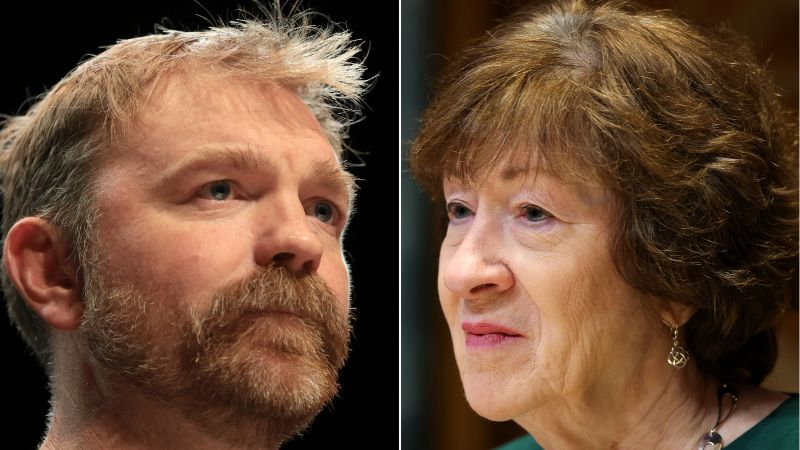
Maine Democratic Senatorial Primary: Platner’s Victory and the Road Ahead Against Collins
Sandego.net – On Tuesday, Graham Platner secured a decisive win in Maine’s Democratic Senate primary, cementing his position as the party’s candidate in the November general election against Republican Sen. Susan Collins. His victory, which saw him garner approximately 75% of the vote, marked a significant milestone for Democrats aiming to reclaim a Senate majority. Despite lingering doubts about his campaign’s integrity due to past controversies, Platner’s success signaled that Maine voters remained committed to his bid to challenge Collins, a long-standing political figure in the state.
The primary race had been shadowed by debates over Platner’s personal conduct. From his tattoo, which bore a resemblance to Nazi symbols, to his past relationships and alleged sexting during marriage, his campaign faced scrutiny. Additionally, reports of his behavior toward women he dated raised further questions. Yet, these controversies did not derail his path to victory. With final results still being tallied, Platner’s message of progressive change resonated strongly with the state’s electorate, leaving little room for doubt about his viability as a contender in the November matchup.
Platner’s campaign had anticipated challenges, particularly regarding protest votes for former Gov. Janet Mills. Though Mills had suspended her bid in April, her name remained on the ballot, potentially drawing support from disillusioned voters. However, the data suggested that most Democrats were focused on Platner’s vision rather than lingering loyalty to Mills. His overwhelming lead in the primary underscored a clear shift in the state’s political landscape, with Maine’s voters favoring a more radical approach to challenging Collins.
A Defining Moment in Democratic Strategy
As the primary results solidified, the stakes for the November election became clearer. Maine, a critical battleground for Democrats, is seen as a key state in their efforts to flip four Republican-held Senate seats. Platner’s victory not only bolstered Democratic hopes but also set the stage for a heated campaign against Collins, who has historically maintained strong support despite Democratic challenges. With her six-term tenure in the Senate, Collins is viewed as a seasoned politician with deep roots in the state’s political system.
Platner’s triumph was met with a mix of reactions. In his victory speech, delivered at a YMCA in his hometown of Blue Hill, he addressed the months of scrutiny his campaign had faced. “If you believe, as I do, that we can change our politics, and change our country, then you must also believe that people can change,” he said, referencing his own personal growth. Platner’s wife, he claimed, had been instrumental in his transformation, a theme he repeatedly emphasized to counter critics who had questioned his character.
“To all those who feel let down, disappointed, or disillusioned. It is my job to earn your trust, your faith, and your support. And I will spend every day of this campaign, and if I have the privilege, every day in the United States Senate, doing exactly that.”
Despite his denials, Platner’s campaign had been marked by contentious moments. The allegations of his behavior toward former partners, including a New York Times report suggesting he had exhibited physically threatening conduct, were a central issue. While Platner insisted he had never acted in a physically intimidating manner, these claims had fueled debates about his credibility. His speech, however, seemed to shift the focus from his past to his future, promising a new direction for the state’s Democratic Party.
Collins, a 73-year-old senator with a reputation for political pragmatism, had been unshaken by the criticisms. In an interview with CNN’s Manu Raju, she acknowledged the concerns but emphasized the need for answers. “The allegations against Graham Platner are extremely troubling and serious, and he owes the people of Maine a detailed answer. And I haven’t heard that,” she said. Collins’ campaign, backed by the Senate Leadership Fund—a major super PAC—had positioned her as a reliable leader, even as Platner’s campaign painted her as a “dangerous deviant” who could not be trusted.
Platner’s rhetoric in the victory speech was sharp, targeting Collins on multiple fronts. He accused her of being “just as spineless and corrupt as the establishment she now serves,” a charge that resonated with voters frustrated by the current political system. Additionally, he criticized her for aligning with former President Donald Trump, including her vote to confirm Supreme Court Justice Brett Kavanaugh, a decision Platner linked to the erosion of abortion rights. “She lied to us,” he said, arguing that Collins’ promises to protect Roe v. Wade were hollow given her support for a justice who overturned it.
“The truth is, Susan Collins does not serve us. She serves Donald Trump. She serves the Epstein class. She serves her corporate donors and the corrupt political system that has rigged the economy against us. She does not serve us, and so we will defeat Susan Collins.”
Collins’ campaign, through her spokesperson Shawn Roderick, sought to counteract Platner’s aggressive messaging. “Mainers aren’t looking for bitter campaigns, grand promises, or angry speeches riddled with lies,” Roderick stated. The statement aimed to reassure voters that the race would remain focused on policy and leadership, rather than personal attacks. However, Platner’s ability to mobilize support suggested that the political dynamics in Maine had shifted, with a younger, more progressive base ready to challenge the status quo.
While Platner’s victory was clear, the Democratic establishment’s reaction remained cautious. The Democratic Senatorial Campaign Committee (DSCC) issued a statement from Senate Democratic leader Chuck Schumer and New York Sen. Kirsten Gillibrand, which did not explicitly endorse Platner but highlighted Collins’ “never been more vulnerable” position. This tempered response indicated that while the party had no choice but to support Platner, they were still evaluating his long-term potential as a candidate. The next phase of the campaign will be crucial in determining whether Platner’s grassroots appeal can translate into a decisive victory in November.
For now, the focus remains on the upcoming general election. With Platner’s campaign already framing the race as a battle between progress and tradition, the political battle in Maine is set to intensify. As both candidates prepare for the final stretch, the state’s voters will be watching closely to see which message resonates most. The outcome could shape not only the Senate’s balance of power but also the broader trajectory of Democratic politics in the years to come.