The next mayor of DC will have to navigate its most famous resident: President Donald Trump
Sandego.net – During a campaign event in the district, Janeese Lewis George, a prominent DC councilmember and leading candidate for mayor, encountered an unexpected challenge when her campaign team received news of President Donald Trump’s remarks. The president had stated he would not “put up with it” if Lewis George, a democratic socialist, won her Tuesday primary. This comment, delivered in the Oval Office earlier in the week, sparked immediate concern among her supporters. “Maybe we’ll take back Washington, run it on the federal basis,” Trump said, hinting at a potential shift in the city’s governance. Lewis George’s team, engaged in door-to-door outreach, quickly paused their activities to strategize. Within hours, they issued a statement condemning Trump’s stance, framing it as a direct challenge to DC’s autonomy.
The Debate Over Home Rule
The candidates’ response highlighted a growing tension in the DC mayoral race: the struggle to balance local governance with federal influence. Lewis George, who has long advocated for statehood, emphasized that Trump’s threat to undermine DC’s self-rule was an attack on democratic principles. “Threatening home rule because you don’t like how residents are voting is an attack on democracy itself,” she declared in a video released by her campaign. This sentiment resonates with many DC residents, who view the city’s current mayor, Muriel Bowser, as having failed to assert sufficient resistance against federal encroachment. The debate reflects a broader national trend, where Democrats across the country are scrutinizing their leaders’ ability to protect local rights in the face of a Trump administration.
“The people of DC elect their mayor, and they want someone who’s going to stand up to Donald Trump,” Lewis George said, underscoring her commitment to defending the district’s independence. Her words echo the frustrations of a community that has grown weary of federal interference, particularly after the recent deployment of National Guard troops to the city. The presence of these troops, which arrived in August 2023, has symbolized the administration’s willingness to assert control over DC’s affairs, raising questions about the city’s long-term autonomy.
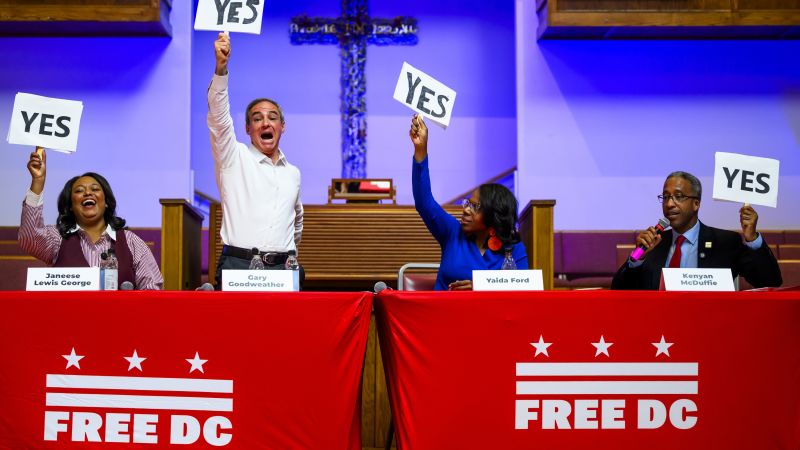
Meanwhile, her primary opponent, Kenyan McDuffie, a more moderate former councilmember, has positioned himself as a pragmatic alternative. McDuffie, who resigned from the DC Council earlier this year, argued that Trump’s comments about Lewis George demonstrate the president’s strategy to use local leaders as tools for his agenda. “If you believe Donald Trump is a threat to DC’s local autonomy, then the last thing we should do is elect someone whose agenda would make it easier for him to justify federal intervention,” McDuffie told CNN. His message, a call for unity with Congress, contrasts sharply with Lewis George’s more confrontational approach, which seeks to challenge the administration head-on.
Candidates’ Visions for the District
McDuffie’s campaign has focused on building bridges with federal officials, emphasizing the need for collaboration to address the city’s challenges. He claimed that Trump’s remarks reveal the president’s intent to leverage Lewis George as a political asset, should she secure the nomination. “You don’t stop Donald Trump by fearing him,” Lewis George countered, dismissing McDuffie’s cautious strategy. “I’ve been fighting for DC statehood my entire life. I’m not going to take a lecture from Kenyan McDuffie on Home Rule.” Her defiance has galvanized grassroots activists, who see her as a symbol of resistance against the Trump administration’s efforts to reshape the district’s governance.
“The president’s comments show he’s ready to use any elected official as a foil if it serves his interests,” Lewis George added in a statement to CNN. “I’m not just running for mayor—I’m running to protect the rights of DC residents, who deserve a voice in their own government.” Her rhetoric has positioned her as a polarizing figure, appealing to those who believe the city’s current leadership has not done enough to resist federal control.
The mayoral race has become a microcosm of the national struggle over statehood and self-governance. While Democrats in other states grapple with similar issues, DC’s situation is uniquely volatile, given its limited political power. As a territory, the district’s government operates under the Home Rule Act of 1973, which grants it limited autonomy. However, its delegate to Congress holds no voting rights, and federal lawmakers can override local laws—a power that has been exercised only occasionally in recent decades.
Despite these constraints, the threat of federal intervention remains a constant concern. Last August, Trump’s decision to send National Guard troops to DC and declare a crime emergency marked a significant escalation in the administration’s influence over the city. This move allowed federal authorities to temporarily take control of the district’s police department, a move that drew sharp criticism from Bowser and her allies. While Bowser sought to mitigate the impact of the takeover, her efforts were seen by some as overly accommodating, fueling calls for a more assertive leader.
The Weight of Federal Influence
DC’s political landscape is shaped by its status as a federal district, a reality that complicates its bid for full statehood. The Home Rule Act, enacted in 1973, established the city’s current framework of self-governance, but it leaves room for federal override. Congress can pass legislation to repeal the act, a power that has been used sparingly in recent years. However, the BOWSER Act—a GOP-backed measure aimed at dismantling home rule—failed to gain momentum, signaling a lack of support for such a drastic change.
Phil Mendelson, the chairman of the DC Council, acknowledged the difficulty of translating campaign promises into policy. “Being in office is different,” he said, noting that candidates often speak passionately about fighting Trump during elections but face complex decisions once in power. He criticized Bowser’s handling of the National Guard deployment, arguing that her approach to the issue did not align with residents’ expectations. “I would describe it as a balancing act,” Mendelson explained. “Mayor Bowser has been trying to navigate that for years, but many feel she hasn’t done it effectively.”
The stakes for the mayoral race extend beyond local politics. A new administration in DC could shape the city’s relationship with the federal government for years to come. Lewis George’s campaign has framed her election as a step toward restoring DC’s independence, while McDuffie’s platform emphasizes pragmatic solutions. Both candidates recognize the importance of countering Trump’s influence, but their methods differ. For Lewis George, the fight is personal—a battle against a president who has long dismissed the district’s needs. For McDuffie, it’s about maintaining a delicate equilibrium between local and national interests.
As the primary approaches, the race has become a test of leadership, with voters weighing the candidates’ ability to protect DC’s rights. The outcome will not only determine the city’s next mayor but also signal the direction of its political future. Whether the chosen leader will be a bold defender of autonomy or a mediator between the district and the federal government remains to be seen. For now, the debate continues, fueled by the presence of a president who sees DC as a battleground for his broader agenda.