
Supreme Court allows Alabama to eliminate congressional district held by a Black Democrat
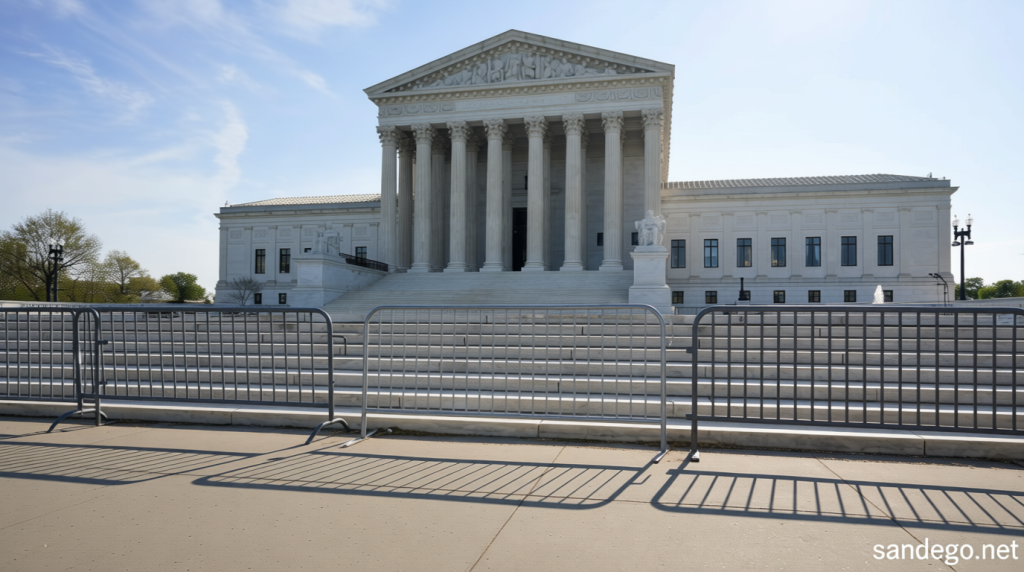
Supreme Court Approves Alabama’s Congressional Map Change
Supreme Court allows Alabama to eliminate – On Monday, the Supreme Court’s conservative bloc issued a swift decision that permitted Alabama to adopt a congressional map eliminating the district currently represented by a Black Democrat. The ruling, which came unexpectedly late in the day, overturned a lower court’s injunction that had previously blocked the state from implementing its 2023-drawn boundaries. This move has sparked immediate debate, with the court’s three liberal justices issuing a dissent that highlighted concerns over the decision’s impact on voting rights.
Alabama’s state government had filed an urgent request with the Supreme Court on Friday, seeking an immediate halt to the lower court’s order. The state argued that its 2023 map, which had been enacted under a previous iteration of the Voting Rights Act, was valid and should be allowed to take effect. The justices’ decision drew immediate criticism, as it appeared to prioritize partisan interests over protections for minority voters. The ruling was issued without an accompanying explanation, raising questions about its reasoning and the potential consequences for the upcoming primary elections.
The decision was influenced by the Supreme Court’s broader trend of narrowing the scope of the Voting Rights Act, particularly in its April ruling on Louisiana’s congressional map. That case marked a pivotal moment in the court’s approach to redistricting, as it significantly weakened the act’s ability to prevent discriminatory voting practices. The Alabama case, while distinct, aligns with this pattern, reflecting a growing willingness among the conservative majority to intervene in state-level map changes that favor Republican candidates.
The Louisiana Connection
The current Alabama ruling echoes the court’s treatment of Louisiana’s redistricting plan. In that case, the justices had previously required the state to revise its map to address concerns about diluting Black voters’ influence. Now, Alabama’s decision to eliminate a majority-Black district appears to mirror similar strategies employed by other southern states. The ruling underscores how the Supreme Court is increasingly shaping the electoral landscape by enabling states to redraw boundaries in ways that may limit opportunities for minority representation.
Although the order itself was brief, it carried significant weight. By tossing out the lower court’s decision, the high court effectively allowed Alabama to proceed with its original map. The state had already taken steps to adjust its primary election schedule, with Governor Kay Ivey signing legislation to permit new US House primaries if the map change is finalized. This ensures that the state can hold elections under the revised districts, despite the legal controversy surrounding the decision.
Impact on the Midterm Elections
Justice Sonia Sotomayor, joined by the court’s other two liberal justices, criticized the decision in a dissenting statement. She argued that the ruling would create confusion for voters and undermine the integrity of the electoral process. “The order is inappropriate and will cause only confusion as Alabamians begin to vote in the elections scheduled for next week,” Sotomayor wrote. She further noted that the conservative majority had “unceremoniously discarded” the lower court’s findings, which had determined that Alabama’s map constituted intentional discrimination against Black voters.
“The order is inappropriate and will cause only confusion as Alabamians begin to vote in the elections scheduled for next week.”
The ruling also highlights the Supreme Court’s growing role in major redistricting disputes. Over the past several months, the court has been involved in cases across Louisiana, Texas, Alabama, and California, with each decision reinforcing its stance on limiting federal oversight of state voting maps. This trend suggests a coordinated effort to reshape electoral boundaries in ways that may benefit the Republican Party at the expense of minority communities.
Alabama’s political strategy has been a subject of scrutiny. The state’s 2023 map, which included only one district where Black voters could elect a representative of their choice, was initially challenged in court. The lower court had found that the map diluted Black voting power, leading to a temporary block on its implementation. However, the Supreme Court’s reversal has cleared the path for Alabama to use the map, which it claims is more equitable. The state’s legislative action to adjust the primary date further demonstrates its urgency to finalize the change before the November midterms.
Broader Implications for Southern States
The Alabama case is part of a larger pattern in the South, where states have rapidly acted to reshape their congressional districts following the Supreme Court’s April decision. Tennessee and Florida, for example, have already implemented new maps that advantage the Republican Party, reducing the likelihood of Black voters forming a majority in any single district. This trend reflects a strategic shift by states to maximize partisan gains, leveraging recent court rulings to weaken federal protections.
Virginia Democrats, meanwhile, took a parallel approach by asking the Supreme Court to intervene in their own redistricting dispute. This demonstrates how the court’s decisions are being used as a tool to influence elections across multiple states. The situation in Alabama, however, stands out due to the direct elimination of a district that had historically been a stronghold for Black representation. The move has been described as a “strategic shift” by Alabama’s leadership, aiming to consolidate political power in districts where the GOP holds an advantage.
The 2024 primary elections in Alabama were originally scheduled for May 19, but the state now has the opportunity to hold additional contests if the map change is approved. This flexibility allows Alabama to test the effects of its new boundaries, potentially reshaping the political landscape for the midterms. The decision has also raised concerns about the broader implications for the Voting Rights Act, which has long served as a safeguard against discriminatory practices in states with a history of racial bias.
Historically, Alabama’s congressional map had included two districts where Black voters could elect a representative of their choice, as seen in the 2024 court-drawn plan. However, the state’s 2023 version had reduced this number to one, a move that critics argue was designed to weaken the influence of Black voters. The Supreme Court’s approval of the 2023 map marks a reversal of that trend, but the decision has been met with bipartisan criticism. Advocacy groups have warned that the ruling could set a dangerous precedent, emboldening states to enact maps that marginalize minority communities.
As the nation prepares for the November midterms, the Supreme Court’s involvement in redistricting has become a defining feature of the political season. Its decisions in Alabama, Louisiana, and other states are shaping the electoral terrain, with implications for representation and voter access. The court’s willingness to act swiftly in these cases has also drawn attention to its ideological divide, with liberal justices expressing frustration over the lack of detailed reasoning in the Alabama ruling.
The Supreme Court’s actions in Alabama underscore its ongoing commitment to reshaping the Voting Rights Act. By allowing the state to revert to a map with one majority-Black district, the court has effectively enabled a strategy that reduces the number of opportunities for Black voters to elect their preferred candidates. This decision, combined with similar rulings in other states, has sparked renewed calls for reform, as advocates argue that the current framework does not adequately protect minority voting rights.
