Rubio and Miller Warn of Far-Left Terror Threat to Global Stability
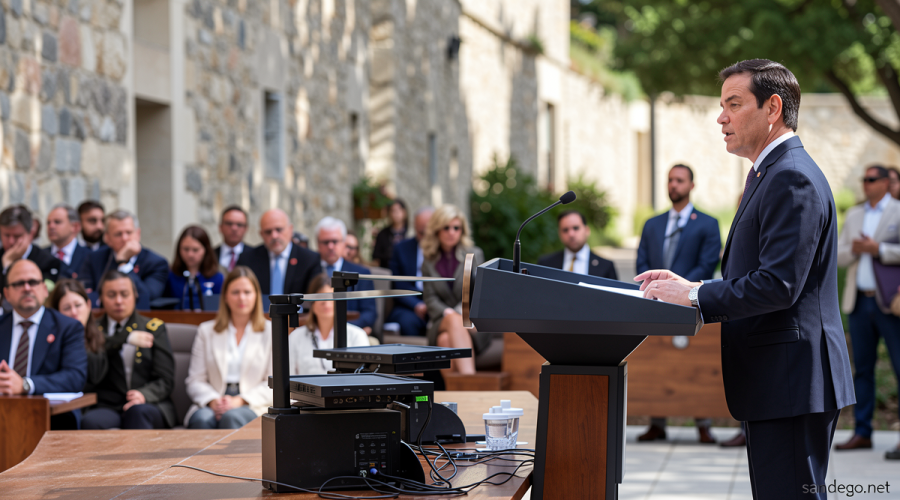
Sandego.net – Rubio and Miller warn of a “mortal threat” posed by far-left political terrorism as Secretary of State Marco Rubio and senior White House adviser Stephen Miller addressed diplomats from 67 nations at the State Department on Thursday. The officials painted a stark picture of what they described as a growing menace to Western civilizations, urging international partners to help “defend” against what Miller called the “scourge” of left-wing extremism. Speaking primarily about domestic concerns, Miller characterized the issue as a “fatal cancer of civilization,” warning that unchecked left-wing terrorism inevitably transforms societies into gulags. He emphasized that American political, legal, and judicial institutions cannot function properly when violence and terror remain unaddressed. Miller also criticized Antifa demonstrators as “deformed,” suggesting their physical appearance reflected their internal hostility. “The greatest risk that we have is that our institutions have grown too soft and too cowardly to be able to defend themselves against a mortal threat,” Miller declared to the assembled representatives.
International Response and New Visa Restrictions
The ministerial gathering aimed to unite allied nations around a coordinated approach to counter what the administration termed a resurgence of far-left terrorism. Following the event, Rubio unveiled fresh visa restrictions designed to target “members of Far-Left Terrorist and other aligned groups.” This initiative represents a central priority for the Trump administration, which has positioned violent left-wing extremists—including anarchists and anti-fascists—as among the foremost terrorist dangers facing the United States. Rubio emphasized the need for international cooperation, calling on attending nations to “identify and map this threat and rebuild our counterterrorism architecture to defeat it.” He outlined a multi-pronged strategy: “Through intelligence and information sharing, through coordinated law enforcement strategy, through financial targeting and disruption, we will dismantle these networks brick by brick.” Treasury Secretary Scott Bessent, who participated in the opening session, announced that his department was “expanding its efforts to identify organizations that abuse charitable and nonprofit structures as vehicles for illicit finance” in connection with alleged far-left terrorism.
“They can call themselves anti-capitalist or anti-imperialist, communist, or anarchist, or Marxists, but the fundamental character is always the same,” Rubio said.
Rubio’s decision to convene this ministerial reflects both the issue’s growing importance domestically and speculation surrounding the secretary of state’s potential political ambitions. According to a State Department spokesperson, the 67 participating countries were predominantly European, though delegations also came from Asia and the Western Hemisphere. Israel stood as the sole Middle Eastern nation represented at the gathering. Rather than being led by foreign ministers, many delegations were headed by ambassadors or working-level technical officials. Several sources attributed this lower-level attendance to scheduling constraints, noting that invitations were extended only in early July.
Despite the administration’s heightened rhetoric, multiple former officials have suggested the issue has been politicized and that the far-left threat does not approach the severity of challenges posed by ISIS or far-right extremists. Notably, the latter group was entirely absent from the administration’s counterterrorism strategy released in May. Critics worry the strategy serves to amplify the perceived danger while targeting political opponents of President Donald Trump. Rubio countered such skepticism, stating the threat had been dismissed “as a right-wing fever dream, or worse, as a dangerous fascist conspiracy,” yet insisted its resurgence remains “an undeniable reality” comparable to left-wing attacks from the 1970s.
Former officials emphasized that the ministerial appears connected to a broader administration effort to elevate the threat narrative for domestic political purposes. Several CNN sources indicated that actual data does not support the administration’s characterization. “We looked at terrorism of all stripes, including left-wing terrorism, but the reality and the data, both here domestically and abroad, indicate that left-wing extremism is not and has not been the type of threat or the degree of threat that far-right terrorism or extremist violence or jihadist violence have posed,” explained Ian Moss, former deputy coordinator for counterterrorism at the State Department under the Biden administration.
Moss, now practicing as an attorney with Jenner & Block, highlighted that “other forms of violent ideological extremism, Islamist violence for starters, and then certain far-right movements” represent more significant dangers according to available evidence. Nevertheless, the administration continues to position far-left terrorism as a critical concern requiring both domestic and international attention, with Rubio and Miller’s recent addresses serving as a platform to rally global support for their approach.