White House Adviser and House Minority Leader Signal Bipartisan Path Ahead of Midterms
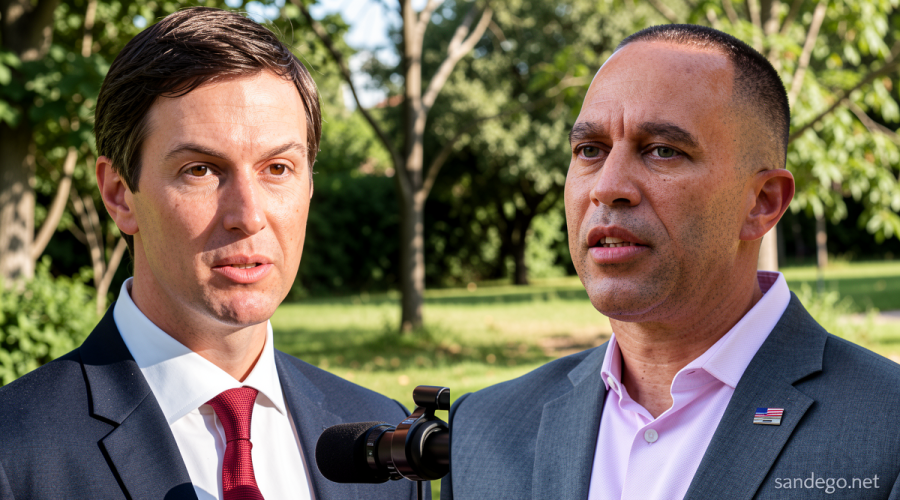
Sandego.net – In a private gathering in New York several weeks ago, Jared Kushner — the president’s son-in-law and one of his most trusted policy advisers — sat down with House Minority Leader Hakeem Jeffries to explore areas where the White House and congressional Democrats might find common ground. A source familiar with the conversation confirmed the meeting took place and described the agenda as focused on immigration reform, housing affordability, and the broader cost-of-living pressures weighing on American households. The encounter, first made public on Sunday, carries significant weight given the political landscape heading into next year’s midterm elections.
A Prior Track Record of Bipartisan Cooperation
The two men are not strangers to working across the aisle. In 2018, Kushner and Jeffries collaborated on what became the Second Chance for Successful Reentry Act, commonly known as the Step Act. That legislation, passed with bipartisan support, aimed to shrink the federal prison population by softening mandatory minimum sentencing requirements for certain nonviolent offenses and expanding access to reentry programs. The experience gave both men a shared vocabulary for cross-party problem-solving, and it appears to have laid the groundwork for their recent sit-down.
During the New York meeting, Kushner reportedly encouraged Jeffries to extend the dialogue by arranging a separate conversation with Susie Wiles, the White House chief of staff. The suggestion implies the administration is open to structured, ongoing engagement with the opposition party rather than treating the relationship as purely adversarial. No formal response from the White House had been secured as of Sunday.
Jeffries Positions Himself as Speaker-Designate
The timing of the meeting is difficult to separate from the midterm calculus. Jeffries has emerged as the leading candidate to become House speaker should Democrats reclaim the majority in November. Party strategists view that outcome as increasingly plausible, pointing to President Donald Trump’s declining approval ratings amid the ongoing Iran conflict and to economic anxieties amplified by a national debt that recently crossed the $40 trillion threshold. In that environment, a Democratic speaker would inherit a chamber tasked with overseeing an administration whose policies many voters now associate with rising prices and fiscal instability.
Jeffries made his priorities explicit in a statement released Sunday:
“The American people want bold change and that’s what House Democrats will deliver. In every conversation that we have with the Trump administration, we will continue to make it explicitly clear that the affordability crisis is not a hoax and nothing short of transformational policy change is acceptable.”
The language is deliberately confrontational. By framing the affordability issue as a matter requiring “transformational” rather than incremental reform, Jeffries signals that he intends to use the speaker’s gavel — if he obtains it — to force structural legislative action on housing costs, energy prices, and consumer protection. His repeated insistence that the party’s agenda centers on lowering costs for ordinary Americans, which he attributes to the president’s policy choices, underscores that the collaboration he seeks with the White House is transactional, not conciliatory.
Speaker Johnson Dismisses the Signal
On a Fox News appearance Sunday, House Speaker Mike Johnson, the Republican leader, sought to minimize the political resonance of the Kushner-Jeffries meeting. He rejected the interpretation that the encounter represented an implicit admission by the president that he might have to govern alongside a Democratic majority for the next two years.
“I’m telling you, we’re going to defy history and hold this majority,” Johnson said, explaining that Republicans see a viable path toward preserving their razor-thin chamber advantage.
Johnson characterized Kushner as “a smart guy and he hedges his bets,” while stressing that the president’s son-in-law is not involved in “day-to-day” White House operations. The comment serves a dual purpose: it credits Kushner’s judgment while simultaneously insulating the administration’s core decision-making from the implication that the meeting carried presidential endorsement.
Impeachment on the Table, Costs at the Center
Jeffries has been among the most vocal Democratic critics of Trump’s second term, regularly pressing the president on television interviews and at press conferences. He has stopped short of formally endorsing impeachment proceedings but has not ruled them out should Democrats control the House next year. At the same time, he has repeatedly emphasized that the party’s legislative focus will remain on reducing the costs he argues have been driven upward by the administration’s tariff, energy, and spending decisions.
The Kushner-Jeffries dialogue, whatever its ultimate legislative yield, marks a notable departure from the purely combative posture that has defined the relationship between the White House and the opposition since January. Whether it evolves into substantive policy work on immigration enforcement, housing construction incentives, or debt-management frameworks will depend on whether both sides can convert a private New York conversation into a durable institutional channel. With the national debt at $40 trillion and midterm voters weighing their options, the stakes of that conversion are considerable.
Related Reading
Frequently Asked Questions
What is Kushner Jeffries discuss ways White House?
Kushner Jeffries discuss ways White House is the main topic of this guide. The article explains the context, practical details, and next steps readers should understand.
Why does Kushner Jeffries discuss ways White House matter?
Kushner Jeffries discuss ways White House matters because readers are looking for a useful answer, not just a short summary. Good content should match search intent and help them decide what to do next.