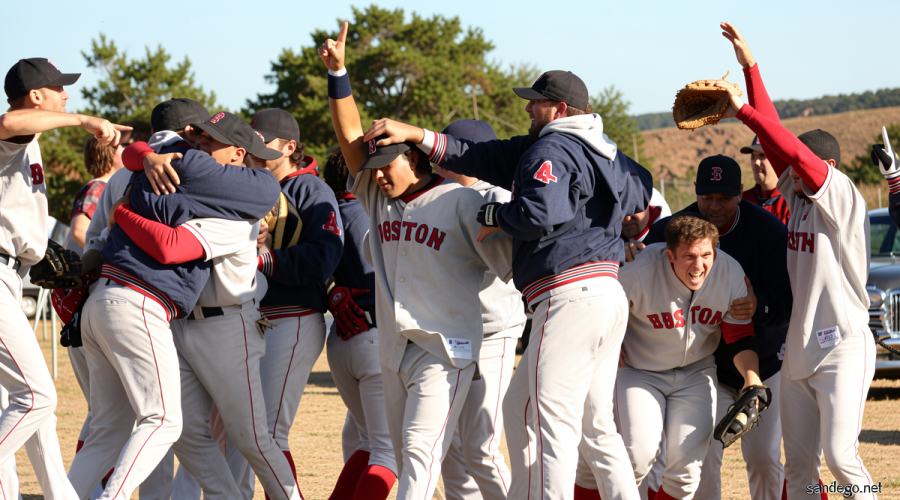
How the Boston Red Sox Finally Broke the Curse
Sandego.net – How the Boston Red Sox finally ended an eighty-six-year championship drought came down to one swing in the twelfth inning of Game 4. David Ortiz lifted the ball over the Green Monster and into the Boston night, and the city’s reaction was seismic. Yet that single home run was merely the last word in a sentence first drafted in 1918, when the franchise last raised the Commissioner’s Trophy. Every October between that triumph and the fall of 2004 had delivered near-misses, final-inning collapses, and a running score of heartbreak that made the team’s history read more like a Greek tragedy than a sports ledger.
The Trade That Wounded a City for a Century
The origin story is simple to narrate and nearly impossible to forgive. In 1919, Boston shipped Babe Ruth — a two-way force who pitched and hit with a dominance that still ranks among the greatest ever displayed on a diamond — to the New York Yankees. What followed was a century of asymmetry. New York, armed with Ruth’s bat, assembled a dynasty that would eventually collect twenty-seven World Series titles. Boston, meanwhile, spent the rest of the twentieth century watching from the cheap seats, accumulating heartbreak the way other franchises accumulated pennants.
That transaction birthed what fans and writers began calling the “Curse of the Bambino”: the conviction that releasing Ruth was not merely a poor deal but a metaphysical wound scarring every subsequent October. Devin Gordon, a contributing writer at The New York Times Magazine, laid out the curse’s internal logic plainly:
“is the reason why the Red Sox go not only so long without winning a World Series, but losing them in such catastrophic, fateful, cursive ways.”
A Scoreboard of Final-Inning Ruin
The curse was never abstract; it carried a scoreboard. In 1946, Boston lost Game 7. In 1967, Game 7 again. In 1975, the same pattern repeated. Then came 1986: leading the New York Mets three games to two, holding a 5-3 advantage in the top of the tenth with two outs, and watching Bill Buckner’s throwing error hand New York the title. After that play the narrative calcified — this was a team that could not finish, a franchise destined to arrive at the doorstep and find the door locked.
“The story of the Red Sox is heartache… so close, yet so far.”
Bob Costas, the longtime broadcaster, compressed the emotional ledger into those few words. Even as the calendar rolled into the new millennium the pattern held. In 2003, Boston fell to the Yankees in Game 7 of the American League Championship Series, confirming that the curse had not expired with the century.
Three-Down and Counting: The 2004 Comeback
When the ALCS returned in 2004, the mood in Boston was less cautious optimism than resigned dread. Joe Posnanski, author of Why We Love Baseball, captured the prevailing sentiment: “hopelessness was probably at a high.” New York delivered a three-game sweep to open the series. Game 3 was a massacre — the Yankees scored nineteen runs and left Boston’s pitching staff in pieces. Kenny Albert, who called the games for NBC Sports, recalled the scene: “in Game 3 it’s not even close, the Yankees score 19 runs (and) they had just demolished the Red Sox.”
Even Boston’s own press corps had surrendered. Jackie MacMullan, then a columnist for the Boston Globe, described her nightly ritual: “I’m a columnist for the Boston Globe, and I destroy these guys in print.” She added, with a wry shrug, “Their nickname was ‘the idiots,’ and I was like, ‘yeah, they’re idiots alright.'”
The Steal That Cracked the Wall
Game 4 arrived with Boston down four to three in the ninth, three outs from elimination. Manager Terry Francona made a substitution that would be dissected for decades: he sent Dave Roberts to first base as a pinch runner. On the mound stood Mariano Rivera, the Yankees’ closer, whose entire repertoire was essentially one pitch — a ninety-five-mph fastball that had retired thousands of hitters. Everyone in Yankee Stadium, Rivera included, understood what Roberts intended.
“it’s very, very hard to steal a base of a pitcher whose one pitch is a 95 mph fastball… which is exactly what happened.”
Gordon noted. Roberts slid into second. In the moment it looked like a lucky bounce; in retrospect it was the fracture line through which the entire comeback poured. Posnanski observed: “It’s not like Dave Roberts’ steal changed anything that was obvious, but looking back on it, you realised it changed everything.” Bill Mueller followed with a single that brought Roberts home, and the series flipped. From there, the path to the World Series and ultimately to the title opened — and How the Boston Red Sox finally erased eighty-six years of October pain became the defining narrative of a generation of fans.
FAQ
What year did the Boston Red Sox last win a championship before 2004? The franchise’s previous title came in 1918, making the 2004 victory the end of an eighty-six-year drought.
What was the “Curse of the Bambino”? It was the fan-coined belief that trading Babe Ruth to the New York Yankees in 1919 placed a metaphysical hex on Boston’s October fortunes, producing a century of near-misses and final-inning collapses.
How did the Red Sox overcome a three-game deficit in the 2004 ALCS? After losing the first three games to New York, Boston won four straight. The turning point came in Game 4 when Dave Roberts stole second off Mariano Rivera with two outs in the ninth, setting up Bill Mueller’s single and igniting a walk-off home run by David Ortiz in the twelfth inning.
Who was the key managerial decision behind the Roberts steal? Manager Terry Francona inserted Roberts as a pinch runner with two outs and Boston trailing four to three in the ninth, a substitution that became one of the most studied plays in modern baseball.