
I Feel Your Pain vs Let Data Reign: Trump-Vance Split
Sandego.net – The “I feel your pain vs let” divide has become the single most awkward messaging problem facing the Republican ticket heading into the November midterms. Within a matter of hours on Monday, President Donald Trump and Vice President JD Vance issued diametrically opposed takes on whether American communities should absorb the construction of hyperscale artificial-intelligence data centers. For strategists already struggling to articulate a coherent post-2024 platform, the collision between the two men’s positions is not a footnote — it is the headline.
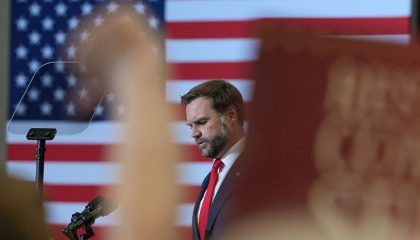
The “I Feel Your Pain” Side: Vance in Michigan
Vance, traveling to Michigan where data-center siting is poised to influence Senate races and down-ballot contests, chose empathy over dismissal. He conceded that the overwhelming majority of local opposition traces to a single, tangible grievance: rising utility bills.
“I think probably 99% of the backlash to data centers has come in areas where building a data center means higher utilities and higher electricity for the people on the ground,” Vance told reporters.
His prescription was straightforward. Facilities should function as net contributors to local grids, not as parasitic drains. “They should be putting power back into the grid, not taking it out,” he continued. “And if that is happening, I don’t think the data centers are that controversial. It’s when the utility bills get so much higher; that’s when it’s a real problem.” The register was that of a constituent-service office, not a rally stage.
The “Let” Side: Trump’s Social-Media Counterpunch
Hours earlier, the president had posted a message that left no room for the economic complaint Vance had just validated. “The only reason that communities throughout the U.S.A. should not want Data Centers is if they want to end up being backwards and poor,” Trump wrote. He capped the post with a slogan aimed at his loyal base: “If they want to be successful and rich, with far lower taxes and jobs all over the place, let Data Reign.”
The juxtaposition is stark. Where the vice president acknowledged a legitimate fiscal worry, the president recast dissent as voluntary impoverishment. The “I feel your pain vs let” framing, once confined to internal strategy memos, now sits in plain view of every voter watching both feeds simultaneously.
What Households Actually Want
The polling does not side with the president’s characterization. Recent surveys show that roughly seven in ten Americans oppose having a data center built in their own neighborhood. That number sits in sharp tension with Trump’s repeated public enthusiasm for the structures, including remarks marveling at how visually impressive the enormous buildings appear. The gap between executive fascination and household sentiment is among the widest in modern American politics.
The Mandate That Was Never Issued
Compounding the messaging fracture is a factual problem embedded in Trump’s own prior statements. In March, at an event tied to the previous election cycle’s calendar, the president unveiled a plan urging developers to make voluntary pledges that construction would not inflate local energy costs. He framed the concern as already settled: “They need some PR help, because people think that if a data center goes in there, electricity prices are going to go up,” he said. “And that’s not happening. It’s not going to happen. And for the areas where it did happen, it won’t happen anymore.”
Five months later, on August 4, he told Fox News that data centers were “not taking” from the community and were in fact a net energy benefit, claiming excess generation was sold back at negligible cost. On August 21 he went further, asserting that he had personally mandated the facilities to produce their own electricity. “The data centers now are mandated by me that they build their own electricity, so they’re not taking it from the grid,” he said. “It’s going to lower the electric costs.”
No such federal mandate exists. What Trump appeared to reference were behind-the-meter power plants — on-site generation units that some operators install under contractual, voluntary arrangements. The mechanism is commercial, not regulatory. The March plan, for its part, amounted to asking technology companies to self-police rather than imposing any binding requirement.
FAQ
What exactly did Vance say about data-center opposition? Vance stated that roughly 99% of backlash originates in communities where a new facility translates directly into higher utility bills, and he argued that data centers should return power to the grid rather than extract it.
What did Trump post in response? Trump posted that the only reason communities should reject data centers is if they prefer being “backwards and poor,” and urged supporters to “let Data Reign” for lower taxes and jobs.
Is there a federal mandate requiring data centers to generate their own electricity? No. On-site generation (behind-the-meter units) is a voluntary, contractual arrangement between operators and utilities. No executive order or agency rule compels data centers to self-power.
How do voters feel about local data-center construction? Recent polling indicates approximately 70% of Americans do not want a data center built in their own community, a figure that contrasts sharply with the president’s public enthusiasm for the structures.