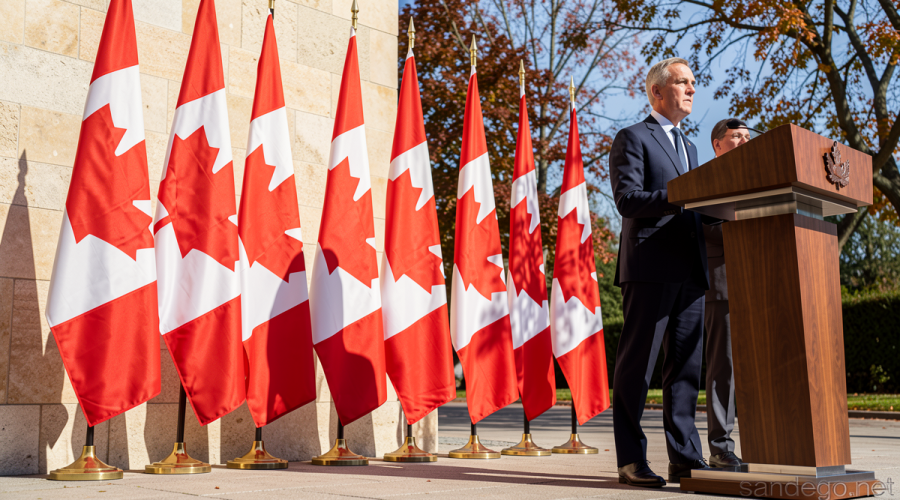
Language Laws Put Quebec’s Identity at the Center of a New North American Trade Clash
Sandego.net – With negotiations between Washington and Ottawa collapsing last week and a full-scale trade war now unfolding, an unexpected fault line has split the two longtime allies: the question of how French is protected, promoted, and enforced across Canadian commerce. The dispute, which had simmered for years beneath the surface of bilateral trade talks, has now erupted into open confrontation — and it is reshaping the political calculus on both sides of the border.
Canada’s constitution enshrines bilingualism, guaranteeing that English and French hold equal status in federal institutions. Roughly one-fifth of the population speaks French as a first language, and in Quebec — where nearly 85% of residents are primarily Francophone — that linguistic heritage is treated as a matter of survival rather than mere preference. The practical implications run deep: product packaging sold in Canada must carry French text alongside English, streaming services operating in the country are obligated to feature and promote Canadian-made content (including works from Indigenous creators and French-Canadian studios), and citizens have a constitutional right to access government services in either official language.
Ottawa Draws a Line in the Sand
Prime Minister Mark Carney made clear last week that his government would not concede on these protections. Walking away from a draft agreement, he explained that the package contained what he described as threats to French language and culture. On Monday, he told reporters that Canada “could not accept” the proposed deal because it would dilute existing safeguards, adding that his government “will not give (the US) what they have asked.”
“For Americans, French language, Francophone culture, Canadian culture, these are irritants,” Carney said in French at a news conference in Lévis, Quebec. “Here in Quebec, here in Canada, these are rights.”
A group of journalists in the room applauded the remark. The moment underscored how deeply the issue resonates beyond Ottawa’s corridors of power. Across the country, citizens rallied behind the prime minister’s refusal to compromise, viewing the defense of French-language rights as inseparable from Canada’s broader national identity.
Washington Pushes Back
US Trade Representative Jamieson Greer dismissed Ottawa’s concerns on Monday, calling the French-language question a “funny, fake story.” Carney responded by insisting the matter was no laughing matter and that there exists an “enormous gap between our perspective and the US perspective.”
President Donald Trump, while not naming the French-language issue directly, renewed his broader attacks on Canada in a Monday Truth Social post, calling the country “entitled” and “among the worst Nations in the World to deal with.” The rhetoric, familiar to Canadian audiences since the start of the current administration, added a layer of personal friction to what was already a structurally difficult negotiation.
The Tariff Math
Since talks stalled on Friday, Washington has imposed 50% tariffs on approximately $20 billion in Canadian goods. Carney initially vowed to match those duties “dollar-for-dollar,” but on Monday he signaled a possible shift toward a more surgical strategy, arguing that the sheer scale of the American economy makes blanket retaliation less effective than targeted measures.
“Everything is on the table,” he said, again switching to French.
Finance Minister François-Philippe Champagne and three other Cabinet ministers were scheduled to announce Canada’s formal response on Tuesday, including measures aimed at shielding domestic workers and firms from the sharpest impacts of the new duties, according to a government statement.
Why Quebec Cannot Be Traded Away
To understand why this issue carries such outsized weight, one must look at Quebec’s long history of defending its linguistic distinctiveness within an English-dominant continent. The province has twice held referendums on full separation from Canada; the most recent, in 1995, ended with the “no” side prevailing by a margin of just 1.16 percentage points. Those near-misses left a lasting imprint on provincial politics and reinforced the determination to protect French-language institutions as a bulwark against cultural absorption.
The language statutes that flow from this history are granular and far-reaching. They cover everything from the right of any Canadian to interact with federal agencies in French, to the requirement that hair-care manufacturers print the French word for “shampooing” alongside English instructions on every bottle sold domestically. For American firms seeking market access, the compliance burden translates into redesigned packaging, additional production runs, and higher unit costs — friction that Washington has long catalogued as a trade barrier.
Experts See No Middle Ground
Stewart Prest, a lecturer in the Department of Political Science at the University of British Columbia, argued that pressing Canada to relax these rules amounts to an unreasonable demand in any trade negotiation. He characterized it as something Ottawa has “no choice but to say no to.”
“People in Canada speak French. It’s not a country where everybody speaks English, and some people like to dabble in French,” Prest said. “It is not so different than asking France to relax its requirement that packaging must include French.”
The analogy is apt. Just as Paris would resist a trade partner demanding that French labels be optional, Quebec’s institutions view bilingual packaging and content-promotion rules as non-negotiable elements of their legal and cultural architecture.
Political Stakes for Carney
The episode lands at a particularly delicate moment for Carney, who has cultivated a global reputation for standing firm against Trump’s pressure tactics. Stéphanie Chouinard, associate professor of political studies at Royal Military College and Queen’s University, noted that capitating on an issue so central to Canadian identity would be devastating to his political standing under any circumstance, let alone amid an active tariff confrontation.
In Montreal, service workers still greet customers with the familiar bilingual “Bonjour-Hi” — a small daily ritual that encapsulates the coexistence the language laws are designed to protect. Whether that coexistence survives the current trade war remains the central question now facing both capitals.
Related Reading
Frequently Asked Questions
What is French has become a sticking point?
French has become a sticking point is the main topic of this guide. The article explains the context, practical details, and next steps readers should understand.
Why does French has become a sticking point matter?
French has become a sticking point matters because readers are looking for a useful answer, not just a short summary. Good content should match search intent and help them decide what to do next.