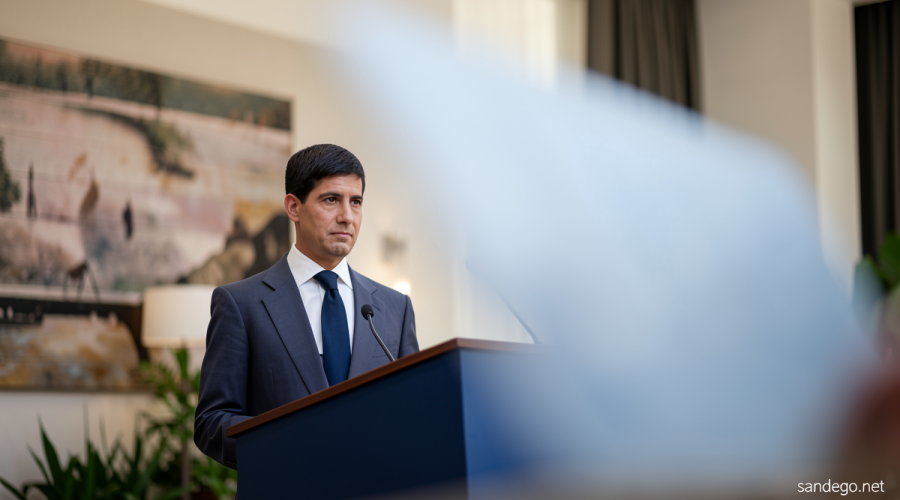
Fed Chairman Kevin Warsh Stays Muted on Rates
Sandego.net – Fed Chairman Kevin Warsh stays silent where markets most need clarity. Speaking at the Kansas City Fed’s annual Jackson Hole symposium in Wyoming, Warsh abandoned a two-decade convention of using the keynote to signal the direction of monetary policy. In place of a rate-path forecast, he offered one blunt assessment: inflation poses the greater threat to the American economy. The timing of any future hike, the data threshold that would trigger action, and the overall shape of the policy trajectory were all left conspicuously unaddressed.
That reticence did not soothe traders. Long-term Treasury yields had already spiked in the weeks after Warsh’s prior post-meeting press conference, where he likewise declined to project where borrowing costs would travel. Dealers interpreted the move as a warning that the central bank might tolerate stubbornly elevated price growth longer than markets could absorb.
A Break from Forward Signaling
For more than twenty years the Fed chair’s Jackson Hole remarks functioned as a de facto policy roadmap, giving markets a framework for anticipating rate decisions. Warsh has swapped that transparency for what he frames as disciplined restraint, arguing that the economy’s complexity defies formulaic responses and that publishing a fixed reaction rulebook is neither feasible nor wise.
“A quieter Fed, more purposeful in its communications, is better able to meet its objectives,” Warsh told the assembled central bankers, finance ministers, and policymakers.
He pushed back against the notion that a central bank should pre-commit to a mechanical response for every conceivable data point. “I wish our understanding of the economy were so precise as to provide a mechanical, tried-and-true answer,” he said. “But our knowledge just doesn’t extend that far—at least not yet—and the factors most relevant to the proper conduct of monetary policy change over time.”
Warsh explicitly distinguished his posture from what economists term “forward guidance,” the explicit projection of a rate path conditional on the economy unfolding as expected. He defended withholding both a reaction function and forward guidance, contending that the variables governing sound policy shift too rapidly to be pinned down in advance.
What Fixed-Income Desks Are Watching
The absence of a reaction function has not escaped notice. A Brookings Institution analysis published last month defined the concept as a central bank’s explanation of “what it is watching, how it interprets the economy, how it weighs competing risks, and what developments would change its judgment.” Fed Chairman Kevin Warsh stays evasive when pressed by reporters to articulate such a framework.
Ian Kresnak, senior investment strategist at Vanguard, voiced the frustration of fixed-income desks:
“The bond market is really looking to the Fed for clues on their reaction function. What’s driving a lot of the volatility in the rates market is uncertainty around how the Fed is going to respond to inflation.”
A CNBC survey conducted this week of 31 economists, strategists, and investors found that 80 percent of respondents believed Warsh should elaborate his economic reasoning in greater detail. Many in the market viewed the Jackson Hole platform as his most credible opportunity to do exactly that — an opportunity he largely passed over.
Inflation, Debt, and the AI Spending Wave
The backdrop against which this silence lands is one of compounding pressures. Price growth has reaccelerated, driven by tariff costs passed through to consumers, a war-driven energy and commodity spike, and the enormous capital-expenditure wave as corporations build out artificial-intelligence infrastructure. Simultaneously, expanding federal deficits and a swelling supply of corporate debt have pushed bond yields higher across the curve, compounding the interest burden on a national debt now standing at roughly $40 trillion.
Within the Fed itself, some members are already arguing for a rate increase — the first since July 2023 — to contain the inflationary impulse before it entrenches. Warsh did not endorse or reject that view on Friday. His characterization of inflation as “more concerning” than the employment situation, however, tilts the internal debate toward hawkishness.
Frequently Asked Questions
Why did Fed Chairman Kevin Warsh stay quiet on interest rates at Jackson Hole? Warsh deliberately withheld forward guidance and a reaction function, arguing that the economy’s complexity and rapidly shifting policy variables make pre-committed rules impractical. He offered only a qualitative judgment that inflation is the more pressing risk.
What does the market expect next? With no reaction function published, fixed-income desks are watching for incremental signals in upcoming data releases and FOMC communications. The CNBC survey suggests most professionals want Warsh to elaborate his reasoning sooner rather than later.
Is a rate hike imminent? Some Fed members favor a hike — the first since July 2023 — to head off entrenched inflation. Warsh did not confirm or deny that view, but his “more concerning” framing of inflation relative to employment leans hawkish.