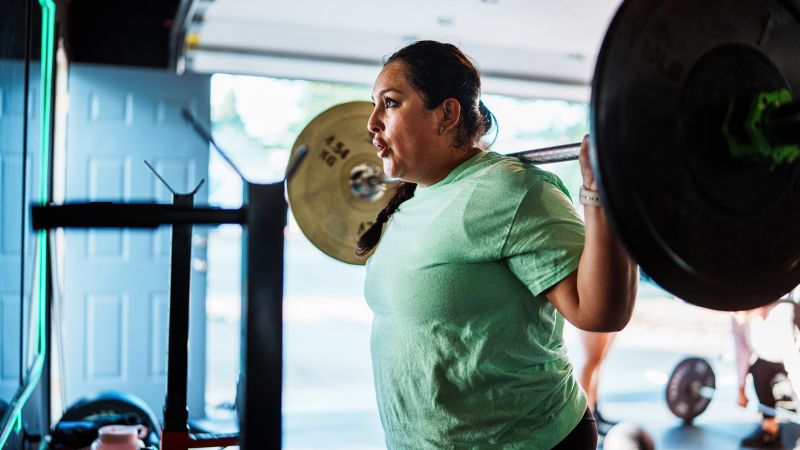
Strength Training Is Reshaping Women’s Fitness — but It Can Carry New Pressures
Sandego.net – For many women now reaching midlife, the old fitness message was unmistakable: exercise was meant to make the body smaller. The goal was often framed through appearance, from toned legs and flat stomachs to the era of “Buns of Steel,” rather than through power, mobility or the ability to lift heavy objects.
That message is changing. More women are embracing resistance training, drawn by its role in maintaining muscle, supporting bone health and preserving physical function with age. Yet the growing popularity of lifting has also raised a difficult question: can a movement intended to build strength become another narrow standard for how women believe they should look?
Oona Hanson, a writer, educator and parent coach focused on diet culture and eating disorders, sees both the promise and the risk. For generations, women were often cautioned away from weights because of fears that they might look “bulky.” Cardio dominated the conversation for decades, especially for women encouraged to pursue thinness above all else.
Today’s interest in muscle is a meaningful shift, particularly because strength work can help address age-related physical decline. Even limited resistance exercise can be valuable as people get older, when maintaining strength and bone density becomes increasingly important. But an emphasis on lifting heavier, monitoring protein intake and visibly changing one’s physique can also fuel harmful fixation on food, exercise and body size.
Moving Beyond the Cardio-Only Mindset
Liz Bucar, a religion professor at Northeastern University in Boston, spent years approaching fitness primarily through cardio and the desire to be smaller. Now in midlife, she views that earlier approach differently.
“We’re all being told, actually, oops, all that advice was terrible,” Bucar said.
She pointed to the consequences of excessive exercise and inadequate nourishment, including lost menstrual cycles and concerns around bone health. Bucar, who now works with a strength coach, said learning to progress in the weight room has offered a different way to think about fitness — one centered more on protection and capability than calorie restriction.
“Your bones are disintegrating because you didn’t have your period because you were just on the stair machine for hours a day,” Bucar said.
For Bucar, the appeal is not simply physical. Strength training can challenge conventional ideas about femininity and aging. She imagines a generation of older women whose bodies are defined less by fragility or appearance and more by what they can do.
“I love the idea that we’re creating this whole generation of grandmas who can’t knit and bake or whatever but are the first in our line of ancestors who can lift our husbands over our heads,” Bucar said.
When Fitness Supports Healing
Mikala Jamison, a fitness journalist who writes the Body Type newsletter and authored the forthcoming book “The Forever Project: How Exercise Strengthened Me Inside and Out for the Long Haul,” believes strength work can help women rebuild their relationship with movement. She describes exercise as having been deeply connected to diet culture for many people, with activity used as punishment or as a tool to change the body.
“For so many of us, exercise was this very toxic thing when it came to our bodies and our mindset, and how it was entwined with diet culture,” Jamison said.
Seen differently, movement can become an act of care rather than control. Jamison said that taking fitness seriously can represent women claiming room for themselves — physically, socially and psychologically.
“Taking care of yourself through fitness feels like inarguably a good thing to do. It’s women taking up space,” Jamison said.
She also credits lifting as an important element in her own recovery from an eating disorder. Still, she is cautious about the phrase “strong is the new skinny,” because it can disguise old appearance pressures in newer language.
“‘Strong is the new skinny’ should be like a Bat-Signal to somebody like me, right? Like, oh, that sounds so great. But I think it’s also very complicated,” Jamison said.
A New Ideal Can Still Exclude
Strength training is reaching more women than ever, but the images associated with it often show a limited version of strength: women who remain conventionally small while displaying visible muscle definition. That portrayal can make muscularity seem acceptable only when it is paired with thinness.
“More women are strength training than ever before in America. The benefits of that can’t be overstated,” Jamison said.
At the same time, she noted that the public face of the movement frequently remains narrow, focused on bodies that fit a familiar beauty ideal with added definition.
Keri Harvey, a certified personal trainer and co-owner of Form Fitness Brooklyn in New York, said strong bodies exist across a much wider range of sizes than popular fitness imagery suggests. People in larger bodies can be powerful, athletic and committed lifters, even if they have body fat, cellulite or do not resemble the people most often featured on social media and magazine covers.
“You’re seeing people in smaller bodies who have muscles, and they are strong, and that’s amazing,” Harvey said. “And yet there are people in larger bodies who are strong as well.”
That distinction matters because gaining strength does not always mean becoming smaller. Muscle takes up space. A stronger back can affect bra fit, and more developed arms can make a shirt feel tighter. These changes are not evidence of failure; they may be part of the physical reality of becoming stronger.
“I like to tell people to remember that muscles need room,” Harvey said.
The most constructive version of the strength-training trend may be one that leaves room for bodies to change without demanding that they conform to a new aesthetic. For women considering weights, the useful questions are not only about appearance: Does movement improve daily life? Does it support health, confidence and independence? Is it sustainable without fear, guilt or rigid food rules?
Strength can be liberating when it expands what women believe their bodies are capable of. It becomes restrictive when it is treated as another requirement for being acceptable. The difference lies in whether the goal is to build capacity — or simply to chase a new version of the same old ideal.
Related Reading
Frequently Asked Questions
What is Strong is the new skinny?
Strong is the new skinny is the main topic of this guide. The article explains the context, practical details, and next steps readers should understand.
Why does Strong is the new skinny matter?
Strong is the new skinny matters because readers are looking for a useful answer, not just a short summary. Good content should match search intent and help them decide what to do next.