Federal Agents to Sweep Nine States in Coordinated Voter-Fraud Push Amid Midterm Season
Sandego.net – Beginning Tuesday, federal investigators will deploy to nine states in what internal guidance describes as a coordinated criminal initiative aimed at pursuing voter-fraud leads, conducting field interviews, and supporting prosecutorial review. The operation, run through Homeland Security Investigations (HSI) — a division of Immigration and Customs Enforcement — will run from early September through mid-October, placing agents in Washington, Wisconsin, Missouri, Georgia, California, Pennsylvania, Nevada, New York, and Connecticut at precisely the moment midterm elections are underway.
The timing is not incidental. Long-standing Justice Department guidance has counseled prosecutors to avoid overt investigative steps while elections approach, warning that visible federal action could chill legitimate voting and campaign activity or inject the investigation itself into ongoing contests. The department formally rescinded that policy during Donald Trump’s first term yet continued to observe it in practice; President Joe Biden later reinstated it formally. DHS, however, operates as a separate cabinet-level department and is not bound by DOJ prosecutorial norms. The new internal guidance makes no mention of those timing concerns.
HSI: An Agency Built for Different Work
Homeland Security Investigations is best known for pursuing high-stakes criminal matters — human trafficking networks, international drug-smuggling operations, child-exploitation rings. Under the current administration, the agency has been redirected toward a markedly different mission: tracing the voter histories of individuals believed to be noncitizens who may have registered or cast ballots without legal authorization. Internal memos have instructed HSI agents to coordinate with U.S. Citizenship and Immigration Services so that removal proceedings can begin the moment a noncitizen is suspected of or linked to voter fraud.
Homeland Security Secretary Markwayne Mullin has positioned himself as the principal enforcer of what the White House frames as a nationwide crackdown on election integrity. Earlier this summer, his department announced that an audit of public voter rolls in four states — California, Pennsylvania, New Jersey, and Nevada — had identified more than 250,000 registered noncitizens. Mullin has also pressured state governments to hand over their voter rolls for federal audit and has threatened to withhold grant funding from states that decline to adopt a broader package of election reforms.
“One thing that I love about numbers, and I love about facts, is” — Mullin, referencing the audit findings.
The DOJ Timing Question
The Justice Department’s own manual explains the logic behind its caution: overt federal investigative activity in the run-up to an election risks “chilling legitimate voting and campaign activities and of interjecting the investigation itself into ongoing campaigns and the adjudication of any ensuing election contest.” The manual does allow exceptions — sharing information with state or local authorities when an immediate need for overt measures exists, in consultation with the Public Integrity Section.
That exception has not been invoked in the DHS guidance. The department’s spokesperson offered a brief statement instead:
“While ICE Homeland Security Investigations is not able to comment on any active investigations, HSI is actively rooting out and investigating election fraud wherever it can be found. Under President Trump, HSI is committed to restoring integrity to our election systems and ensuring that American citizens and only American citizens are electing American leaders.”
What the Prosecution Record Shows
Despite the dramatic reallocation of investigative resources, the administration has brought only a small number of prosecutions to date, most targeting noncitizens who voted or were unlawfully registered. Last week, the Justice Department announced the arrest of a Honduran national who had been legally residing in the United States; he was charged with fraudulently registering to vote and falsely claiming U.S. citizenship.
“Today’s arrest is the first of many to come,” First Assistant United States Attorney Bill Essayli said in a statement.
Independent election-watch groups and academic researchers have consistently found no evidence of widespread voter fraud in recent federal or state elections. The scale of the new HSI deployment — an “unprecedented number of agents” per internal descriptions — nonetheless signals that the administration intends to treat the question of noncitizen voting as a sustained criminal-enforcement priority rather than a one-time audit exercise.
Why the Surge Matters to Voters
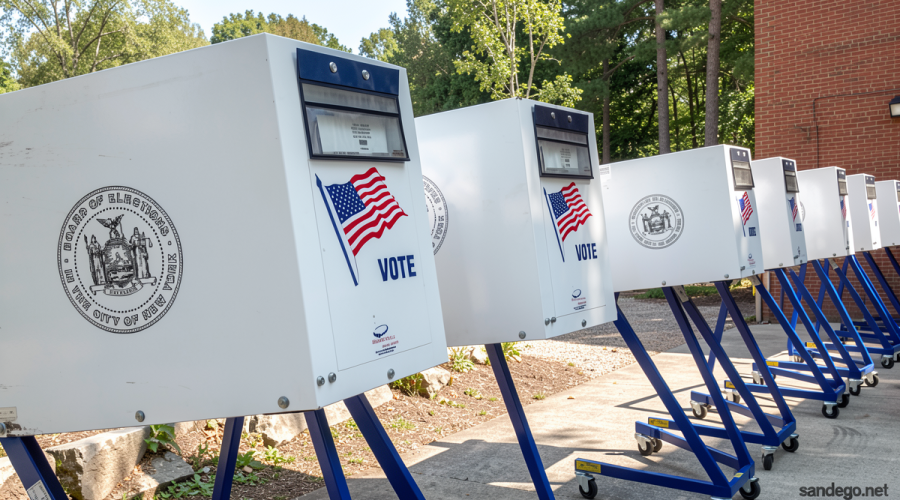
For residents of the nine targeted states, the practical effect of the initiative is that federal agents may appear at polling places, community centers, or private residences to conduct interviews and gather records during the weeks surrounding the midterms. While the guidance frames the effort as investigative rather than prosecutorial, the visibility of federal agents in election-adjacent settings is precisely the scenario the DOJ’s old timing policy was designed to prevent. Voters in those states may encounter questions about their own or family members’ registration status, and the coordination memo with USCIS means that a single interview could trigger immigration consequences for noncitizen household members.
The broader political stakes are equally clear: by centralizing voter-fraud enforcement in DHS rather than leaving it to state election boards or local prosecutors, the administration has created a federal instrument that can operate across state lines, draw on immigration databases, and sustain pressure on state governments through the leverage of grant funding. Whether that architecture produces meaningful prosecutions or primarily generates a record of federal presence during an election cycle remains to be seen over the coming weeks.
Related Reading
Frequently Asked Questions
What is Exclusive?
Exclusive is the main topic of this guide. The article explains the context, practical details, and next steps readers should understand.
Why does Exclusive matter?
Exclusive matters because readers are looking for a useful answer, not just a short summary. Good content should match search intent and help them decide what to do next.