Nepal’s Flooded Hydropower Tunnels: A Rescue Operation Measured in Days, Not Hours
Sandego.net – Thick rivers of mud swallowed entire underground facilities along the Trishuli river corridor last week, burying scores of construction and maintenance workers inside reinforced concrete tunnels. As of the latest count from Nepal’s national disaster agency, at least 933 people remain unaccounted for across multiple hydropower installations threading the remote, high-altitude districts through which the river flows. Whether any of those individuals were actually inside the tunnels at the moment the floodwaters struck — and whether any are still breathing in the darkness below — remains unknown.
The search has been slowed by a convergence of obstacles: persistent heavy weather, meters of saturated sediment clogging access points, and the outright destruction of roads and bridges that once connected these isolated sites to the outside world. Foreign specialists from India and China arrived over the weekend to join Nepal Army engineers and police search-and-rescue units in what has become one of the largest coordinated underground rescue efforts ever attempted in the Himalayan region.
Why the Himalayas Became a Hydropower Frontier
Nepal’s rivers carry enormous kinetic energy, and in recent years the country — backed by investment from both China and India — has poured resources into damming and channeling that flow. The Trishuli basin alone hosts a dense cluster of plants, each designed to convert the river’s steep gradient into electricity for domestic grids and export markets. That rapid buildout, however, has placed thousands of workers in deep, heavily fortified tunnels where a single catastrophic flood event can seal them in for days or weeks.
A list compiled Saturday by the Independent Power Producers’ Association (IPPAN) placed roughly 900 missing workers at 11 separate hydro projects hit by the flooding. Each installation presents a distinct geometric puzzle to rescuers: some tunnels extend several kilometers from their surface portals, meaning a trapped worker could be far beyond the reach of any immediate intervention. Internal rooms, stored rations, and ventilation shafts could theoretically sustain life for extended periods, though oxygen depletion in sealed sections remains a persistent concern.
Trishuli 3A: Digging Through Uncertainty
At the Trishuli 3A plant, where 42 workers were listed as missing, the tunnel connecting the surface to the underground powerhouse exceeds four kilometers (2.5 miles) in length. Dozens of personnel were inside that powerhouse when the flood struck. Arnold Dix, an Australian geologist advising the rescue operation on site, described the central uncertainty facing the drilling teams:
“So, we might only have to dig 10 meters, or we might have to dig 100 meters.”
The stakes extend beyond simple excavation. If the plant’s emergency shutdown systems failed during the flood, the turbine room itself could have filled with water, drowning anyone still inside. Moreover, breaking through the overlying structure risks releasing that stored water onto the very crews working below. Dix characterized the engineering challenge bluntly:
“We need special equipment to get through the steel and everything that’s surrounding the turbine room. So, it’s layer upon layer of technical difficulties.”
Rescuers at Trishuli 3A managed to bore a hole large enough to rappel into the tunnel using ropes and harnesses. They called out into the darkness and received no answer. In earlier phases, teams pumped fresh air into the shaft and lowered food supplies. Officials said the next step, planned for Monday, would be to send trained rescuers inside carrying oxygen tanks, medical kits, two-way communication gear, and cameras.
Chilime: Chest-Deep Mud and a 130-Meter Standoff
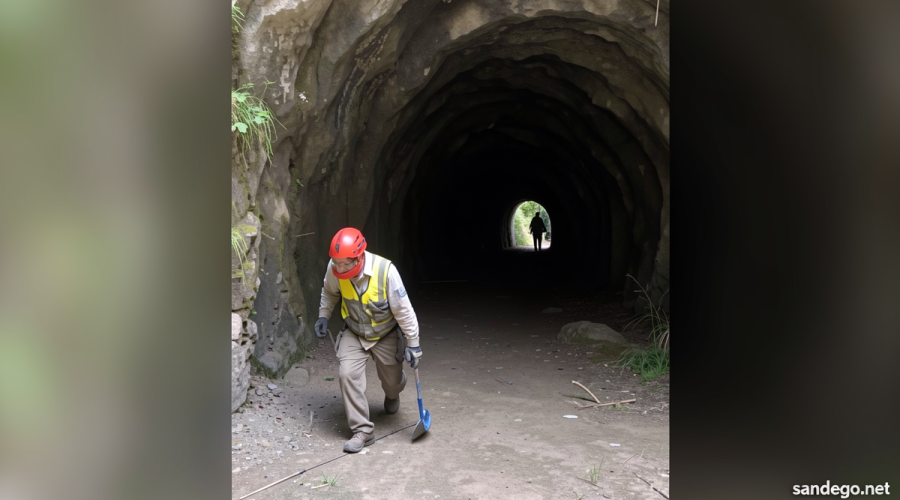
Six workers are believed trapped inside the Chilime Hydropower Plant. Jenjen Lama, a mountain guide participating in the search-and-rescue effort, walked through the facility’s layout: a 250-meter (820-foot) tunnel descending from the surface before joining a larger complex that houses a service bay, a control room, and the main transformer.
On Sunday, teams found the tunnel passage “completely blocked by deep, muddy sediment and sludge” that reached up to their chests. They advanced only 130 meters before conditions forced a halt. Helicopter access to the site was further degraded by damaged infrastructure in the surrounding area, Lama noted. Inside the sealed section, he said, basic survival elements exist:
“there is the kitchen, there is some food … but I don’t know about the oxygen.”
Scale of Damage and What Comes Next
Dix estimated that as many as 27 hydropower plants sustained damage in the flooding, with approximately 12 rendered all but destroyed. Across the affected corridor, at least 279 workers have been recovered or have managed to walk their way out of the silt-choked tunnels, each carrying accounts of near-drowning in near-total darkness. Thermal-imaging cameras mounted on drones have been deployed to scan for heat signatures while ground teams locate tunnel entrances and clear sediment. Drilling through the reinforced concrete roofs of the stations continues in parallel.
The broader implication for Nepal’s energy sector is stark: the very infrastructure built to tame the Himalayan rivers proved vulnerable to the same hydrological forces it was designed to harness. As rescue operations continue under deteriorating weather, the question facing Kathmandu and its international partners is no longer only how many workers remain below ground, but how the country will rebuild a corridor of tunnels that the river has already shown it can fill in a single night.
Related Reading
Frequently Asked Questions
What is Race against time to find workers?
Race against time to find workers is the main topic of this guide. The article explains the context, practical details, and next steps readers should understand.
Why does Race against time to find workers matter?
Race against time to find workers matters because readers are looking for a useful answer, not just a short summary. Good content should match search intent and help them decide what to do next.