
Record Bear Fatalities Push Japan Toward High-Tech Wildlife Deterrence
Sandego.net – Thirteen people died and more than 220 were injured by bears across Japan between April 2025 and March 2026, marking the deadliest stretch of human-bear conflict in the country’s modern record. The figure represents a dramatic jump from the prior year’s same window, which saw three fatalities and 82 injuries. With autumn approaching — the period when bears enter peak feeding mode — local authorities have escalated their alert posture, deploying everything from motion-sensing cameras to autonomous aerial units to keep the animals away from populated areas.
A Decades-Long Demographic Shift Set the Stage
The surge in encounters did not appear overnight. Following World War II, millions of young Japanese residents left rural villages for urban centers, and the farmland that had historically formed a buffer zone between settlements and forested habitats gradually disappeared. Liam Adcock, a wildlife researcher based at the Picchio Wildlife Research Center in Nagano, explains the consequence plainly:
“With the loss of farmland that once buffered settlements from bears, the boundary between towns and forests became more blurred for them.”
Compounding the geographic compression, tighter hunting regulations and a steadily shrinking pool of working hunters have allowed populations of Japan’s two native bear species — the Hokkaido brown bear and the Asiatic black bear — to expand. Current estimates place the national bear population above 57,000 individuals. Climate change has added another layer of pressure: the vegetables, wild berries, and acorns that bears depend on for autumn nutrition are ripening later each season and appearing in reduced quantities, Adcock notes. Bears, however, have adapted their foraging strategy to one reliable, year-round resource.
“But they know that one food source remains unchanged: human rubbish.”
That behavioral shift has drawn hungry animals closer to residential zones than at any point in recent memory. Last year alone, roughly 50,000 bear sightings were logged nationwide.
Government Policy Shifts From Coexistence to Control
In its 2026 environment white paper, the Japanese government formally characterized bears as “a serious threat to public safety and peace,” while simultaneously loosening restrictions on bear hunting and unveiling a multi-year population management roadmap. The plan calls for culling operations designed to bring bear numbers down to between 62% and 67% of present levels across several prefectures by 2030.
Adcock observes that although a broad cultural preference for peaceful coexistence persists among the public, the operational priority has pivoted toward immediate public-safety outcomes and rapid threat response. Traditional scare tactics — fireworks launched in town squares, for instance — remain in use, but their limitations are well understood.
“Often, fireworks are set off in towns to scare off bears. But when it’s not enough, the police or military is deployed, which is often synonymous with euthanizing the bears, especially if it’s during the day and there’s people around.”
The research community is working to demonstrate that nonlethal, technology-assisted management can close that gap.
AI Cameras and Rapid-Response Drones Enter the Field
In prefectures with high encounter rates — Gunma, Toyama, and Ishikawa among them — forests bordering residential zones are being fitted with movement-detection cameras powered by artificial-intelligence recognition software. When a bear is identified, the system alerts local officials in real time, enabling targeted warnings to residents and coordinated efforts to steer the animal back toward deeper woodland. The network was developed jointly by Hokuriku Electric Power Company and communications firm Hokutsu.
In Hokkaido, drone operator KDDI SmartDrone installed a compact launch port in the town of Shintotsukawa. Once a bear sighting is confirmed, a unit can be airborne within ten minutes, tracking the animal’s movement until ground teams arrive. Nonlethal deterrence measures are prioritized at every stage of the response.
“AI and drones are very efficient for detection, and quite helpful for deterrence,”
Adcock says. Comparable aerial-hazing programs have shown measurable success abroad. A small 2024 field study in Montana, United States, found that drone deployments successfully drove bears away from human habitations in 91% of encounters.
The $4,000 Robot That Howls Like an Extinct Wolf
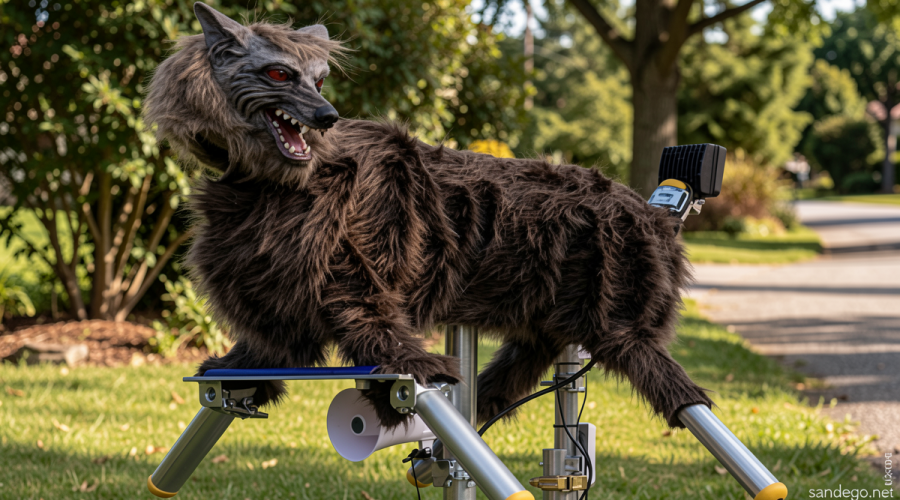
For individual landowners who cannot deploy institutional drone or camera infrastructure, a different tool has entered the market. Wolf Kamui Co. sells a solar-powered, animatronic figure called the “Monster Wolf,” priced at roughly $4,000. The device replicates the howl of the Japanese wolf — a species extinct since the early twentieth century — to trigger an innate avoidance response in bears near agricultural plots and rural properties.
Motohiro Miyasaka, managing director of Wolf Kamui Co., told the company’s sales have doubled since last year, driven by the spike in urban-area bear sightings. The firm is also developing a portable eight-inch plush variant aimed at outdoor recreationists — stream anglers, campers, hikers — who want a lightweight deterrent in their pack. Miyasaka indicated the compact “Monster Wolf Mini” will undergo field testing around the end of 2026.
Limitations and the Road Ahead
None of these technologies, however, constitutes a complete solution. The systems address detection and short-range deterrence but do not eliminate the underlying drivers — habitat compression, climate-driven food scarcity, and the sheer density of a 57,000-strong bear population living in close proximity to shrinking rural communities. Authorities and researchers alike stress that technology must operate alongside habitat management, waste-removal discipline, and the population-control measures now embedded in national policy. The coming autumn feeding season will be the first true stress test of whether Japan’s layered, technology-assisted approach can bend the fatality curve downward before the next record is set.
Related Reading
Frequently Asked Questions
What is Japan is using AI drones and wolf?
Japan is using AI drones and wolf is the main topic of this guide. The article explains the context, practical details, and next steps readers should understand.
Why does Japan is using AI drones and wolf matter?
Japan is using AI drones and wolf matters because readers are looking for a useful answer, not just a short summary. Good content should match search intent and help them decide what to do next.