Paris’s Cheapest Rooms Are Turning Into Ovens — and the City’s Most Vulnerable Residents Feel It First
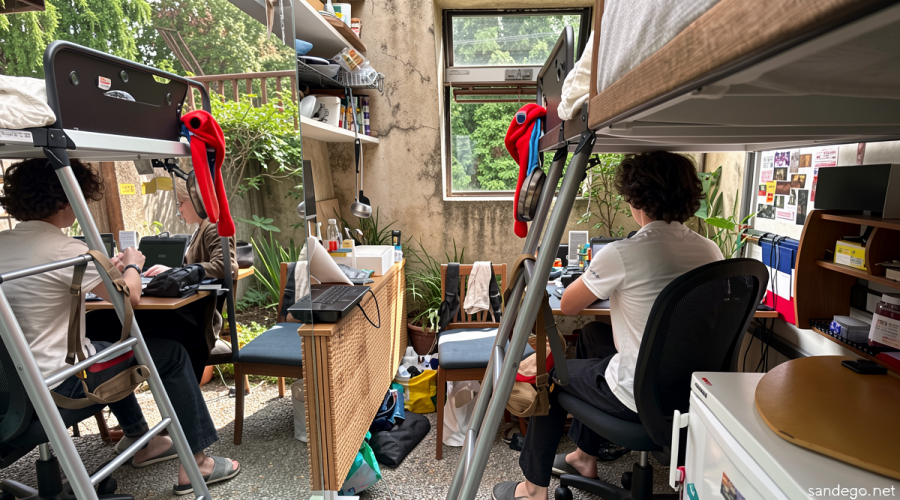
Sandego.net – Every summer, temperatures across France climb past 40 degrees Celsius, and the consequences fall hardest on those who can least afford to relocate. Tucked beneath the zinc rooftops of Haussmann-era apartment blocks, a category of lodging known as the chambre de bonne — literally, a maid’s room — is reaching a breaking point. These compact spaces, originally built more than two centuries ago to shelter domestic servants in bourgeois households, have long served as the entry ticket for students, young artists, and budget travelers who need a bed in central Paris without paying luxury rents. Now, a convergence of heat-trapping roof materials and inadequate airflow is rendering them increasingly unlivable, threatening to erase what remains of the city’s most affordable housing tier.
The Numbers Behind the Heat
A 2024 study conducted by Paris Atelier of Urbanism (APUR), the city’s urban planning agency, found that top-floor units lacking adequate solar shielding can register indoor temperatures roughly 10 degrees Celsius above the outdoor reading. For a nine-square-meter room with a single window and a ceiling that soaks up afternoon sun all day, that margin is not an abstraction — it is the difference between sleeping and suffering. The architects who drafted these buildings in the early 1800s had no framework for regularly enduring triple-digit-Fahrenheit summers, and the structures were never retrofitted with modern insulation or mechanical ventilation. As climate projections push heat-wave frequency higher each decade, the practical habitability of these spaces is eroding year by year.
A Brief History of the Chambre de Bonne
The term refers to small, often windowless or single-windowed rooms positioned at the very top of Haussmannian buildings, directly beneath the roofline. They were conceived in the early nineteenth century as functional quarters for household staff — cooks, maids, footmen — who needed proximity to their employers but did not require the comfort of a proper bedroom. Over time, as servant households declined, these rooms migrated into the student and working-class rental market. Their defining feature has always been location: a few hundred euros per month for a square that sits above some of Paris’s most prestigious boulevards and gardens.
That trade-off — extraordinary geography exchanged for extraordinary confinement — has persisted through generations. From the nineteenth-century Grand Tour, when young Europeans made a rite of passage out of continental exploration, to the expatriate writers of the 1920s who shaped the Lost Generation’s mythology, aspiring city-dwellers have routinely accepted cramped, poorly ventilated quarters in exchange for proximity to the cultural center. Countless novels, poems, and memoirs owe their raw material to the indignities and exhilarations of those early years.
Life Inside: Two Students, Two Perspectives
Novikov: Nine Square Meters in a Million-Euro Neighborhood
Anatoly Novikov, a 23-year-old Russian student enrolled at Institut Polytechnique de Paris, occupies a chambre de bonne in the Notre-dame-des-Champs district — one of the most expensive postal codes in the city. The median property price there hovers around 14,000 euros (approximately $16,400) per square meter. His monthly rent: 700 euros ($820). His room measures exactly nine square meters, roughly the footprint of a standard parking space, which is also the minimum legal size for a dwelling in France.
“It was kind of a childhood dream come true,” Novikov says. “I was always living in the suburbs; I wanted to experience actually being in the city. I think it’s just a very cool authentic student experience where, yes, the location is amazing, but everything else is terrible.”
Friends visiting from outside Paris have expressed alarm at the dimensions, but Novikov frames the constraint as part of the bargain he signed up for.
“I guess prison cells are bigger,” he says. “Other people wouldn’t make it in here; I can. I’m enjoying my survival. That’s a challenge I accepted.”
Guénanain: Six Flights of Stairs and an Eiffel-Tower View
Bilal Guénanain, 24, a student originally from Brittany, rents a studio near the Champs-Élysées for 550 euros ($632) per month — a fraction of what a comparable address would command in the open market. The price tag comes with a daily commute of six flights of stairs to reach his floor.
“Living in Paris without seeing the Eiffel Tower to me, would be very sad,” he says. “I love living my ‘Emily in Paris’ era!”
He adds, with a wry smile, that the stairwell is one detail the television show leaves out.
“We don’t see this in ‘Emily in Paris,'” he jokes.
The Literary Ghost in the Attic
The tradition of the young writer squashed into a rooftop cubby predates modern tourism by well over a century. Victor Hugo, then a student of barely twenty, occupied a tiny lodging just a couple of streets from Novikov’s current address in 1821. The claustrophobia and deprivation of that attic are widely believed to have seeded his later depiction of Marius’s wretched quarters in Les Misérables. Two hundred years on, the spatial logic has not changed; only the climate envelope around it has.
When the Traveler Meets the Room
For visitors unfamiliar with Parisian housing typology, the chambre de bonne can arrive as a genuine shock. Emilie Reh, a 23-year-old freelance creative from New York who launched a personal “Grand Tour” of Europe this summer, booked one through Airbnb without fully grasping what she was purchasing.
“I wasn’t aware that there was a shared bathroom as well,” she recalls. “Because the room was so small and it was pretty hot, I didn’t spend any time in it. Despite the initial shock of discovery, it was a memorable experience.”
What Disappears When the Last Chambre de Bonne Closes
The practical question is no longer whether these rooms will become less comfortable — they already are — but whether they will become uninhabitable at all. If sustained heat pushes indoor temperatures beyond what a human body can tolerate for sleep, landlords face a choice: invest in retrofit insulation, mechanical cooling, and solar shading (costs that may exceed what the rent tier can absorb), or let the units lapse from the market entirely. Either outcome narrows the already thin slice of Parisian housing accessible to students earning minimum wages or travelers on fixed budgets.
The chambers de bonnes have functioned, for two centuries, as a pressure valve in the city’s housing economy — a way for the young and the poor to remain physically present in neighborhoods that would otherwise exclude them. Their disappearance would not merely eliminate a quirky lodging category. It would sever a thread connecting Paris’s present to its literary, artistic, and social past, and it would push the last affordable square meters of central Paris into a market that prices them at fourteen thousand euros each.
Related Reading
Frequently Asked Questions
What is The cheapest accommodation in Paris is disappearing?
The cheapest accommodation in Paris is disappearing is the main topic of this guide. The article explains the context, practical details, and next steps readers should understand.
Why does The cheapest accommodation in Paris is disappearing matter?
The cheapest accommodation in Paris is disappearing matters because readers are looking for a useful answer, not just a short summary. Good content should match search intent and help them decide what to do next.