A Molecular Blueprint for Autism Opens New Avenues for Drug Development
Sandego.net – For families navigating the autism spectrum, the question of why the condition emerges in some brains and not others has long resisted a clean scientific answer. A study published Thursday in the journal Science pushes the field meaningfully forward by charting, at unprecedented scale, how specific genetic mutations associated with autism physically restructure protein networks inside the developing brain. The work, led by researchers at the University of California, San Francisco, produced what its authors describe as the most comprehensive molecular map ever assembled for the disorder — and potentially for any neuropsychiatric condition.
From a Parts List to a Wiring Diagram
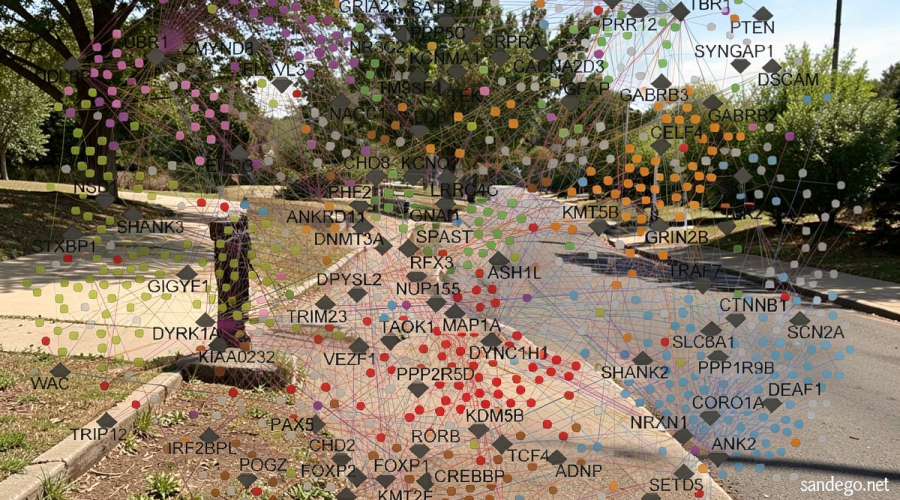
More than 250 distinct genes have been linked to autism spectrum disorder over the past two decades. That sheer number has made the prospect of a single pharmacological intervention feel almost absurd: targeting each mutation individually would require a separate therapeutic strategy for every variant, a task no drug-development pipeline could realistically absorb. The new study reframes the problem. Rather than treating each gene as an isolated endpoint, the researchers traced how mutations in those genes converge on shared protein-interaction pathways during early brain development. In effect, they converted a sprawling inventory of genetic parts into a functional wiring diagram.
The resulting map catalogs over 1,800 protein-protein interactions implicated in autism risk. Strikingly, 87 percent of those interactions had never been documented before this work. By constructing the map in the presence of the relevant mutations, the team could observe precisely how each variant “rewires” the protein landscape, then used an artificial-intelligence system known as AlphaFold to rank which mutations were most consequential. Those top-priority variants were subsequently examined in lab-grown brain organoids — tiny, three-dimensional cultures that mimic aspects of early human brain development.
“You need this insight to ultimately develop drugs, and we’ve generated a map now that is providing essentially the molecular underpinnings of autism and pointing us in a multitude of different directions for ultimate drug discovery,” said Dr. Nevan Krogan, professor at UCSF and senior investigator at the nonprofit Gladstone Institutes.
Why Protein-Level Targeting Changes the Calculus
Krogan, who also directs the Quantitative Biosciences Institute at UCSF, draws an analogy that captures the study’s significance. Knowing which genes carry mutations is comparable to holding a parts list for a complex machine; it tells you what components exist but not how they interact. What a therapeutic strategy truly requires, he argues, is understanding the circuitry — how proteins communicate, what happens when a single mutation disrupts a conversation between two molecules, and where that disruption cascades through the network.
“When you have the genes and the mutations, that’s just a list. That’s a parts list. What you need to do is have a wiring diagram of that parts list, and that’s where you need to go to the proteins and understand how the proteins talk to one another, and understand when you put a mutation in a protein, what does it do to the protein-protein interactions?”
That reframing carries practical weight. If dozens or hundreds of mutations funnel into a limited set of disrupted protein complexes, a smaller number of therapeutic interventions could address a far broader swath of genetic risk. Krogan confirmed that his group already has three programs in active development, drawing directly on insights from the new map to pursue candidate compounds.
External Perspectives and Future Directions
Fikri Birey, assistant professor in the Department of Human Genetics at Emory University School of Medicine and not involved in the study, called the work “the most systematic protein-level view of autism risk we’ve had to date” in an emailed commentary. He noted that the findings could inform disease-modeling research in his own laboratory and suggested a longer-term possibility: identifying drugs that stabilize disrupted protein complexes or block pathological interactions, rather than attempting to correct every individual autism-causing mutation.
The study’s scale is itself a landmark. Krogan characterized the map as the largest ever produced for autism, the largest of its kind for any neuropsychiatric disorder, and the largest mutant-interaction map generated for any disease area to date. He credited advances in computational biology for making the project feasible.
“AI is allowing us to study proteins that we could never have even dreamed of even a couple of years ago, and it’s providing an unprecedented light being shone on autism, the underlying biology behind autism.”
What Comes Next
The map does not deliver a finished drug; it delivers a navigational framework. Its value lies in narrowing an otherwise intractable search space. By identifying which protein interactions are most frequently perturbed across the autism gene landscape, the study gives medicinal chemists and neuroscientists a prioritized shortlist of molecular targets to probe. Whether that shortlist ultimately yields the first disease-modifying therapy for autism remains an open question, but the path from genetic association to mechanistic intervention has just become considerably shorter.
“The hope would be at some point you’d be looking back and saying, ‘Ah, this map led to X, Y, and Z, and therefore we have now the first-ever treatment to autism.’ That’s the vision, and I believe that’s going to come to fruition at some point in the future,” Krogan said.
Related Reading
Frequently Asked Questions
What is Largest ever map of autism may hold?
Largest ever map of autism may hold is the main topic of this guide. The article explains the context, practical details, and next steps readers should understand.
Why does Largest ever map of autism may hold matter?
Largest ever map of autism may hold matters because readers are looking for a useful answer, not just a short summary. Good content should match search intent and help them decide what to do next.