
US aircraft carrier returns home after record deployment that included Iran war, Maduro capture
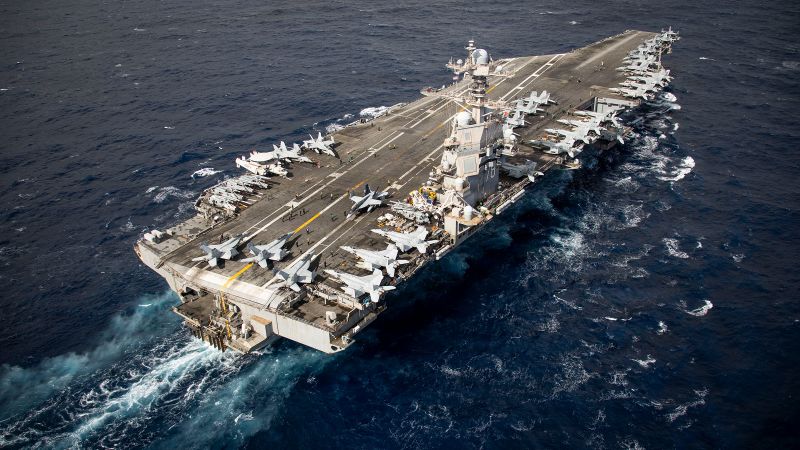
US Aircraft Carrier Returns Home After Record Deployment Highlighting Global Missions
US aircraft carrier returns home after – The USS Gerald R. Ford, America’s most advanced and largest aircraft carrier, arrived back in Virginia on Saturday, marking the end of a 11-month deployment that spanned a wide array of military operations. This voyage, which stretched beyond the typical seven-month limit for such vessels, became a defining chapter in the ship’s service history, featuring its role in the Iran conflict, the capture of former Venezuelan leader Nicolás Maduro, and a series of technical challenges that tested the crew’s endurance. The return to Norfolk was met with cheers from sailors and their families, who endured a year of uncertainty and logistical hurdles while the carrier remained at sea.
Extended Deployment and Strategic Objectives
The Ford’s prolonged mission was a testament to its critical role in President Donald Trump’s foreign policy agenda. From the outset, the ship served as a mobile command center for operations in the Mediterranean, where it supported NATO efforts and monitored regional tensions. Later, it pivoted to the Caribbean, where it played a key part in the capture of Maduro, a mission that required precise coordination and rapid response. The deployment’s length underscored the U.S. military’s commitment to maintaining a visible presence in global hotspots, even as the ship faced unexpected setbacks.
The deployment’s unique duration also highlighted the challenges of operating a cutting-edge vessel in unpredictable environments. While the Ford was designed for seven months at sea, its extended time at sea forced the crew to adapt to a range of issues, from prolonged shifts to resource constraints. Admiral Daryl Caudle, the ship’s commander, acknowledged the difficulties, stating, “We really want to deploy our ships for the length of time they’re designed to.” However, he noted that the Ford’s mission was a product of “a once-in-a-lifetime confluence of events,” including the ongoing conflict in Iran and the need for rapid intervention in Venezuela.
Families and the Human Toll
For the families of the sailors, the deployment was a year of constant worry and sacrifice. Victoria Dobson, whose husband served aboard the Ford, shared her relief as the ship docked in Norfolk. “I’m very excited, I’m very relieved,” she said to CNN’s Brian Todd. “The most difficult part was definitely the single parenting. When he left, she was a baby, and now she’s a big girl.” Dobson described the emotional weight of navigating daily life without her spouse, from adjusting to a new routine without a “baby bottle” to managing the transition from infancy to toddlerhood alone.
The extended deployment also placed additional strain on the crew’s personal lives. Amini Osias, whose daughter worked as an aviation electrician on the Ford, expressed the relief of finally being able to “relax and breathe” after the ship’s return. “Now I can go back to a normal sleeping pattern,” he said. “I just want to be a dad with her.” The Ford’s presence in the Caribbean meant that the crew was often deployed far from home, with limited opportunities for rest or family time.
Technical Challenges and Resilience
Despite its advanced design, the Ford faced several technical hurdles during the deployment. One of the most significant incidents occurred in March when a fire broke out in the ship’s laundry area. The blaze, which required over 30 hours to extinguish, disrupted operations and forced the crew to relocate for several days. “The damage meant the ship couldn’t do laundry for a stretch,” said one sailor, adding that the situation added to the daily challenges of life at sea. While no serious injuries were reported, the fire sparked questions about the ship’s safety protocols and maintenance standards.
Compounding the issues, the Ford’s plumbing system experienced repeated malfunctions, leading to intermittent partial outages that affected daily routines. These problems forced the ship to make a port visit for repairs, further extending its time away from home. “It was a rough journey at times,” said Dakota Klinedinst, a Petty Officer First Class and aviation structural mechanic. “The extended deployment was tough, but we worked as a team to keep things running.” Klinedinst emphasized the crew’s resilience, noting that even during the fire, they maintained composure and continued their duties without breaking stride.
Airman Osias, who also mentioned the reliability of the ship’s systems, admitted that the prolonged deployment raised doubts among families. “Even though the Ford is technically advanced, there were still those worries that something could go wrong,” he said. “It’s not just about the ship’s capabilities—it’s about how it performs under pressure.” These concerns were echoed by other military officials, who highlighted the strain of operating the $13 billion vessel for an unprecedented duration.
Operational Flexibility and Strategic Impact
The Ford’s electronic catapult system, a revolutionary feature compared to older carriers, proved instrumental in its diverse missions. This system allows the ship to launch everything from small drones to large fighter jets, providing commanders with a versatile array of firepower options. “The ship’s catapult technology gives us a unique advantage,” said Brent Sadler, a 26-year Navy veteran and former submarine officer. “It’s not just about speed—it’s about adaptability in different combat scenarios.” Sadler pointed out that no other U.S. aircraft carrier possesses this capability, making the Ford a vital asset in both the Iran conflict and the Venezuela operation.
During the Iran campaign, the Ford served as a launching point for sustained air strikes, showcasing its ability to project power across vast distances. The ship’s presence in the region also acted as a deterrent, reinforcing U.S. commitments to allies and partners. In Venezuela, the carrier’s aircraft played a pivotal role in the capture mission, highlighting its strategic importance in regional security operations. These missions, while successful, required the crew to operate under high-stakes conditions, often with little time for respite.
The return of the Ford to Virginia marked not just the end of a mission, but the beginning of a new chapter for its crew. Families gathered in Norfolk to celebrate the sailors’ homecoming, waving handmade signs that expressed their gratitude and pride. One banner read, “I missed you! Glad you’re back,” symbolizing the deep connection between the ship and its personnel. As the carrier docked, the crew’s accomplishments were recognized, though the challenges they faced during the deployment remained a subject of reflection.
Admiral Caudle, addressing the crew and families, acknowledged the “difficulties” of the extended deployment but expressed hope that it would not set a precedent. “We don’t want that to be the norm,” he said, emphasizing the need to balance operational demands with the well-being of the crew. With the Ford now back in port, the U.S. military will evaluate its performance and prepare for future deployments, ensuring that its capabilities are fully leveraged in the years to come.
