Supreme Court Upholds Birthright Citizenship, Limiting Trump’s Immigration Push
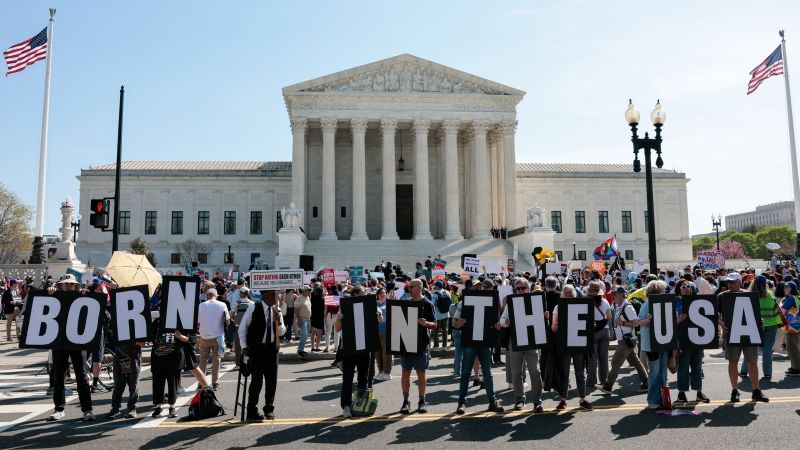
Sandego.net – On June 30, 2026, the Supreme Court delivered a landmark ruling that preserved birthright citizenship for children born in the United States, dealing a major setback to President Donald Trump’s efforts to reshape the nation’s immigration policies. The decision, handed down in a 6-3 split, rejected Trump’s executive order aimed at ending automatic citizenship for babies born to undocumented parents. While the outcome was anticipated, it marked a critical moment for a president whose campaign hinged on curtailing “birth tourism” and redefining the criteria for American citizenship.
A Mixed Bag of Outcomes for a Trump-Led Court
Though the ruling aligned with Trump’s broader immigration agenda, it fell short of a complete dismantling of his vision. The court’s decision, though not entirely surprising, underscored the president’s struggles to consolidate power on key issues. During his term, Trump faced several high-profile challenges, including disputes over tariffs and federal independence, yet also secured notable victories. This latest ruling, however, highlighted a persistent tension within the conservative bloc, as some justices diverged from the majority’s interpretation of the 14th Amendment.
The 26-page opinion, authored by Chief Justice John Roberts, was crafted to simplify a complex legal debate that had dominated political discourse for over a year. Roberts emphasized textual fidelity, arguing that the amendment’s language should be taken at face value rather than through interpretive lenses. His reasoning resonated with a strategy often employed by conservative justices: focusing on the explicit wording of statutes and historical context to avoid perceived judicial overreach.
“If Congress intended to limit American citizenship to the children of those domiciled in the United States, nothing in the succinct language of the citizenship clause conveyed that design,” Roberts wrote.
Roberts’ argument hinged on the idea that the 14th Amendment’s Citizenship Clause was designed to ensure that all children born within the country, regardless of their parents’ immigration status, would be granted citizenship. He pointed out that terms like “mother,” “father,” “lawful,” and “temporary” — frequently used in Trump’s executive order — were absent from the amendment’s text. “They did not matter,” he concluded, framing the decision as a return to the original intent of the amendment’s framers.
The Echoes of Wong Kim Ark
The ruling drew heavily from the 1898 case US v. Wong Kim Ark, which established that children born to foreign nationals in the U.S. automatically acquire citizenship. Roberts invoked this precedent to argue that the majority’s interpretation was consistent with the amendment’s historical application. “What the Court held in Wong Kim Ark was simple: the Citizenship Clause incorporated the common law and granted citizenship to nearly all children born in the United States,” he stated.
Roberts acknowledged that the decision might have been more contentious if the court had split further, but the 6-3 outcome allowed for a clear majority. Only Justice Amy Coney Barrett joined Roberts in the majority opinion, while the three liberal justices — Sonia Sotomayor, Elena Kagan, and Ketanji Brown Jackson — supported the ruling. The three conservative dissenters, however, combined their arguments into a 130-page critique, underscoring their disagreement with the majority’s approach.
Dissenting Voices: A Divided Front
Justice Samuel Alito, the longest-serving conservative on the bench, was the most vocal in his dissent, calling the decision “one of the most important” in the court’s history. “The court has made a serious mistake,” he asserted, arguing that the 14th Amendment was not intended to grant citizenship to all children born in the U.S., regardless of their parents’ status. Alito contended that the ruling created an incentive for undocumented individuals to remain in the country, potentially undermining immigration enforcement.
“This is one of the most important decisions in the history of the court, and in my judgment, the court has made a serious mistake,” Alito wrote.
Justice Clarence Thomas, in a nearly 100-page dissent joined by Justice Neil Gorsuch, further criticized the majority for “repurposing” the amendment to align with contemporary political goals. He argued that the amendment’s original purpose was to secure citizenship for former slaves and their descendants, not to extend it to all children born on American soil. “I am not sure that today’s opinion will stand the test of time,” Thomas noted, suggesting the decision might be revisited in the future.
Thomas also accused the majority of diluting the legal definition of citizenship, claiming their interpretation could conflict with the amendment’s foundational principles. His dissent highlighted a growing concern among some conservatives that the court’s recent rulings might be influenced by ideological preferences rather than strict textual analysis. This perspective stood in contrast to Roberts’ emphasis on historical continuity.
A Shift in Legal Interpretation
The ruling sparked debate over the evolving role of the Supreme Court in shaping immigration policy. Critics argued that the majority’s reliance on historical precedent, while logical, failed to address modern concerns about border security and the number of births to undocumented parents. Meanwhile, supporters of the decision praised Roberts for anchoring the argument in the amendment’s plain language, rather than allowing it to be reshaped by executive action.
Justice Ketanji Brown Jackson, one of the liberal justices in the majority, countered Thomas’s claim that the amendment was solely for former slaves. She emphasized that the 14th Amendment’s broader purpose was to secure civil rights for all Americans, including those born to immigrants. Jackson’s rebuttal highlighted the importance of the amendment in fostering a unified national identity, a principle she argued the majority’s interpretation upheld.
The decision also underscored the growing ideological rift within the court. While Roberts and Barrett aligned on the need for textual clarity, the other conservative justices saw the ruling as a missed opportunity to redefine citizenship rules. Their dissent reflected a broader strategy to challenge the majority’s authority and assert a more expansive view of immigration policy.
Implications for the Future
With the ruling, the Supreme Court preserved a cornerstone of American immigration law, but it did not end the debate. The decision could influence future legislative efforts, as lawmakers may seek to clarify the amendment’s provisions through congressional action. It also raised questions about the role of executive orders in immigration reform, particularly under a president who has used such tools to advance his agenda.
For now, the majority’s stance appears to have prevailed, but the dissenting opinions suggest that the issue is far from settled. The ruling will be remembered as a pivotal moment in the court’s recent history, reflecting the balance of power among its justices and the enduring impact of the 14th Amendment on American identity. As the debate continues, the decision serves as both a defense of tradition and a catalyst for future legal challenges.
Roberts’ opinion, while concise in its structure, encapsulated the core of the court’s reasoning. By grounding the decision in historical precedent and the amendment’s original intent, he provided a framework that the majority justices followed. However, the dissenting justices’ detailed critiques revealed a willingness to explore alternative interpretations, even as they acknowledged the amendment’s significance.
In the end, the ruling reaffirmed the principle that birthright citizenship remains a fundamental aspect of American law. While Trump’s administration may have been disappointed, the decision solidified the 14th Amendment as a key pillar in the nation’s immigration framework. As the court continues to navigate contentious issues, this case will be a reference point for how legal principles are applied in the modern era.