Trump Posts AI-Generated Image of Golden Eagle on Truman Balcony
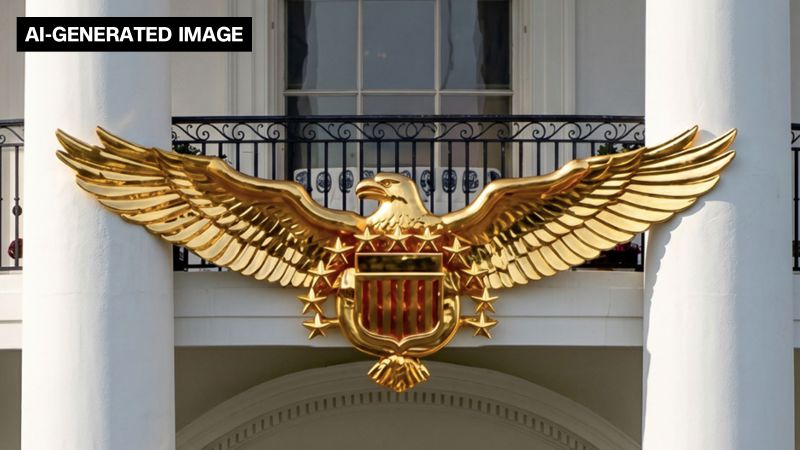
Sandego.net – On Monday evening, President Donald Trump shared an image on Truth Social that depicted a strikingly large, golden eagle perched atop the Truman Balcony of the White House. The visual, which appeared to be digitally crafted, showcased the eagle with its wings spread wide, its golden feathers catching the light, and a stars and stripes shield positioned prominently in the foreground. The accompanying caption read, “A Golden Gift to the White House for its 250th Birthday Year!”—a statement that quickly sparked debate over the authenticity of the image.
The White House later amplified the post by sharing it on its official X account, signaling approval of the visual. However, experts and observers noted subtle inconsistencies between the balcony railing in the image and its real-world counterpart. These discrepancies, such as slight variations in texture and spacing, suggested the photo might not have been taken in the present moment but rather generated using artificial intelligence. Additionally, the shield in the image featured only 11 stars, a detail that raised eyebrows given the traditional symbolism of 13 stars representing the original 13 colonies at the nation’s founding.
Metadata Confirms AI Origin
Upon closer examination, the image revealed metadata credentials tied to Google AI, further confirming its synthetic nature. This information, embedded within the file’s technical details, indicated that the eagle and its accompanying elements were created through advanced image-generating algorithms rather than captured from life. The use of such technology has become increasingly common in political messaging, allowing leaders to craft visually compelling narratives without the need for real-time photography.
“A Golden Gift to the White House for its 250th Birthday Year!” – President Donald J. Trump ??
Trump’s choice to feature a golden eagle—a departure from the traditional bald eagle emblem—added a layer of symbolism. While the bald eagle has long been associated with American identity, the golden variant could be interpreted as a nod to the president’s own brand of populism or a tribute to the nation’s historical legacy. The stars and stripes shield, with its 11-star configuration, also sparked curiosity, as it seemed to diverge from the standard design used in official White House imagery.
Photographer Andrew Leyden provided a critical perspective by posting his own images of the Truman Balcony, captured at 9:30 p.m. the same night Trump’s post went live. Leyden’s photos, which were uploaded to X, showed no trace of the golden eagle, despite the presence of the shield and the balcony’s distinctive railing. This raised questions about the timing of the image’s creation, suggesting it might have been generated hours or even days prior to Trump’s public display.
Trump’s Renovations and Symbolic Gestures
Since assuming the presidency in 2025, Trump has embraced a strategy of adding personal elements to the White House’s iconic spaces. This includes the installation of gold accents throughout the Oval Office and the placement of large, challenge-coin-style medallions in the West Wing and White House residence. The eagle image on the Truman Balcony appears to be part of this broader effort to infuse the presidential estate with a sense of exclusivity and grandeur.
His renovations have extended beyond aesthetics, encompassing significant infrastructure projects. These efforts include the complete remodeling of the White House Rose Garden, the addition of two massive flagpoles on the North and South Lawns, and the demolition of the East Wing to make way for his controversial ballroom development. The Truman Balcony, a historic site that has hosted numerous presidential events, now seems to be another canvas for Trump’s vision of the White House as a symbol of his political legacy.
The eagle image, though AI-generated, has been strategically aligned with the 250th anniversary of the White House, which is being celebrated this year. This timing adds context to Trump’s decision, as the anniversary provides a natural opportunity to highlight his contributions to the building’s image. However, the image’s synthetic nature has led some to question whether it was meant to be taken literally or as a metaphorical representation of Trump’s impact on the nation’s landmarks.
Experts in digital media have pointed out the growing trend of AI-generated visuals in political communication. These images, often indistinguishable from photographs to the untrained eye, allow leaders to craft idealized versions of reality. Trump’s eagle image is a prime example, blending historical symbolism with modern technology to create a visually striking message. The use of Google AI’s tools underscores the accessibility of such technology, even for high-profile figures like the president.
Despite the skepticism surrounding the image’s authenticity, the White House has not yet issued a formal statement addressing the controversy. CNN, which first reported on the image, has sought comments from the administration to clarify the situation. Meanwhile, the public and media continue to dissect the details, with some suggesting the image is a clever blend of nostalgia and innovation, while others view it as a calculated move to reshape historical narratives.
The Truman Balcony, originally constructed in 1948 as part of the Presidential Office Building, has long been a focal point of presidential imagery. Its historical significance, combined with Trump’s recent modifications, has made it a subject of fascination. The golden eagle, while a fictional addition, aligns with the president’s tendency to reframe iconic symbols to reflect his personal brand. This approach has been consistent with his previous efforts to modernize and personalize the White House’s appearance.
As the debate over the image’s origin continues, it highlights the evolving role of technology in political discourse. AI-generated visuals offer new possibilities for storytelling, but they also challenge the public’s perception of reality. Trump’s eagle post is a case study in how such images can be used to blend historical context with contemporary messaging, all while leveraging the power of digital tools to amplify his influence.
In an age where visual content can be manipulated with ease, the distinction between real and artificial images becomes increasingly blurred. The eagle on the Truman Balcony serves as a reminder of this trend, inviting scrutiny over the accuracy of political imagery. While Trump’s post has generated both praise and criticism, it underscores the ongoing dialogue about the role of AI in shaping public opinion and the symbolic weight of presidential gestures in the modern era.
The image’s placement on the Truman Balcony also raises questions about its intended audience. Was it meant to symbolize the White House’s enduring legacy, or to celebrate Trump’s own resurgence in power? The answer may lie in the president’s broader narrative of reinvention, which has characterized his political career. As the eagle’s golden feathers caught the light in the image, so too did the spotlight on Trump’s use of technology to reframe the nation’s history and his place within it.
With the White House’s 250th anniversary serving as a backdrop, Trump’s AI-generated eagle has become a focal point for discussions about the intersection of politics and technology. It represents not only a creative endeavor but also a strategic use of visual media to connect with the public. Whether viewed as a genuine tribute or a calculated move, the image has sparked a conversation about the authenticity of political symbols in an era of digital innovation.
As the debate unfolds, the focus remains on the balance between artistic expression and factual precision. Trump’s post exemplifies how leaders can use AI to craft narratives that resonate with their base, even if the visuals themselves are not grounded in reality. The eagle, now a permanent fixture in the digital landscape of presidential communication, stands as a testament to the power of technology in shaping the visual language of politics.