Self-Exiled Chinese Billionaire Gets 30-Year Sentence in U.S. for ‘Astonishing’ Fraud
A Conviction That Shook Global Investors
Sandego.net – On Monday, Guo Wengui, a Chinese business magnate who had left the country a decade ago, was handed a 30-year prison sentence in the United States for orchestrating a colossal financial scheme. The federal judge presiding over the case, Analisa Torres, called the fraud “astonishing,” emphasizing its widespread impact on over 1,000 individuals worldwide, who lost hundreds of millions of dollars through what she described as a calculated exploitation of trust. Guo, who now resides in the U.S., has long been a vocal critic of the Chinese Communist Party (CCP), and his legal proceedings highlighted the tension between his role as a dissident and his alleged misconduct.
The sentencing took place in a Manhattan courtroom that buzzed with activity, as Guo’s supporters filled the gallery, some waving flags and others chanting his name. Torres, delivering the verdict, accused Guo of targeting individuals who aimed to promote democratic reforms in China, using their financial contributions to fund his extravagant lifestyle. The judge noted that Guo’s actions not only drained investors’ savings but also caused profound emotional distress, leaving victims “severely anxious and shamed,” as detailed in letters she reviewed during the case. These letters painted a vivid picture of families torn apart by Guo’s schemes, with some describing how their life savings were wiped out overnight.
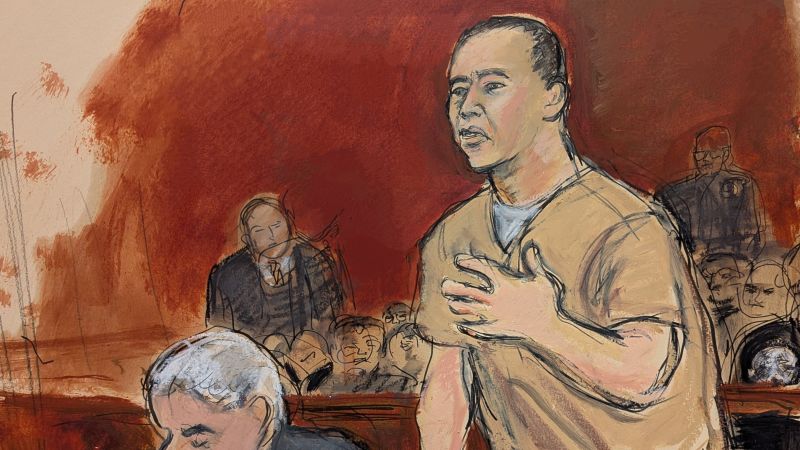
“When I came here, I said: ‘I have a tummy ache, I need to go to the bathroom, I don’t feel well,’” Guo said through an interpreter, recounting his protest against the judicial process. He claimed to have been taken to the hospital early Monday, disputing the prosecutor’s assertion that he was faking his illness. Guo argued that his repeated vomiting during the return to custody was a genuine symptom, not a sign of malingering. His defense also highlighted the physical toll he endured in China, including scars and disfigurements from torture, which required extensive medical procedures from 1993 to 2022.
Guo’s legal team had previously emphasized the challenges he faced in China, alleging that the CCP’s “grand, pervasive, and life-threatening” pursuit of him drove him to seek refuge abroad. They argued that a lengthy prison term would not only reinforce China’s narrative of discrediting dissidents but also embolden further efforts to silence critics. In contrast, prosecutors had stressed the severity of the case, noting that Guo’s fraud spanned from 2018 to 2023 and involved manipulating investors into pouring over $1 billion into entities he controlled. These included his media company, GTV Media Group Inc., as well as the Himalaya Farm Alliance and the Himalaya Exchange, which he used to funnel funds into personal wealth.
A Lifestyle of Excess and Deception
Prosecutors painted a picture of Guo as a man who lived opulently while defrauding thousands. They described his “gilded life” as one filled with mansions, yachts, race cars, designer clothing, and luxury furnishings, all made possible by the billions he siphoned from unsuspecting investors. The case, which unfolded over seven weeks, revealed how Guo’s intricate network of shell companies and false promises created a web of deception that ensnared global participants. His defense, however, countered that his wealth was a direct result of his family’s ownership of China’s largest publicly traded securities company, and that he became a target of Chinese officials after exposing their corruption.
During the trial, Guo’s lawyers argued that his move to Hong Kong, London, and eventually New York in 2017 was a response to political persecution. They noted that a court probation officer had documented his physical injuries from torture in China, which he claimed were severe enough to require multiple surgeries. This medical history, they suggested, should be considered in determining his sentence, as it demonstrated his resilience in the face of oppression. Meanwhile, prosecutors maintained that Guo’s actions were deliberate, with the fraud designed to erode trust in the CCP and fund his personal ambitions.
“The reason I came to the U.S. was to destroy the CCP,” Guo stated during his brief address to the court, underscoring his belief that the fraud was a strategic move against the ruling party. His defense also pointed out that defendants in similar cases had received two-to-four-year sentences, arguing that a 30-year term would unfairly reflect the U.S. government’s broader campaign against Chinese dissidents. Wei Chen, a victim who testified at the trial, told Torres that Guo’s actions had shattered her family’s financial stability, describing the loss as “a complete destruction of our lives.”
The judge, however, remained unmoved by Guo’s claims of victimhood, insisting that he took no responsibility for his crimes. Torres highlighted Guo’s tendency to “harass and intimidate” those who criticized him, a pattern she said extended to his supporters, who had been vocal in the courtroom. The sentence also required Guo to forfeit $889 million in restitution, a figure that underscores the scale of the financial harm caused by his schemes. His supporters, who had gathered outside the courthouse before the sentencing, erupted into applause as he exited, though the judge’s remarks left little room for celebration.
A Political Alliance and a Nation’s Backlash
Guo’s journey to the U.S. was marked by a strategic alliance with conservative political strategist Steve Bannon. The two men had announced a joint initiative in 2020 to overthrow the Chinese government, a move that positioned Guo as both an economic powerhouse and a political agitator. While in New York, he resided in a luxury apartment overlooking Central Park and was a member of Donald Trump’s Mar-a-Lago Florida golf club, symbolizing his integration into American society. Yet, this integration did not shield him from the wrath of Chinese authorities, who accused him of crimes ranging from rape and kidnapping to bribery.
Despite his claims of being framed, Guo’s legal team admitted that his wealth grew rapidly as his family solidified their position as the largest shareholder of a key Chinese securities firm. This financial success, they argued, was a double-edged sword, making him a target for the CCP’s retribution. The prosecution, on the other hand, framed his actions as a deliberate attack on the party’s credibility, using his wealth to fund a propaganda machine that amplified his criticisms of China’s leadership. The case, therefore, became a microcosm of the broader ideological clash between Guo and the CCP, with the U.S. court serving as a battleground for their competing narratives.
Legacy of Deception and Dissent
Guo’s conviction has sparked debates about the fairness of his trial and the broader implications for Chinese dissidents. His defense highlighted how the U.S. legal system could be used to target individuals with political motivations, arguing that his sentence would validate China’s efforts to discredit him. Meanwhile, prosecutors emphasized that Guo’s “astonishing” fraud had left a trail of devastation, with victims not only losing money but also suffering from emotional and psychological trauma. The judge’s decision to impose a 30-year sentence reflected the gravity of the case, as well as the U.S. government’s determination to hold Guo accountable for his role in the financial crisis.
As Guo’s supporters cheered outside the courthouse, the case raised questions about the balance between individual accountability and political persecution. His lawyers had hoped for a more lenient term, citing his physical suffering in China and the potential for his imprisonment to strengthen the CCP’s narrative. But Torres’s ruling signaled a clear stance: Guo’s actions, whether motivated by ideology or greed, had caused irreversible harm, and the sentence was a testament to the seriousness of his crimes. The story of Guo Wengui, once a symbol of Chinese economic success, now stands as a cautionary tale of how ambition and dissent can intertwine in a web of deception and legal consequences.