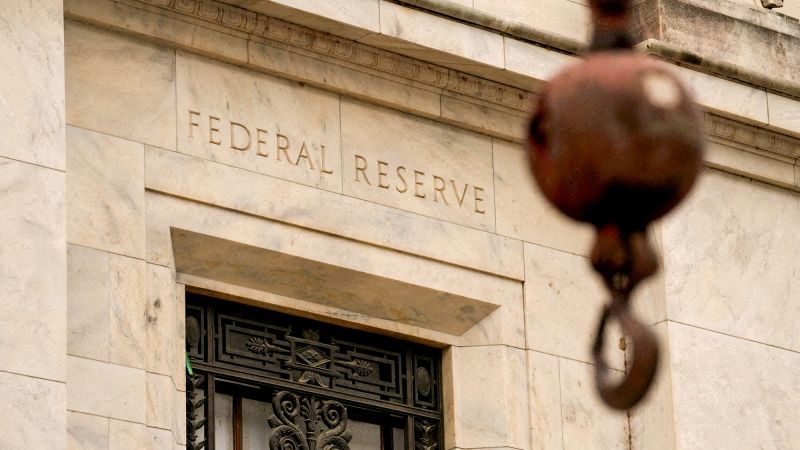
Trump is losing his fight with the Fed
Sandego.net – President Donald Trump’s second term has brought renewed efforts to influence the Federal Reserve’s policies, but a recent Supreme Court decision has marked a pivotal moment in his campaign to exert control over the central bank. The ruling, issued on Monday, dealt a decisive blow to Trump’s strategy, reinforcing the Fed’s autonomy and highlighting the challenges he faces in reshaping its direction.
A High-Stakes Legal Battle
At the center of the dispute was Lisa Cook, a Federal Reserve governor whose removal Trump attempted last year. The president accused Cook of mortgage fraud, alleging that her designation of two properties as primary residences—a home in Ann Arbor, Michigan, and a condo in Atlanta—was a misstep. While no formal charges have been filed against her, Trump sought to leverage this claim to oust a policymaker who had been a vocal advocate for maintaining higher interest rates. The Supreme Court’s 5-4 decision on Monday confirmed that the administration had not provided Cook with the due process required by law, effectively blocking the removal.
“Trump’s efforts to oust me were an attempt to remove me on a manufactured pretext,” said Cook in a statement following the ruling. She emphasized that the allegations were not substantiated, and her actions were in line with standard practices.
The case has broader implications for the Fed’s political independence. Cook, who votes on interest rate decisions, was a key figure in the central bank’s approach to economic stability. If Trump had succeeded in replacing her, it could have shifted the balance of power within the Fed, potentially aligning its policies more closely with the president’s agenda of lower borrowing costs. However, the court’s decision preserved the Fed’s ability to act based on economic data rather than political pressure.
Legal Precedent and Economic Credibility
The ruling underscored a critical legal principle that has long safeguarded the Fed’s independence: officials can only be removed for “cause,” such as malfeasance or negligence. Justice Brett Kavanaugh, a conservative who joined the majority in the 5-4 decision, noted that the case highlighted the risk of allowing presidents to dismiss Fed members based on “trivial or inconsequential allegations.” He warned that such a precedent could lead to uncertainty, undermining the central bank’s credibility and destabilizing financial markets.
Chief Justice John Roberts, who authored the majority opinion, stressed that the decision focused on procedural fairness rather than the merits of Cook’s alleged misconduct. “Without such protections, she could not properly dispute the charges the President laid against her,” Roberts wrote. The court did not evaluate whether the fraud claims were valid, only that they were not presented with sufficient evidence or opportunity for rebuttal.
The Fed’s Role in Economic Stability
Trump’s push to control the Fed reflects a long-standing debate over the central bank’s role in monetary policy. For decades, the Fed has operated independently, making decisions that prioritize long-term economic health over short-term political gains. This independence has been crucial in maintaining public trust in the U.S. dollar and ensuring stable prices, even when such choices are unpopular. As the global economy grapples with the aftermath of a historic oil shock, the Fed’s ability to act without presidential interference has become more vital than ever.
Michael Reynolds, vice president of investment strategy at Glenmede, echoed this sentiment in a Monday commentary. He remarked that “if July 4th is the nation’s independence day, the Fed got its own five days early,” underscoring the significance of the court’s decision in preserving the central bank’s autonomy. The ruling also serves as a reminder that the Fed’s independence is not just a legal formality—it is a foundational element of its effectiveness.
Broader Implications for the Central Bank
The case has been a focal point in Trump’s broader strategy to influence the Fed. By targeting Cook, he aimed to replace a policymaker who had resisted his push for rate cuts. However, the Supreme Court’s decision signals that this approach may not succeed. The ruling reaffirms that the Fed’s leadership must be evaluated through established legal standards, not just executive will.
Trump responded to the decision by reiterating his commitment to removing officials who fail to act in the nation’s interest. On Truth Social, he declared, “We will take appropriate action immediately to ensure that someone who has committed wrongdoing will not be making vital decisions concerning the Welfare of the United States of America!” This defiance highlights the ongoing tension between the executive branch and the Fed, even as the central bank continues to assert its independence.
Despite the setback, the Fed remains steadfast in its current trajectory. Officials have indicated that interest rates will stay elevated for the foreseeable future, even with the appointment of new leadership. This stance reflects the central bank’s prioritization of inflation control over political pressure, a policy that has drawn criticism from Trump but remains critical in stabilizing the economy during periods of global volatility.
As the ruling solidifies the Fed’s independence, it also raises questions about the future of presidential influence over monetary policy. While Trump may still attempt to challenge the central bank’s decisions, the legal framework established in this case limits his ability to act unilaterally. The decision serves as a reminder that the Fed’s autonomy is a cornerstone of its ability to serve the public interest, even when its choices conflict with the agendas of elected leaders.
With the Supreme Court’s intervention, the battle over the Fed’s independence has taken a decisive turn. The ruling not only preserved the central bank’s structure but also set a precedent that could shield it from future attacks. As the economy navigates complex challenges, the Fed’s continued independence ensures that its decisions remain grounded in economic realities rather than political convenience.