Can the so-called nanobubbler save the Reflecting Pool?
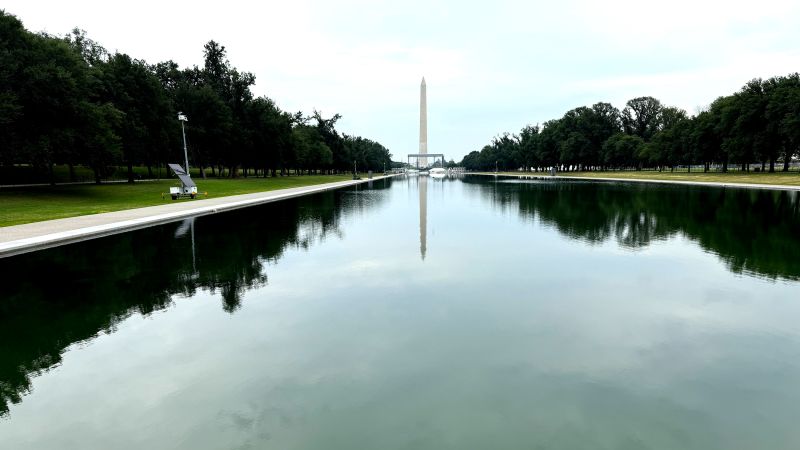
Sandego.net – The Lincoln Memorial Reflecting Pool, a historic landmark that has long been a symbol of American unity, now faces a new challenge in its quest for clarity. A $1.7 million ozone nanobubbler system has been deployed to tackle the persistent algae and bacterial growth in its waters. This technology, which generates 500 million microscopic bubbles per teaspoon of water, is designed to break down contaminants through oxidation. Despite its promise, the project has sparked debates about its effectiveness and the political implications of its implementation.
The Technology in Action
The nanobubbler system operates by injecting oxygen into the water, creating an environment where algae, bacteria, and other impurities are neutralized. While the process is scientifically described as oxidation, it’s often colloquially referred to as a way to “smash through” these substances. The Trump administration has positioned this innovation as a modern solution to an aging infrastructure issue, highlighting its advanced capabilities. However, the system’s application to the Reflecting Pool has raised questions about its scalability and long-term viability.
Greenwater Services, the company tasked with managing the pool’s water quality, has been at the center of this initiative. Based in Brookfield, Ohio, the firm is one of the few in the country to offer this specific technology. Its involvement in the project, which aims to restore the pool’s pristine appearance for the 250th anniversary of the United States, has brought it into the national spotlight. The company’s work has also been scrutinized amid broader concerns about the administration’s renovation efforts, which have faced setbacks like structural damage and allegations of intentional disruption.
Political Controversy and Unanswered Questions
While the nanobubbler’s technical aspects are the focus of the project, its political dimensions have grown more prominent. The system’s deployment coincided with the Trump administration’s push to revitalize the Reflecting Pool, a move seen by some as a symbolic gesture to reclaim public space. However, the lack of a competitive bidding process has fueled criticism. Greenwater Services, the sole provider of this technology, has been implicated in the controversy, with its owner’s campaign donations drawing attention to the project’s perceived politicization.
Chas Antinone, the company’s president and chief operating officer, addressed the political angle in a brief but firm statement. “Yes,” he told CNN when asked if the project had proceeded as planned. “Our job was to bring a technology we believe can keep the pool clean and reflective, as it should be.” Antinone emphasized that the company’s work was purely technical, with no political ties influencing its operations. Yet, the absence of clear political affiliations doesn’t fully dispel the association with the administration’s broader agenda.
A review of campaign finance records revealed no direct contributions from Antinone to Trump’s campaigns. However, the owner’s financial ties to the project have become a point of contention. The Reflecting Pool, which has struggled with cleanliness for decades, now stands as a focal point of debates about the administration’s priorities and the role of private companies in public projects. As the algae returned after the nanobubbler’s initial success, the pool has become a metaphor for the nation’s growing divisions.
A Timeline of Events
Greenwater Services provided CNN with a detailed account of its work, shedding light on the timeline of the project. The company had to adapt quickly to meet the administration’s deadline for the July Fourth celebrations. Before the permanent nanobubbler unit was fully constructed in Ohio, temporary equipment was introduced to ensure the system could function until the final setup was complete. This decision allowed the pool to be refilled and prepared for public viewing in time for the event.
On June 6, four standalone mobile units were installed in the Reflecting Pool, two days after the water was refilled. These machines, visible to the naked eye, produced small white plumes of bubbles as they dispersed nanobubbles into the water. According to the company’s representatives, the temporary units operated with the same intensity as the permanent system, resulting in immediate improvements. At that point, the pool’s waters were reported as clear, with the system running smoothly.
However, the progress was short-lived. On June 12, the National Park Service requested the removal of the temporary structures without specifying a reason. Greenwater Services complied, taking the units offline and off-site. The algae bloom reappeared, as captured by CNN’s cameras that afternoon. The company declined to comment on the time gap between the temporary systems’ operation and their removal, leaving the cause of the algae resurgence unclear. The Department of Interior has yet to provide a timeline for the necessary repairs to the decades-old pipes, which are critical to the nanobubbler’s continued functionality.
Industry Perspectives and Skepticism
Industry experts have offered mixed opinions on the nanobubbler’s potential. Joe Trusty, editor of Pool Magazine and a veteran in pool service and construction, acknowledged the technology’s popularity. “It’s not surprising that it’s been a buzzword in our field,” he said. “But whether it can maintain effectiveness in a large, shallow body of water like the Reflecting Pool remains uncertain.” Trusty noted that while the nanobubbler has been tested in smaller systems, its performance in such a vast and unique environment hasn’t been fully validated.
Greenwater Services has faced pressure to prove its approach is sustainable. The company’s reliance on temporary equipment and the lack of a formal evaluation of the technology’s long-term impact have raised doubts about its reliability. The absence of a set schedule for pipe repairs further complicates the project, as the infrastructure must support the nanobubbler’s operations. Critics argue that the system’s success hinges on addressing these foundational issues, which have been overlooked in favor of a quick fix.
As the Reflecting Pool’s condition fluctuates, the nanobubbler’s role in its restoration continues to be debated. While the technology offers a novel approach to water treatment, its implementation has intertwined with political narratives, casting a shadow over its scientific merits. The pool, once a symbol of tranquility, now reflects the complexities of balancing innovation, tradition, and public scrutiny in the heart of Washington, D.C.
With the algae returning and the nanobubbler’s effectiveness under question, the project serves as a case study in both engineering and politics. The Trump administration’s enthusiasm for the technology contrasts with the ongoing challenges of maintaining its performance. As the pool’s future hangs in the balance, the nanobubbler’s success will determine whether it can restore clarity — both in the water and in the public’s perception of the landmark’s revitalization.