Trump Reveals New Passport Design for America’s 250th Anniversary
Sandego.net – President Donald Trump made a bold statement on Friday by introducing a new visual design for a commemorative U.S. passport that honors the nation’s 250th anniversary. The special edition, which features a striking image of the president, has sparked discussion about its artistic choices and potential implications for the official identity of the country’s travel documents. This move comes as part of a broader effort to mark the milestone, blending historical symbolism with contemporary leadership imagery.
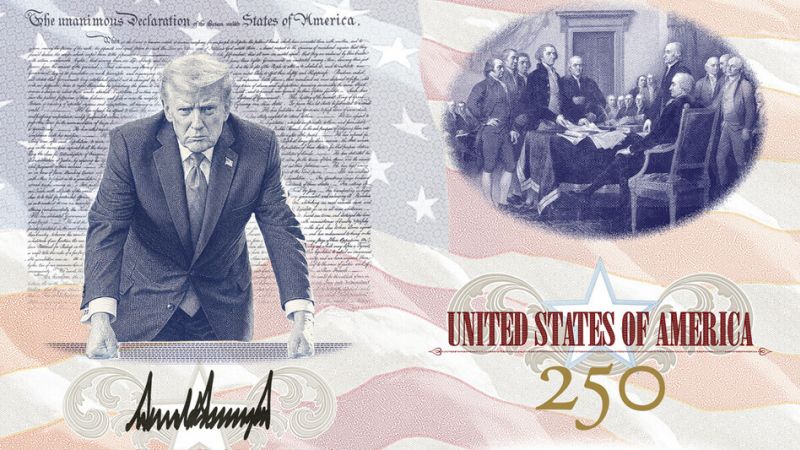
The newly unveiled passport page showcases a photograph of Trump positioned prominently over the Resolute Desk, a symbol of presidential authority and tradition. Behind him, the original text of the Declaration of Independence is subtly integrated into the background, evoking the foundational ideals of the United States. His signature appears at the bottom, reinforcing the document’s authenticity. The opposite side of the passport includes a reproduction of the famous painting “The Declaration of Independence” by John Trumbull, which depicts the signing of the document in 1776. This juxtaposition of Trump’s likeness with the nation’s historical roots has raised questions about the balance between modern representation and patriotic heritage.
“The U.S.A.’s New Passport, which says, ‘Welcome, but be good!’”
Trump’s social media post on Truth Social emphasized the patriotic message embedded in the design, suggesting a call for civic responsibility. The president’s image in the passport is derived from a portrait housed at the Smithsonian National Portrait Gallery, a departure from earlier versions released by the State Department this year. Those initial designs featured a different photograph of Trump, prompting speculation about the decision to adopt a new visual.
Historically, U.S. passports have featured iconic imagery to reflect national identity. For example, the inside front cover currently displays Percy Moran’s painting of Francis Scott Key, capturing the moment after the bombardment of Fort McHenry in 1814—the event that inspired the lyrics to the national anthem. Lines from the anthem are also printed on this page, a nod to the enduring significance of the document. The shift to Trump’s portrait in the commemorative edition marks a departure from this tradition, as the new design emphasizes the president’s role in the nation’s ongoing story.
White House and State Department Collaboration
The White House’s X account later shared an image of the same passport design, captioning it “New U.S. Passport to Commemorate America’s 250th.” This alignment between the executive branch and the State Department has led to further scrutiny of the design’s official status. When questioned about whether the image was the final approved version, the White House directed inquiries to the State Department, leaving the agency to clarify its position. CNN has since contacted the State Department for comments, highlighting the ongoing debate over the design’s authenticity.
Commemorative passports often serve as a means to celebrate significant anniversaries, offering a unique blend of historical and contemporary elements. This year’s 250th anniversary of the United States—a milestone dating back to the Declaration of Independence in 1776—has prompted a nationwide reflection on the nation’s legacy. While the State Department has traditionally handled passport design, the collaboration with the White House suggests a desire to integrate presidential imagery into the commemorative effort. This partnership may also reflect the administration’s strategy to use the passport as a platform for promoting its vision of American identity.
Background on the Passport Design Process
The limited-edition passport was first announced in April as part of the celebrations for the 250th anniversary. At the time, officials described it as “a limited-edition U.S. passport to commemorate the historic occasion of America’s 250th anniversary,” highlighting its custom artwork and enhanced visuals across the front, back, and interior pages. The design was intended to create a sense of exclusivity and pride, with the hope of making the passport a collectible item for travelers and history enthusiasts alike.
Speaking to CNN in April, a State Department representative stated that the new design would become the default option for those renewing passports in person at the Washington Passport Agency once it was available. However, online renewals and other locations would continue to use the existing design, ensuring consistency for the majority of users. This approach allows for a phased rollout, accommodating both those who prefer the new commemorative version and those who opt for the standard design.
The 250th anniversary is a momentous occasion, as it marks the founding of the United States in 1776. The choice of imagery in the passport aims to reflect this duality—celebrating the past while acknowledging the present. The Resolute Desk, a fixture in the White House since the 19th century, symbolizes the continuity of presidential leadership. By featuring this desk, the design connects the current administration to the historical legacy of American governance. Meanwhile, the inclusion of the Declaration of Independence painting by John Trumbull reinforces the nation’s foundational values, creating a visual dialogue between the past and the present.
Current Passport Design and Its Evolution
Before the commemorative edition, the standard U.S. passport included a portrait of Francis Scott Key on its inside front cover. This image, painted by Percy Moran, has been a staple since the 1960s, serving as a reminder of the nation’s history and the sacrifices made for its independence. The decision to replace this with Trump’s portrait signals a shift in the focus of the design, prioritizing the current leader’s image over that of a historical figure. This change has prompted discussions about whether the new passport represents a broader trend of aligning national symbols with contemporary political figures.
The commemorative passport’s design is not just a visual update but also a strategic choice. By incorporating elements such as the Resolute Desk and the Declaration of Independence painting, the passport aims to bridge historical and modern narratives. The use of the Smithsonian’s portrait of Trump, which captures a formal and recognizable likeness, underscores the administration’s commitment to promoting a specific interpretation of American identity. In contrast, the earlier renderings by the State Department featured a more candid or dynamic image, suggesting a deliberate effort to differentiate the two versions.
This development has also raised questions about the process of approving commemorative passport designs. Typically, such projects involve collaboration between the State Department and the National Archives, with input from historians and artists. The rapid release of Trump’s version, however, has led to speculation about the influence of political priorities on the design process. While the State Department maintains that the final approval rests with its officials, the alignment of the White House and the agency’s X account indicates a coordinated effort to present the new passport as an official milestone.
As the 250th anniversary approaches, the commemorative passport is expected to be a centerpiece of the celebration. Its unique design, combining Trump’s portrait with historical artwork, offers a glimpse into how the nation’s identity is being reimagined for the next generation. The success of the new edition will depend on its ability to resonate with both the public and those who value historical continuity. For now, the passport stands as a symbol of the administration’s vision, blending tradition with the present in a way that has captured national attention.
With the release of the new rendering, the debate over the design’s significance continues. The integration of Trump’s image with the Resolute Desk and the Declaration of Independence painting reflects a deliberate effort to position him as a central figure in the nation’s story. While the State Department has not yet officially confirmed the design as the final version, the widespread attention it has received suggests that it may become a defining element of the anniversary celebration. As travelers prepare to use the new passports, the question remains: will this design be seen as a tribute to the nation’s heritage or a reflection of its current leadership?