
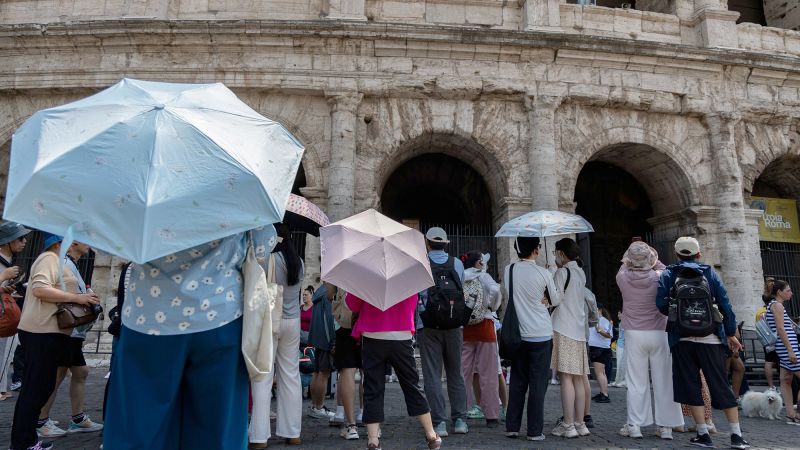
Europe’s Unprecedented Heat Wave: A Climate Crisis in Action
Sandego.net – This week’s record-breaking June heat has left much of Europe in a state of emergency, with temperatures soaring to levels previously thought unimaginable. A new analysis by World Weather Attribution (WWA) reveals that such extreme conditions would have been “virtually impossible” just a few decades ago, attributing the crisis squarely to human-driven global warming. The study, published Friday, highlights how the planet’s rising temperatures have fundamentally altered the likelihood of extreme weather events, pushing the region’s heat patterns to extremes that were once rare.
The Science Behind the Extreme Temperatures
The current heat wave, described as the “most severe ever recorded” for Europe, is driven by a persistent atmospheric phenomenon known as a heat dome. These high-pressure systems, which trap warm air in place, are not new to meteorology, but the intensity and duration of this particular one have exceeded historical norms. Scientists say the heat dome’s lingering presence has created a feedback loop, intensifying heat and humidity to dangerous levels across vast regions of the continent.
According to the WWA team, the combination of real-world data and climate models has allowed them to quantify the role of global warming in the heat wave’s severity. They compared the recent events to two major heat waves in the past: 1976 and 2003. In both years, Europe experienced extreme temperatures, but the current conditions surpass even those records. For instance, the study notes that the same heat wave occurring in June 1976 would have been approximately 6.3 degrees Fahrenheit cooler, a stark contrast to today’s reality.
Global warming has contributed to a significant temperature rise over the past half-century, with the planet’s average surface temperature increasing by nearly 2 degrees Fahrenheit (1.1 degrees Celsius). This shift has dramatically heightened the probability of extreme heat events. “The warming we’ve seen has made these kinds of heat waves not just more likely, but more intense,” the researchers explain. The analysis also underscores that the extreme temperatures are not isolated incidents but part of a broader trend.
Heat Domes and Record-Breaking Weather
Heat domes, which act like a lid over a region, prevent cooler air from moving in and create a stagnation of hot air. While these systems are a natural part of weather patterns, the recent event has been exceptionally powerful. The heat dome has led to a series of record-breaking temperatures across multiple European countries. In France, for example, the country’s hottest day on record was set Wednesday, just days after an earlier record was surpassed. The UK, too, has been affected, with its June temperature peak shattered on Wednesday, only to be eclipsed again the following day.
Spain’s situation is equally alarming, as it endured its two hottest June days ever recorded on Monday and Tuesday. Switzerland, meanwhile, recorded its highest June temperature on Thursday, while Germany’s provisional data suggests it reached a temperature never seen before in the nation’s history on Friday. These records, which have fallen like dominoes, illustrate the rapid escalation of heat extremes in the region.
The analysis also delves into the role of nighttime temperatures, which have been equally extreme. France, for example, experienced its hottest night on record Wednesday through Thursday, a detail that might seem minor but has major implications. “Nighttime heat poses a unique threat, as it limits the body’s ability to cool down,” the study explains. This is particularly critical for vulnerable populations, such as the elderly or those with chronic illnesses, who rely on cooler nights to recover from daytime heat.
The Role of Humidity in Escalating Health Risks
Alongside soaring temperatures, the heat wave has brought unprecedented humidity levels. WWA scientists examined 854 cities across 30 countries affected by the extreme conditions and found that 45% of them have either broken or are on the verge of breaking their all-time records for wet bulb globe temperature. This measure combines temperature, humidity, sun exposure, and wind to assess heat stress and the body’s capacity to regulate itself.
High wet bulb globe temperatures make it increasingly difficult for the human body to cool down through sweating, leading to a higher risk of heat-related illnesses. The report emphasizes that the current conditions have pushed this threshold to dangerous levels, with the heat wave’s humidity amplifying the threat of heat exhaustion and even heat stroke. “The body’s natural cooling mechanisms are being challenged in ways that were unthinkable just a few decades ago,” the researchers state.
Health impacts have already begun to surface. In Spain, over 200 deaths have been linked to the heat wave in just four days, according to the country’s mortality monitoring system. France has also seen severe consequences, with at least 55 people drowning in an attempt to escape the oppressive heat. These incidents highlight the immediate and life-threatening risks posed by the current climate crisis.
Broader Impacts on Society and Infrastructure
The heat wave has disrupted daily life across Europe, causing widespread societal strain. Thousands of schools have been forced to close, while rail services have faced delays and cancellations due to track expansion from high temperatures. Power outages have also occurred, with energy demands peaking as air conditioners and fans are used extensively. Tourist attractions, such as ski resorts and hiking trails, have closed or reduced operations, further impacting local economies.
Europe’s rapid warming has made such events increasingly common. The continent is now experiencing temperature rises faster than any other region on the planet, and scientists warn that extreme heat waves will only become more frequent, intense, and prolonged if fossil fuel emissions are not drastically reduced. “This summer shows that at 1.4 degrees Celsius of global warming, extreme heat is already reaching the limits of our societies’ ability to cope,” the report concludes.
As the heat continues to affect communities, the long-term consequences become more apparent. The study underscores that the current scenario is not just a one-off event but